
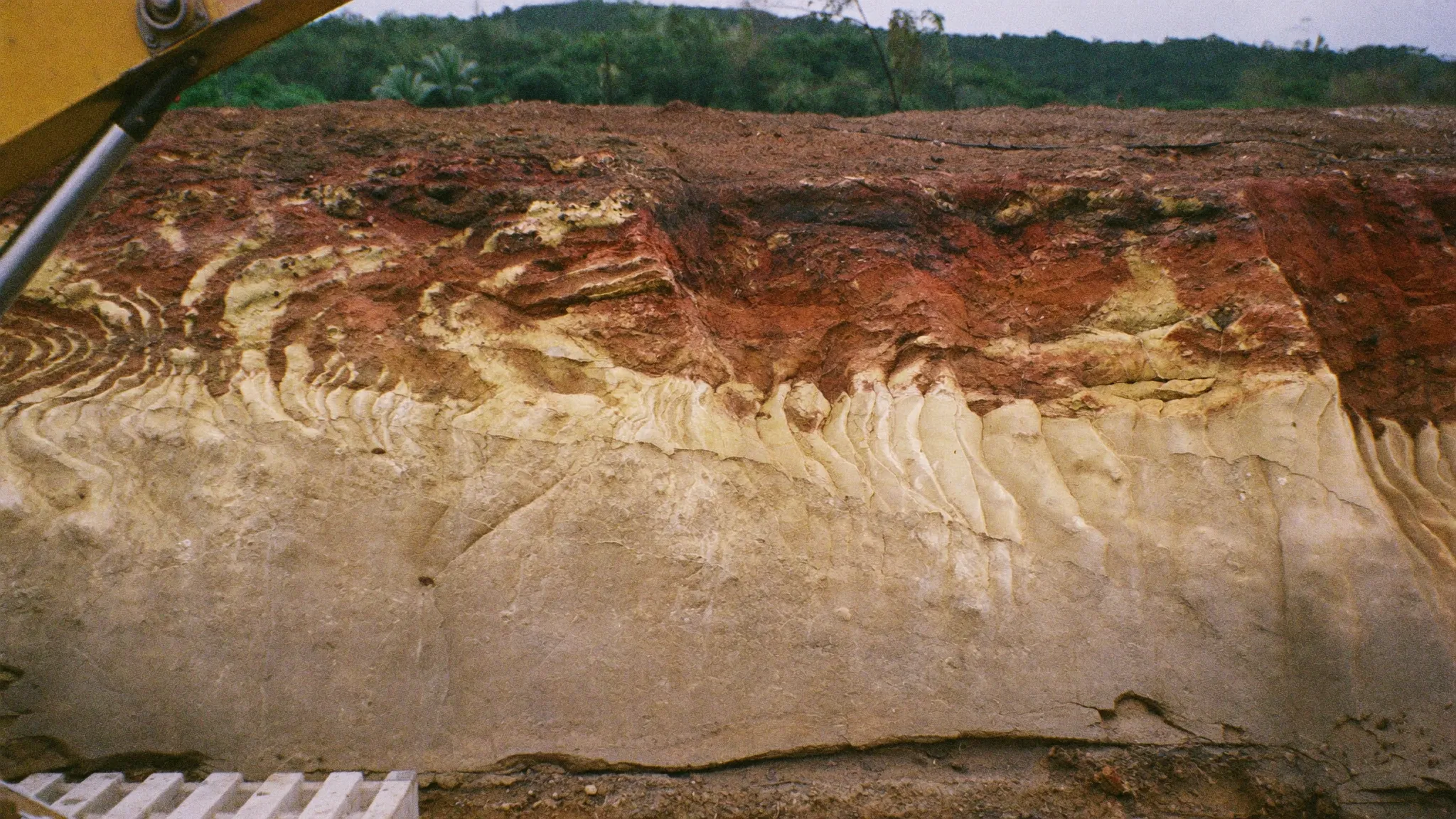
Most rare earths come out of hard rock. The heavy ones often come out of clay.
Ion-adsorption clay behaves nothing like the ores that dominate Western mining plans. That difference explains both why it matters and why it does not solve the supply problem on its own.
How ion-adsorption clay forms
These deposits start as granite. Over long periods of warm, wet weathering, the rock breaks down into a deep clay profile. A portion of the rare earths ends up as ions stuck to the surface of the clay minerals.
That is the whole trick. The rare earths are not locked inside a crystal that has to be smashed and cooked. They are clinging to a surface.
Why the processing path is shorter
Hard-rock ores need crushing, grinding, mineral concentration and high-temperature cracking before separation can start. Ions on clay can be recovered through ion-exchange leaching instead, which can skip much of that front-end work.
The output can be a mixed rare earth carbonate that is already well downstream of the raw ore. A separation plant can dissolve that carbonate and run it through a separation flowsheet, instead of starting with rock or concentrate.
Why the heavies show up here
Ion-adsorption clays can carry meaningful amounts of the heavy rare earths, including dysprosium, terbium and yttrium. Dysprosium and terbium are the elements that keep magnets working at high temperature, and Western supply chains are short of both.
Not every clay deposit is heavy-rich. Grades, recoverability and the mix of elements vary a lot from one deposit to the next, so each one has to be measured on its own.
What the clay route does not fix
A mixed carbonate is not a finished product. It still holds many rare earths side by side, and neighboring elements are chemically almost identical. Pulling them apart takes solvent extraction repeated across many stages, and that separation capacity is the real bottleneck. We explain why in What Are Rare Earth Minerals?.
So a clay deposit does not fix the supply chain by existing. It moves the hard question. The front end gets easier. The separator still has to exist, and it still has to be run well.
Three questions for any ionic clay project
- What is in the basket? The mix of heavy and light rare earths sets the value. A clay rich in dysprosium and terbium is a different business from one dominated by cerium and lanthanum.
- How much can actually be recovered? Recovery varies between deposits, even in the same region.
- Who separates it, and where? Without a separation route, a carbonate is an intermediate, not a supply chain.
Malaysia is a live test of that third question. A Malaysian ionic-clay carbonate is now reaching U.S. separation facilities, and one Malaysian sample has been measured at about 37.8% heavy rare earths within its rare earth distribution. Our news team covered the shipment and the company behind it in Malaysian Heavy Rare Earths Reach U.S. Separators as DTEC MMT Builds New Supply Corridor.
The short version
Ion-adsorption clay offers a shorter path to heavy rare earths than hard rock does. It is still only the first step. Whoever turns the carbonate into separated oxides decides whether any clay deposit becomes usable supply.
Rare Earth Exchanges publishes independent analysis. This article is not investment advice. We receive no compensation from any company named here.
