
Highlights
- Japan announces ¥3 trillion ($19B) five-year investment in Central Asia to diversify critical mineral supply chains and reduce dependence on China.
- Central Asia offers vast uranium, copper, gold, and rare earth reserves, but extraction faces bottlenecks in processing capacity, infrastructure, and water access.
- Japan's focus on the Trans-Caspian International Transport Route aims to bypass Russia and China, though logistics alone won't solve downstream refining challenges.
Tokyo courts minerals, routes, and relevance beyond China’s shadow. So now Japan has announced a ¥3 trillion ($19 billion) five-year business target in Central Asia following an inaugural summit hosted by Prime Minister Sanae Takaichi with leaders from Kazakhstan, Kyrgyzstan, Tajikistan, Turkmenistan, and Uzbekistan. The framing is familiar: diversify critical mineral supply chains, reduce dependence on China, and secure access to “abundant resources.”
Table of Contents
Trans-Caspian International Transport Route
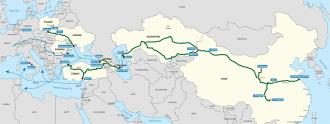
Those goals are real. Central Asia holds uranium, copper, gold, rare earths, and gas. It also sits astride logistics corridors that the West increasingly wants—routes that bypass Russia and dilute China’s leverage. On paper, Japan’s move aligns with a broader scramble by the European Union and the United States to de-risk supply chains after Beijing’s rare earth export controls earlier this year.
Minerals, Maps, and the Hard Physics of Extraction
What’s accurate—and understated—is that Central Asia’s mineral potential is enormous and underdeveloped. Kazakhstan’s uranium dominance is unquestioned. Uzbekistan’s gold reserves are world-class. Mountainous Kyrgyzstan and Tajikistan are opening new deposits. Yet geology is only the opening act. Processing capacity, infrastructure, financing, water access, and permitting remain the bottlenecks. Rare earths, in particular, are not plug-and-play commodities. Mining without downstream separation and magnet manufacturing simply relocates dependence.
Japan’s emphasis on the Trans-Caspian International Transport Route (opens in a new tab) is therefore notable. Logistics is strategy. Any corridor that moves materials west without transiting Russia shifts bargaining power. But corridors don’t refine oxides or sinter magnets.
The Subtext: China Is the Benchmark, Not the Audience
The article’s subtext—cited by experts speaking to Agence France-Presse—is that China’s rare earth moves have accelerated everyone else’s clock. That’s accurate. But there’s a softer narrative at work: announcing targets is easier than underwriting decades-long industrial build-out. Beijing didn’t win rare earths with summits; it did so with sustained state coordination.
Japan’s $19 billion ambition signals intent and diplomatic seriousness. Whether it signals supply chain independence remains unresolved.
Citation: Agence France-Presse (AFP), December 20, 2025
© 2025 Rare Earth Exchanges™ – Accelerating Transparency, Accuracy, and Insight Across the Rare Earth & Critical Minerals Supply Chain.


0 Comments