
The world is experiencing a boom in drone technology and robotics – from autonomous delivery drones to AI-driven humanoids – transforming industries and daily life. However, this rise is built on foundations of rare earth elements and other critical materials, which are essential for the motors, sensors, and batteries that make these innovations possible. Supply of these elements has become a strategic concern: they are geographically concentrated, and unstable supply chains pose risks to economies and national security. This investigational article examines how the United States, China, the European Union, and India are navigating the rapid growth of drones and robotics, while racing to secure the rare earth elements (like neodymium and dysprosium) needed to power them – and to keep supply chains stable in a geopolitically charged era.
Global Drone and Robotics Boom
Drones and robots have moved from science fiction to mainstream use, driving a thriving global market. In 2024, the total drone industry (consumer, commercial, and military) was estimated at around $73 billion, and it’s forecast to more than double by 2030 (opens in a new tab). Military drones currently account for the largest revenue share, but commercial applications – ranging from agriculture to logistics – are expanding rapidly. Likewise, industrial and service robots are seeing record adoption worldwide. By 2023, over 4.28 million industrial robots were operating in factories globally (a 10% increase from the previous year). Annual installations have exceeded half a million units for three consecutive years, driven by automation needs and labor shortages. Crucially, China, the U.S., Europe, and India each play distinct roles in this boom:
| Region | Strengths & Industry Highlights | Rare Earth Exposure & Policy | Key Challenges & Opportunities |
| China | - 70%+ global civilian drone production - DJI dominates consumer drone market - 276,000+ robots installed in 2023 (51% global share) - Strong military drone exports (e.g., Wing Loong) - “Made in China 2025” funds AI & automation | - Controls ~70% of global REE mining - ~90% of refining & 95% of magnet output - Owns full rare earth-to-robot value chain | ✔ Strategic lead ❗ Export control risks for global buyers ❗ Faces Western diversification push |
| USA | - Leader in advanced robotics (Boston Dynamics, Amazon Kiva) - Leading military drone maker (MQ-9 Reaper, Skydio) - Active AI labs and warehouse automation | - Imports most NdFeB magnets, motors, batteriesfrom China - Investing in Mountain Pass, Lynas Texas plants - Defense bans on Chinese REE magnets by 2027 | ✔ Strong tech ecosystem ❗ Still REE import-reliant ❗ Needs scalable domestic refining |
| Europe | - Strong robotics base (ABB, KUKA, Siemens) - Installed 92,000robots in 2023 (Germany ~28,000) - Drone niche: Parrot (survey/agri-tech) | - Critical Raw Materials Act (CRMA) - Targets: 10% domestic mining, max 65% import dependency - R&D into rare-earth-free technologies | ✔ Ambitious industrial strategy ❗ High import dependency ❗ Lags in drone scale-up |
| India | - “Drone Revolution” policy push - Startups like ideaForge growing fast - Banned foreign drones (2022) to promote local manufacturing - Installed ~8,500robots in 2023 - Fastest-growing robotics market in Asia (~60% YoY) | - Holds 3rd-largest REE reserves - Minimal processing/refining to date - New subsidies & incentives (₹3,500–₹5,000 Cr) - Exploring magnet manufacturing JVs | ✔ Huge growth potential ❗ Lacks REE infrastructure ❗ Needs faster policy & industry execution |
What Rare Earths are Powering Drones & Robotics?
| Element | Key Roles in Robotics & Drones |
| Neodymium (Nd) | High-performance magnets for motors & actuators |
| Dysprosium (Dy) | Heat resistance in motors, maintains magnetism |
| Praseodymium (Pr) | Boosts magnet strength & efficiency |
| Yttrium, Terbium, Samarium | Optical sensors, phosphors, magnet alloys |
How About Investor Insight?
- Global robotics and drone markets depend heavily on rare earth materials.
- China dominates supply, prompting U.S., EU, and India to race for independence.
- Watch for policy shifts, refinery investments, and recycling breakthroughs in the coming 12–24 months.
Rare Earth Elements: Small Elements, Big Role
What makes rare earth elements (REEs) so critical for drones and robots? These 17 metallic elements (lanthanides plus yttrium and scandium) possess unique magnetic, electric, and optical properties. Modern drones and robotic systems depend on several of these elements for core components:

In drones, rare earth magnets are what make electric propulsion viable (opens in a new tab): they pack high power in a small weight, directly improving flight time and payload capacity. In robotics, especially humanoid or mobile robots, dozens of electric motors are used to mimic human muscle movements – from lifting arms to walking – and each motor typically uses rare earth magnets to maximize torque in a compact form.
Beyond magnets, some rare earths contribute to sensors and electronics in these systems. For instance, yttrium and europium are used in phosphors for displays and camera sensors (important for drone cameras and robot vision).
Neodymium-doped lasers (Nd:YAG) are common in LIDAR range-finders for drones and autonomous vehicles. All these examples highlight a key point: the performance and miniaturization of drones and robots would not be possible without rare earth elements. They are the unsung heroes inside the motors, guidance systems, and sensor arrays. Conversely, any shortage or quality issue in these materials can cripple the manufacturing of high-tech devices. That is why industry and government leaders are increasingly concerned with shoring up supply.
Supply Chain Vulnerabilities and Geopolitics
While the demand for rare earths in drones, robotics, electric vehicles, and renewable energy is soaring, the supply side is alarmingly concentrated. China has a near-monopoly on the global rare earth supply chain, which creates a strategic vulnerability (opens in a new tab) for the rest of the world. Consider these facts:

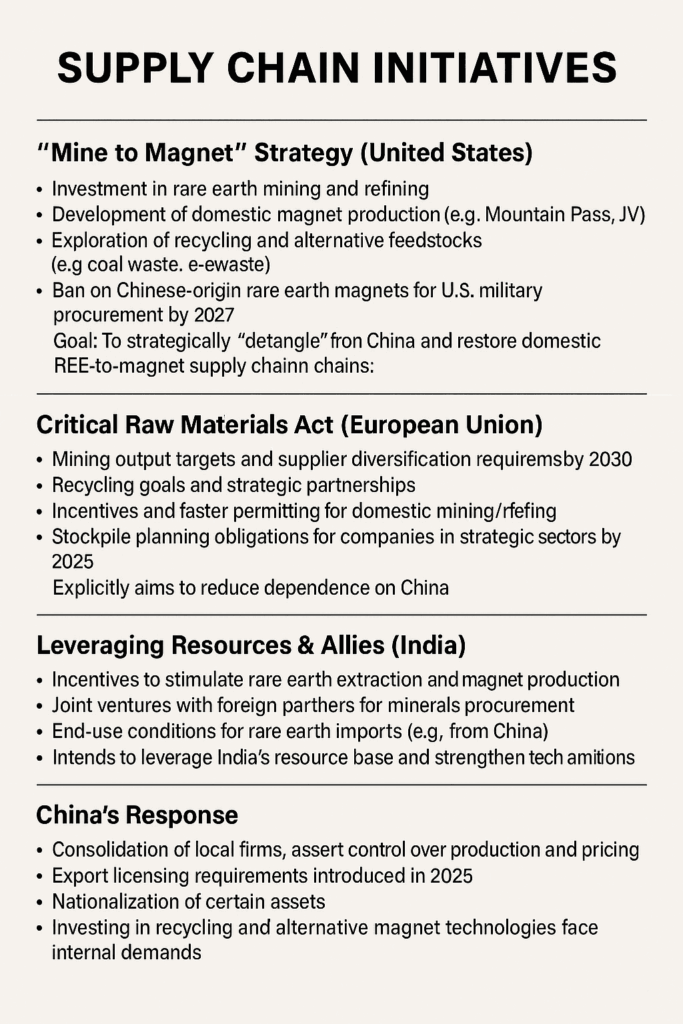
In response, the U.S., EU, and India have all initiated strategies to reduce reliance on Chinese rare earths and build more resilient supply chains. See some initiatives below.
Balancing Growth and Security
The growing drone and robotics industries symbolize the promise of technological progress – safer infrastructure inspections via drones, more efficient factories with robot coworkers, even the prospect of general-purpose humanoid assistants. Yet, as we have seen, these innovations are tethered to a complex web of materials and global trade. Ensuring a stable supply of rare earth elements and other critical inputs has become a 21st-century strategic quest. In the coming years, we can expect:
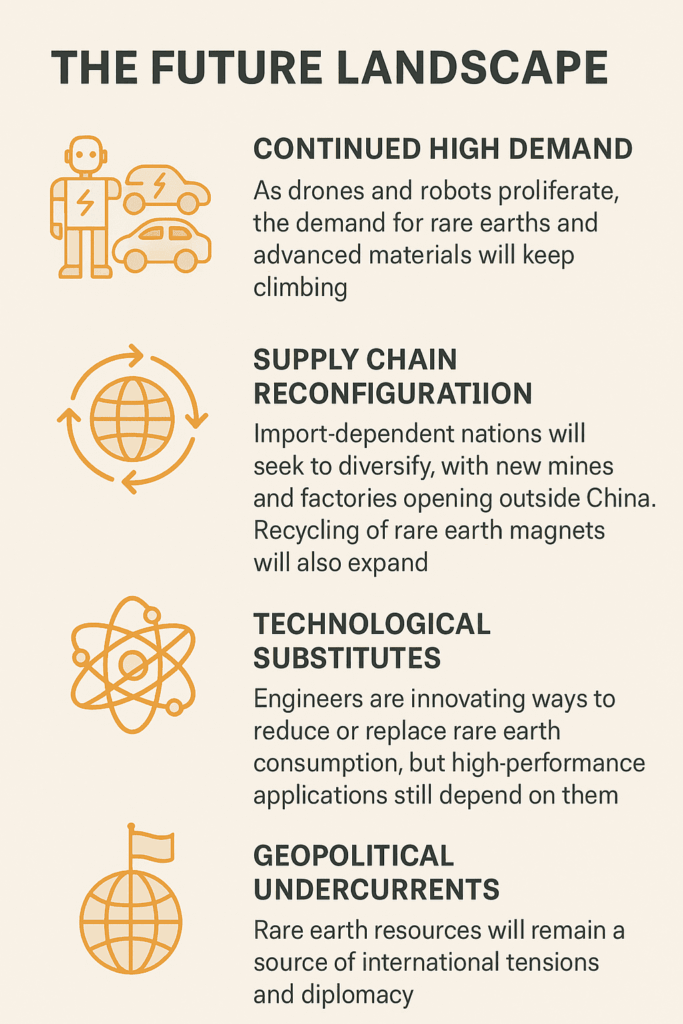
Rare Earth Exchanges suggests that the drone and robotics revolution is inseparable from the story of rare earths and supply chains. The four regions highlighted – the U.S., China, the EU, and India – each illustrate a piece of this puzzle: China shows the power of controlling the supply; the U.S. and EU demonstrate the scramble to rebuild independence; India highlights the challenge and opportunity of an underutilized resource base.
Ensuring a stable, sustainable supply of rare earth elements is now recognized as critical to economic growth and security. For innovators and consumers, this might be a somewhat invisible struggle (happening in mines, factories, and policy meetings far from the gleaming robots and drones we see).
But its outcome will directly impact how far and how fast the world can push the boundaries of robotics and unmanned systems. The next decade will reveal whether we can successfully balance this new oil of the tech world – rare earths – with the soaring ambitions of our drone-filled skies and AI-driven machines on the ground.


0 Comments