
Highlights
- In 2025, China's Unitree Robotics delivered over 5,500 humanoid robots.
- This output surpassed the combined U.S. production from Tesla, Figure AI, and Agility Robotics.
- Each humanoid robot unit requires approximately 1.3 kg of NdPr magnets.
- The real constraint in production is not the mining of rare earth minerals but the midstream processing.
- China controls over 90% of global NdFeB magnet manufacturing, creating a strategic vulnerability for Western robotics ambitions.
- Currently, humanoid robot volumes are negligible against the 50,000-tonne annual NdPr supply.
- Mass adoption of humanoid robots could consume up to 25% of NdPr output.
- Such demand could accelerate existing imbalances driven by electric vehicles (EVs) and wind turbines.
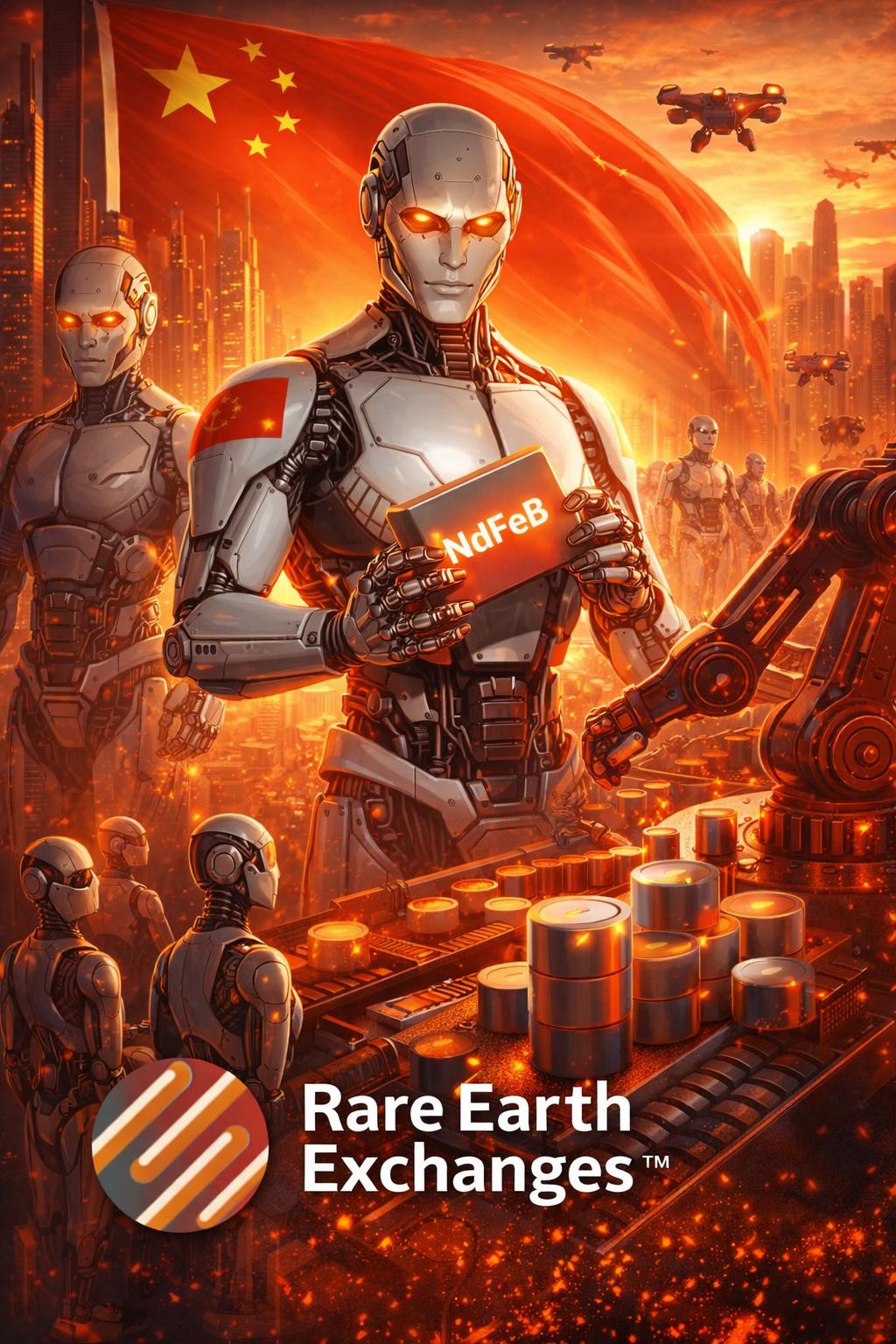
Humanoids scale up—and rare earths quietly take center stage. And China is no longer flirting with humanoid robots; it is shipping them. In 2025, Unitree Robotics reportedly delivered more than 5,500 humanoid units—exceeding the combined output of U.S.-based peers such as Tesla, Figure AI, and Agility Robotics. For non-specialists, the message, captured in a recent South China Morning Post, is simple: humanoids are leaving the lab and entering early industrial production—and they are built around powerful permanent magnets made from neodymium and praseodymium (NdPr).
The Physics Beneath the Headlines
_Why humanoids drink magnets._This foundation is solid. Humanoid robots require dozens of compact, high-torque electric actuators across legs, arms, hands, and torso. At today’s performance thresholds—power density, efficiency, weight—NdFeB permanent magnets are not a luxury but a design constraint. An industry modeling assumption of roughly 1.3 kilograms of NdPr per humanoid is defensible and, if anything, conservative given actuator counts and torque requirements.
Scale: Where Math Meets Narrative
Extrapolation, not prophecy. At current volumes, humanoid demand barely registers against global NdPr supply, estimated around 50,000 tonnes per year. Even 5,500 units amount to statistical noise. Where the article correctly raises eyebrows is at scale. The arithmetic showing that millions of humanoids annually could absorb several percent—and at extreme adoption rates, a quarter—of today’s NdPr output is mathematically sound. What remains speculative is timing. Millions per year this decade is ambitious; hundreds of thousands is far easier to justify.
The Quiet Constraint Is Midstream
Mining headlines miss the real choke point. The constraint discussed across the media is not ore—it is processing and magnets. China dominates rare earth separation and controls over 90% of global NdFeB magnet manufacturing. Ex-China capacity growth is measured in thousands of tonnes, not tens of thousands. Recycling helps later, not now. Even without humanoids, EVs and wind turbines are tightening the system. Humanoids simply add a new, magnet-dense layer.
Reading Between the Lines
Strategy, not villainy. The narrative leans toward inevitability. It is fair to say Beijing prioritizes domestic value chains; it is not proven that humanoids alone will trigger export clampdowns. Still, recent licensing regimes and technology controls point in a consistent direction.
Bottom Line for Investors
Humanoid robots will not “break” NdPr markets by themselves. They accelerate an imbalance already in motion—where magnets, not mining, define strategic risk. Any Western robotics ambition without sovereign or allied magnet capacity is a story missing its final chapter.
Source: reporting by the South China Morning Post


0 Comments
No replies yet
Loading new replies...
Moderator
Join the full discussion at the Rare Earth Exchanges Forum →