
Highlights
- Curtin University and Victory Metals (ASX:VTM) announce collaboration under Australia's Resources Technology and Critical Minerals Trailblazer initiative to advance the North Stanmore clay-hosted heavy rare earth project near Cue, Western Australia.
- The partnership focuses on pilot-scale validation of clay-hosted extraction for strategically critical heavy rare earths like dysprosium and terbium, leveraging Curtin's hydrometallurgical expertise to de-risk commercial recovery rates and operating costs.
- While the collaboration strengthens Australia's upstream rare earth capacity, true supply chain leadership requires proven pilot plant performance data and downstream integration into separation, oxide refinement, and magnet production currently dominated by China.
Curtin University (opens in a new tab) and Victory Metals (opens in a new tab) (ASX:VTM) have announced (opens in a new tab) a collaboration under Australia’s federally backed Resources Technology and Critical Minerals Trailblazer initiative (opens in a new tab) to help advance the North Stanmore HREE Project near Cue, Western Australia (opens in a new tab). In simple terms: a technical university with deep hydrometallurgical expertise is supporting a junior explorer as it moves from resource delineation toward pilot-scale validation and, eventually, commercial production. The stated aim is to strengthen Australia’s role in supplying rare earth materials used in electric vehicles, wind turbines, electronics, and defense systems.
North Stanmore as a clay-hosted rare earth project and in emphasizing the importance of heavy rare earth elements such as dysprosium and terbium.
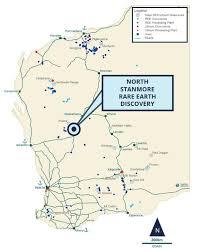
Source: Victory Metals
Clay Deposits: Strategic, but Technically Demanding
Clay-hosted (ionic adsorption) deposits are globally significant because they are the primary source of heavy rare earths today—largely in southern China. The geology allows lower-energy leaching compared with hard-rock systems, but it introduces technical challenges: water management, slope stability, impurity control, and environmentally sensitive extraction chemistry.
Curtin’s expertise in hydrometallurgy, water systems, and process optimization is directly relevant. Co-developing a pilot plant is an important step. In rare earth development, metallurgical validation—not headline resource size—determines bankability.
What is factually grounded in this latest update:
- North Stanmore is clay-hosted.
- Heavy rare earths are strategically critical to magnet performance.
- Pilot-scale process development is a standard de-risking pathway.
What remains unproven:
- Commercial recovery rates at scale.
- Operating costs relative to established Chinese ionic clay producers.
- Downstream integration into separation and metallization.
Leadership Claims vs. Industrial Capacity
Statements positioning the partnership as placing Australia at the forefront of heavy rare earth supply require perspective. Australia has growing upstream capacity and emerging separation ambitions. However, industrial-scale heavy rare earth separation outside China remains limited. It’s true that Australia-based Lynas Rare Earths is the most advanced ex-China rare earth mining operation but it’s ability to produce heavy rare earth elements at scale remains a work in progress.
Mine development alone does not equal supply chain leadership. Without solvent extraction capacity, oxide refinement throughput, and metallization/magnet integration, upstream projects remain part of—not a replacement for—China-dominant processing networks.
Why This Development Still Matters
Heavy rare earthsupply remains structurally concentrated. Western resilience depends on successfully replicating clay-hosted extraction systems outside China while improving environmental performance.
As reported by the university the lead of Curtin’s Western Australian School of Mines, John Curtin Distinguished Professor Mark Buntine (opens in a new tab), said the partnership reflected Curtin’s leadership in critical minerals and advanced processing.
The real signal here is ecosystem formation: university expertise, government-backed innovation funding, and a resource developer aligned around pilot validation. That is how industrial capability begins.
For investors, the milestone to watch is not partnership rhetoric—but pilot plant performance data.
Australia’s geological advantage is real. Converting it into full mine-to-magnet resilience remains the decisive test.


0 Comments
No replies yet
Loading new replies...
Moderator
Join the full discussion at the Rare Earth Exchanges Forum →