
- Xi Jinping urged Germany to become an innovation partner in AI, green technology, and digital development, aligning with China's intelligent and integrated growth plans while keeping supply chains stable.
- Chancellor Merz reaffirmed Germany's commitment to the China market and free trade, while also raising concerns about Chinese industrial overcapacity and market distortions.
- The meeting signals China's strategic courtship of Europe's industrial core in contested domains like AI-enabled manufacturing and supply-chain governance amid transatlantic de-risking efforts.
China’s official readout says President Xi Jinping met German Chancellor Friedrich Merz on February 25, 2026, at Beijing’s Diaoyutai State Guesthouse, during Merz’s first official visit to China (Feb. 25–26) since taking office. Xi framed China–Germany ties as economically consequential beyond bilateral trade—arguing that in a more volatile global environment, the two sides should intensify “strategic communication” and build “strategic mutual trust.”
What makes this business-relevant is the explicit industrial framing. Xi urged Germany to become an “open, mutually beneficial innovation partner,” tying Germany’s stated strategies in technology, innovation, and digital development to China’s forthcoming planning cycle focused on “intelligent, green, and integrated” growth. He called for deeper alignment of development strategies, greater two-way flows of talent/knowledge/technology, and expanded cooperation in frontier areas, including artificial intelligence, with a clear emphasis on keeping industrial and supply chains “stable and unimpeded.”
Merz, in the Chinese-side account, reaffirmed Germany’s one-China policy, signaled that German industry continues to prioritize the China market, and positioned Berlin as a defender of free trade and an opponent of protectionism—while backing stronger EU–China dialogue and cooperation.
China-Germany Deal Making?
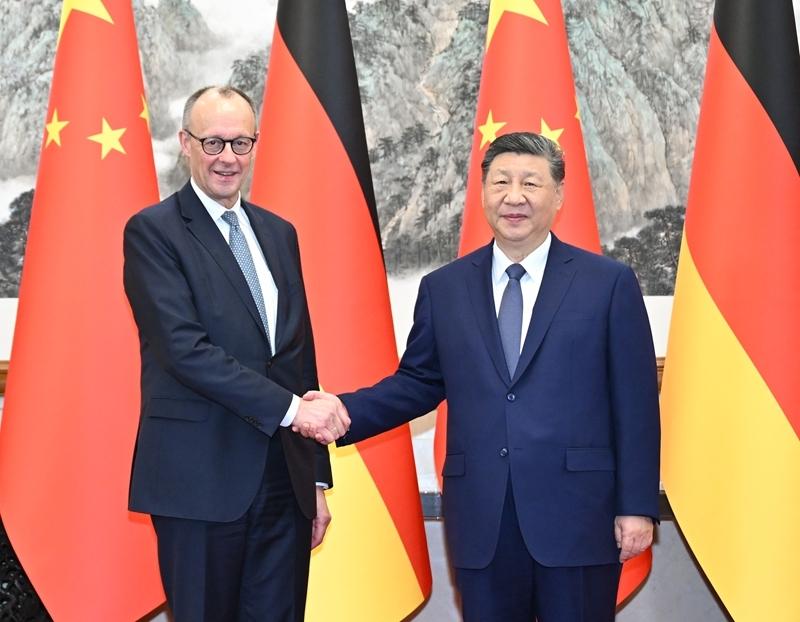
Source: Ministry of Industry and Information Technology, China
For the US and Western stakeholders, the subtext is strategic: Germany sits at the center of Europe’s industrial base, and China is openly courting Berlin around the very domains most contested in transatlantic “de-risking”—AI-enabled manufacturing, green industrial upgrading, and supply-chain governance, not to mention the primary topic of this media—rare earth elements and critical minerals.
Meanwhile, independent reporting around the visit highlights the counter-theme: Merz also underscored unresolved tensions, including concerns about Chinese industrial overcapacity and market distortions—signaling Europe’s balancing act between engagement and constraint.
The leaders also exchanged views on Ukraine, with Xi reiterating Beijing’s position that the “key” is to pursue a settlement through dialogue and negotiation, and that the parties’ “reasonable concerns” should be addressed.
Disclaimer: This item is translated and summarized primarily from Chinese state-linked official messaging (Xinhua / China’s foreign ministry readout/MIIT). The framing reflects official narratives and should be cross-checked against independent reporting and primary documents before business or policy decisions.


0 Comments
No replies yet
Loading new replies...
Moderator
Join the full discussion at the Rare Earth Exchanges Forum →