
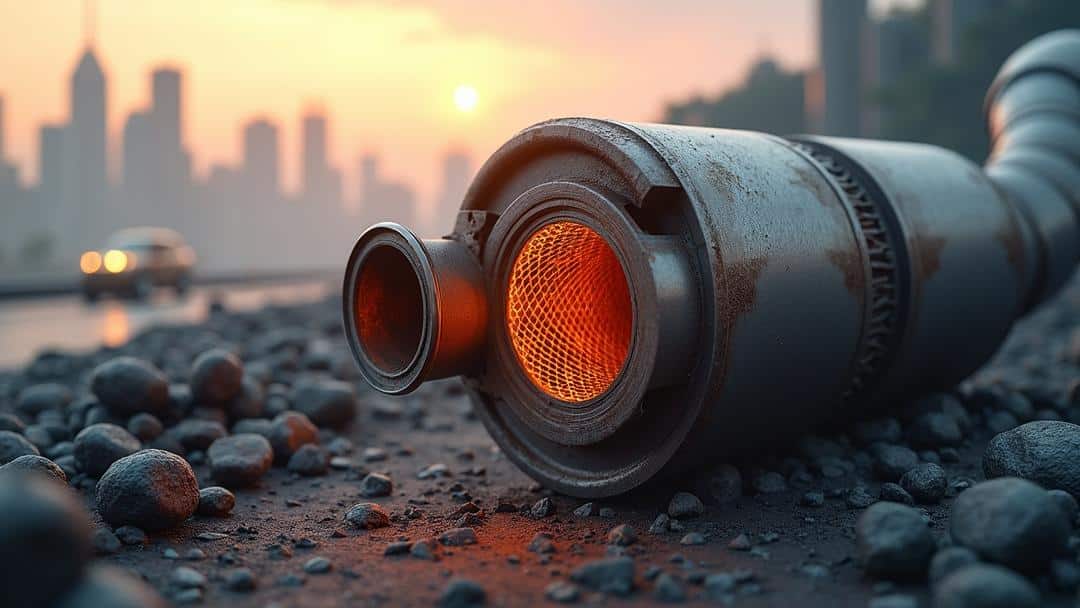
Catalytic converters are exhaust aftertreatment devices that turn harmful engine pollutants (CO, HC, NOx) into less harmful gases (CO2, H2O, N2). They use ceramic honeycombs coated with catalysts and oxygen-storing oxides to clean exhaust, dramatically improving urban air quality since the 1970s.
Table of Contents
How Did Catalytic Converters Change Vehicle Emissions Control?
Before catalytic converters, city air was thick with pollution. Gasoline engines spewed clouds of carbon monoxide, unburned hydrocarbons, and nitrogen oxides that created dangerous smog and health risks. The Environmental Protection Agency (EPA) reports (opens in a new tab) that pre-1970s vehicles released dramatically higher levels of toxic emissions [EPA Emissions Data].
A catalytic converter is an exhaust system device that transforms harmful engine pollutants into less dangerous gases. It uses a ceramic honeycomb coated with special metals and rare earth elements to convert carbon monoxide, hydrocarbons, and nitrogen oxides into carbon dioxide, water, and nitrogen.
The Rare Earth Magic Behind Emission Control
Rare earth elements are the unsung heroes of catalytic converter technology. Cerium, for example, helps store and release oxygen during engine operation, which allows the catalyst to work more efficiently. Lanthanum stabilizes the converter's internal structure, preventing breakdown at high temperatures.
Specifically, cerium works like a chemical sponge. It can quickly absorb and release oxygen, helping the catalyst maintain the perfect chemical balance for converting pollutants. This oxygen storage capacity is crucial for keeping emissions low across different driving conditions.
From Rare Earth Mining to Vehicle Integration
The journey of rare earth elements begins deep underground. Rare earth ore is mined in countries like China, Australia, and the United States. After mining, the ores undergo complex separation processes to extract pure rare earth oxides.
These refined materials are then carefully processed into specialized coatings. Manufacturers blend cerium, lanthanum, and other rare earth oxides into a washcoat - a porous ceramic layer that covers the converter's internal structure. This washcoat is crucial for maximizing the surface area where chemical reactions occur.
Impressive Environmental Impact
Catalytic converters remain one of the most effective clean-air technologies ever deployed. With an estimated 1.4 to 1.5 billion vehicles now on the road globally, (opens in a new tab)nearly all gasoline-powered models are equipped with catalytic converters, sharply cutting tailpipe pollutants. The EPA’s Air Quality Trends report (opens in a new tab) states that modern vehicles emit roughly 99 percent less carbon monoxide, hydrocarbons, and nitrogen oxides than cars from the 1970s — largely due to catalytic converter technology. Global automakers are projected to sell around 89.6 million new vehicles in 2025, virtually all fitted with advanced emission-control systems, according to S&P Global Mobility’s 2024 forecast (opens in a new tab).
Historical Innovators
The story of catalytic converters begins with pioneers like Eugène Houdry, who first developed catalytic processes for fuel treatment. Engelhard Corporation introduced the first practical automotive catalytic converters in the early 1970s, coinciding with new environmental regulations.
Why Catalytic Converters Matter Today
Modern emissions standards continue to push catalytic converter technology forward. With increasing hybrid and electric vehicle adoption, manufacturers are developing even more efficient converters that can handle complex engine cycles and stricter environmental regulations.
Future of Emission Control
Researchers are investigating new materials that could improve catalytic converter performance. Early studies suggest that certain rare earth formulations may help reduce platinum use while maintaining strong conversion efficiency, though results are still preliminary. Recycling research, including work from the U.S. Department of Energy’s Critical Materials Institute, is also advancing methods to recover valuable rare earth elements from spent converters.
The catalytic converter represents a remarkable environmental technology - transforming dangerous engine exhaust into relatively harmless gases through sophisticated chemical engineering and rare earth materials.
Conclusion
While EV adoption grows, the global ICE/hybrid fleet remains large through the 2030s, sustaining demand for catalytic converters with tougher cold-start and real-driving emissions constraints. REE processing concentration stays a risk; diversified refining, modest thrifting of REE loadings via better microstructures, and incremental recycling can buffer supply shocks.
FAQs
What do catalytic converters do, in plain terms?
They convert three major pollutants from gasoline engines—carbon monoxide (CO), unburned hydrocarbons (HC), and nitrogen oxides (NOx)—into less harmful gases: carbon dioxide (CO2), water vapor (H2O), and nitrogen (N2). They do this using platinum-group-metal catalysts supported by rare-earth–doped oxide materials that store oxygen and withstand heat.
Which rare earths are in catalytic converters, and why are they critical?
Cerium (as ceria) stores/releases oxygen to keep the catalyst effective during engine transients; lanthanum stabilizes the alumina washcoat; praseodymium/neodymium can tune oxygen storage and durability; yttrium stabilizes zirconia in oxygen sensors for accurate closed-loop fueling. Without these REEs, catalysts would age faster and convert fewer pollutants.
Are catalytic converters still needed as EVs grow?
Battery-electric vehicles do not use catalytic converters, but the global fleet includes over a billion ICE and hybrid vehicles that will remain in service for many years. Stricter standards and cold-start targets keep pushing catalyst performance, with REE-enabled materials central to meeting air-quality goals during the transition.
How does the shift to electrification affect rare earth markets?
As converters phase out over time, rare earth demand u003cemu003eshiftsu003c/emu003e (rather than disappears) from cerium and lanthanum in emissions control to neodymium and praseodymium in EV motors and wind turbines. It’s a reallocation of value along the clean-energy supply chain, not a decline.
