
Highlights
- Adamas Intelligence reveals that widely quoted European rare earth prices represent <1% of global volume, while 75-96% of consumption occurs at significantly lower Chinese domestic prices, challenging DFS models built on statistical mirages.
- Rare earths operate in a geopolitical pricing regime with parallel markets—Chinese domestic, licensed export, defense-prioritized, and non-Chinese spot—each shaped by industrial policy, export controls, and jurisdictional constraints rather than transparent commodity fundamentals.
- Both thin Rotterdam trades and policy-driven price floors create distortions that destabilize downstream industries; investors must recognize that rare earth pricing is a policy outcome and negotiation, not a single reliable number.
Adamas Intelligence (opens in a new tab) has stepped forcefully into the rare earth pricing debate, arguing that widely quoted European prices (opens in a new tab)—often amplified by certain Price Reporting Agencies (PRAs)—do not reflect where most global material actually trades.
Their 2025 volume-weighted data highlight a sharp disconnect:
- Yttrium oxide: ~75% of global consumption at ~$6.50/kg; <1% above $150/kg
- Dysprosium oxide: ~96% at ~$224/kg; <1% above $800/kg
- Terbium oxide: ~95% at ~$936/kg; <1% above $3,350/kg
The implication is straightforward: thin, marginal Rotterdam trades are frequently treated as benchmarks, even though they represent a sliver of global volume. If such prints anchor Definitive Feasibility Studies (DFS) and capital allocation models, investors may be building projects on statistical mirages.
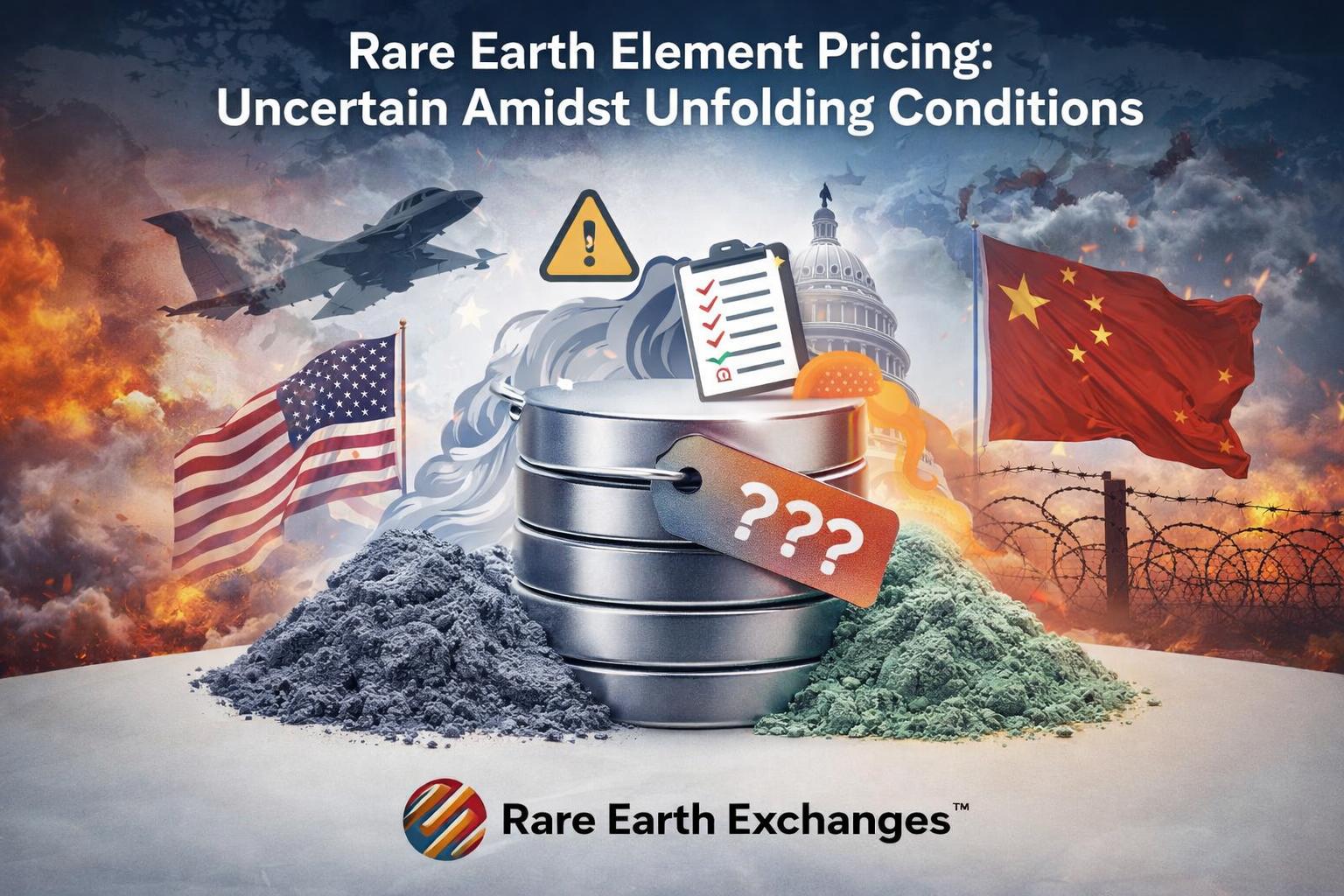
Adamas is right to force discipline into the conversation. And the larger issue, which the Toronto-based firm acknowledges, is deeper—and more uncomfortable. We are no longer operating in a commodity pricing regime. We are operating in a geopolitical pricing regime.
Volume Matters — But Volume Is Not Neutral
Rare earths are not LME-style transparent commodities. They are opaque, relationship-driven, vertically integrated markets—especially in China, which refines roughly 80–90% of global rare earth supply.
Any serious pricing framework must distinguish between:
- Long-term contract prices
- Spot or intermediary asking prices
- License-constrained or sanction-sensitive transactions
Using marginal trades as representative benchmarks distorts capital allocation. Adamas iscorrect: the ex-China heavy rare earth investment thesis is highlysensitive to price assumptions. If price floors are overstated, internal rates of return collapse.
However, the fact that most volume might clear at Chinese domestic pricing does not make that pricing globally neutral. But remember, some ex-China rare earth separation does exist now, and this will grow over the next few years.
Chinese prices reflect:
- Industrial policy
- Vertical integration
- Domestic subsidy structures
- Export controls and licensing
- State-aligned capacity management
Domestic Chinese pricing is not the same as globally accessible pricing (that is, once that product makes its way ‘out’). And many Western brokers and traders still transact China-origin products because there are few alternatives.
In a world where one nation dominates refining, separation, and magnet production, how could it be otherwise?
So which price is “real”?
The domestic Chinese print?
The Rotterdam asks?
The licensed export contract?
The defense-channel transaction?
All of them are real—within theirjurisdictional boundaries.
Policy Can Distort as Much as Thin Trading
A respected industry expert recently added another critical dimension: floor pricing and strategic stockpiling policies—particularly in Nd/Pr—may be creating distortions in an ex-China market that may already be oversupplied. Note, we cannot be certain.
Programs such as DoD-backed price floors and initiatives like “The Vault” can signal support, but they can also:
- Inflate valuations
- Encourage speculative capital
- Decouple prices from physical fundamentals
- Inject volatility into downstream supply chains
Speculative actors may benefit from volatility. Industrial reshoring likely does not.
If magnet manufacturers, motor producers, aerospace suppliers, and semiconductor firms cannot model predictable input costs, reshoring efforts stall. Industrial policy requires stability. Distorted signals—whether from thin PRAs or possibly even politically supported floor prices—potentially undermine that stability. According to some experts in our network, this is the underappreciated risk: pricing distortions are not just an upstream issue. They ripple downstream.
Fragmented Markets, Parallel Realities
There is no single rare earth price.
There are parallel markets:
- Chinese domestic
- Licensed export
- Defense-prioritized
- Non-Chinese spot
- Bilateral offtake agreements
In heavy rare earth oxides, markets are thin by definition. One percent of global volume can move sentiment dramatically. But without transacting across every channel—a pervasive ubiquitous presence-- no analyst has full visibility.
Attempting to normalize pricing across these fragmented channels is inherently imprecise. Trailing averages offer comfort (and with rare earth mining seem to be commonplace)—but in geopolitically fragmented markets, they may not anchor future clearing prices given dynamic conditions.
In our opinion, the right question is not: Which number is correct?
The right questions are:
- What volume does this price represent?
- What jurisdiction governs it?
- What policy constraints shape it?
- What portion of global demand can actually access it?
The Strategic Consequence
Rare earth pricing today is:
- License-sensitive
- Politically mediated
- Capacity constrained
- Policy reactive
- Jurisdictionally segmented
Capital markets demand a single number.
Reality offers conditional numbers.
And Adamas Intelligence is right to challenge lazy benchmarking built on negligible-volume prints. Based on our knowledge, they are among the more disciplined voices attempting to quantify an opaque sector.
And at the same time, dismissing, or at least minimizing (as an outlier), elevated ex-China prices outright ignores embedded geopolitical premiums and supply fragmentation. Likewise, ignoring policy-driven price floors risks overlooking distortions that can destabilize downstream industries.
For investors, the conclusion is disciplined and blunt:
- If your project only works at Rotterdam headline prices, representing < 1% of trade, your model is fragile.
- If your model assumes Chinese domestic averages without accounting for geopolitical divergence, it is equally fragile.
In rare earths, price is not a single number.
It is a policy outcome.
It is a jurisdictional artifact.
It is a negotiation.
It is a structural constraint.
And in today’s geopolitical pricing regime, certainty may be the rarest element of all.


0 Comments
No replies yet
Loading new replies...
Moderator
Join the full discussion at the Rare Earth Exchanges Forum →