
Hightlights
- Modern precision weapons like Tomahawk cruise missiles depend critically on rare earth magnets containing dysprosium and terbium, with China controlling over 90% of global heavy rare earth processing and magnet manufacturing capacity.
- The U.S. holds no strategic reserve of heavy rare earths like terbium, importing 100% from China, while new 2027 DFARS regulations will prohibit defense acquisition of magnets produced in China, Russia, Iran, and North Korea.
- Missile actuators, radar systems, and guidance mechanisms require NdFeB magnets doped with heavy rare earths to withstand extreme temperatures, meaning the pace of modern warfare is constrained by one of the world's most geographically concentrated supply chains.
Why missiles, actuators, and radar quietly depend onthe world’s most fragile supply chain.
In early March 2026, public reporting described a high-tempo U.S.–Iran air-and-missile campaign involving both the United States and Israel. The strikes reportedly relied heavily on precision munitions—including Tomahawk cruise missiles—and triggered urgent discussions inside Washington about accelerating weapons production. Some reports suggest Tomahawk output could eventually ramp toward 1,000 missiles per year, even though the Pentagon’s previously published procurement plan for 2026 listed only 57 missiles, at roughly $1.3 million each, according to Reuters (opens in a new tab). Recent press suggests some potential challenges (opens in a new tab).
Table of Contents
Recent U.S. strikes on Iran under Operation Epic Fury involved the use of Tomahawk cruise missiles, further drawing down a stockpile already strained by repeated deployments in conflicts in Yemen, Nigeria, and earlier operations targeting Iran. Defense analysts warn that continued use of these long-range precision weapons could leave the U.S. short of critical munitions in the event of a major conflict with China, where such missiles would be essential for striking distant targets and suppressing enemy missile systems. Although the Pentagon and RTX are working to expand production as cited above, current procurement levels remain relatively low, and production timelines can take up to two years, raising concerns that the U.S. industrial base may struggle to replenish stocks quickly enough for a high-intensity war in the Indo-Pacific.
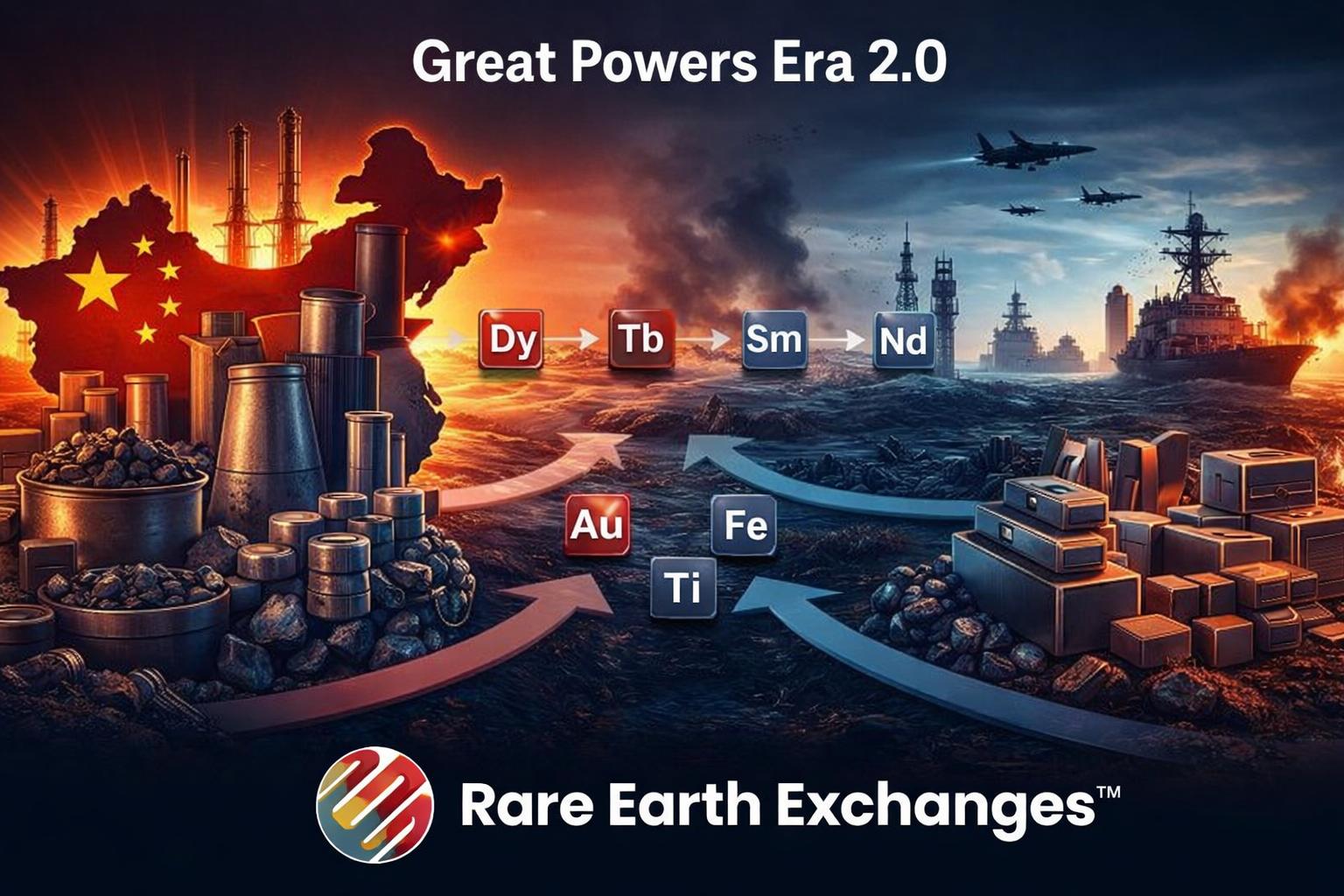
The operational tempo highlights a rarely discussed dimension of modern warfare: the dependence of precision weapons on rare earth magnets—and the heavy rare earth elements that make them viable in combat environments.
What We Can—and Cannot—Measure
A key question circulating in defense and commodities circles is whether the United States is rapidly depleting its rare-earth magnet stockpile as munitions usage rises.
The honest answer: no public data allow calculation of such a burn rate.
Literature reviewed by Rare Earth Exchanges™ suggests that, in some scenarios, supply buffers for certain heavy rare earth elements may be extremely limited. Some analyses have suggested inventories measured in weeks rather than years, although precise figures remain classified or uncertain.
The U.S. Department of Commerce’s investigation (opens in a new tab) into NdFeB permanent magnets concluded that even estimating total defense demand for neodymium-iron-boron magnets is extremely difficult. Militaryconsumption is embedded across multiple classified programs, and mostmagnets move through complex commercial supply chains before entering defense systems.
What can be inferred is simpler:
Missile usage drives replenishment demand.
Replenishment demand drives magnet demand.
But any drawdown of government inventories—if it is occurring—cannot be tracked in real time through open sources.
As reported by REEx, the supply challenge may become even more complex beginning January 1, 2027, when updated DFARS 252.225-7052 regulations take effect. The rule prohibits the U.S. Department of Defense from acquiring samarium-cobalt or neodymium-iron-boron magnets that are mined, refined, separated, melted, or produced in covered countries, including China, Russia, Iran, and North Korea. The update expands current restrictions and effectively requires fully compliant, non-covered supply chains for these materials.
Where Missiles Meet Rare Earths: The Actuator
The most direct link between rare earth magnets and missile warfare is the actuator.
Missile actuators are rugged electromechanical devices that move control fins or thrust-vectoring systems. They translate guidance commands into rapid mechanical motion, allowing a missile to steer precisely toward its target.
Modern missile actuators often rely on brushless DC motors, which place permanent magnets on the rotor. These magnets must be extremely powerful, compact, and resistant to heat and vibration.
That requirement pushes engineers toward NdFeB magnets, the strongest permanent magnets commercially available. But high-temperature environments—such as missile flight—introduce a critical materials challenge.
Why Heavy Rare Earths Matter
Standard NdFeB magnets degrade at elevated temperatures unless alloyed with small amounts of heavy rare earth elements, particularly:
- Dysprosium (Dy)
- Terbium (Tb)
These elements increase magnetic coercivity—a magnet’s resistance to demagnetization under heat and stress.
In practical terms:
- Neodymium and praseodymium provide magnetic strength
- Dysprosium and terbium provide thermal durability
Without Dy or Tb doping, many military magnets would fail under operational conditions.
This makes heavy rare earth supply—not light rare earth mining—the true strategic constraint.
Iron Dome: A Rare Earth Supply Chain in Action
Israel’s Iron Dome air defense system illustrates the same dependency.
A typical Iron Dome battery contains three core components:
- EL/M-2084 Active Electronically Scanned Array radar (IAI-ELTA)
- Battle Management & Weapon Control system (mPrest)
- Missile-firing units launching Tamir interceptors
Each battery typically fields 3–4 launchers, each holding 20 Tamir interceptors, meaning 60–80 ready missiles before reload.
Inside these systems are numerous rare-earth and critical-mineral dependent technologies, including:
- NdFeB magnets in missile actuators and radar motors
- Samarium-cobalt magnets in high-temperature radar subsystems
- Yttrium iron garnet filters are used in radar electronics
- Gallium and germanium semiconductors in sensors and signal processing
Production of Tamir interceptors has partly shifted to the United States. The Raytheon–Rafael Protection Systems joint venture opened a Tamir interceptor manufacturing facility in East Camden (opens in a new tab), Arkansas, under a $1.25 billion production contract, with many components sourced through the U.S. defense supply chain.
Yet the critical materials inside those components still originate largely outside the United States.
The Real Bottleneck: Heavy Rare Earth Processing
Public data suggest the United States is not exhausting a large heavy-rare-earth stockpile—because such a stockpile may not meaningfully exist.
According to the U.S.Geological Survey’s 2026 Mineral Commodity Summaries (opens in a new tab), the U.S.government holds no significant strategic reserve of heavy rare earth elements such as terbium.
Import data shows:
- 100% of U.S. terbium imports came from China between 2021 and 2024
- China supplied roughly 71% of the total U.S. rare-earth compound and metal imports
China also dominates global heavy rare-earth processing, with many industry estimates placing its share well above 90% for several heavy rare-earth oxides.
The Defense Logistics Agency has attempted partial mitigation through targeted acquisitions. Its FY2025 Annual Materials Plan (opens in a new tab) lists potential purchases, including:
- 300 tons NdPr oxide
- 450 tons of NdFeB magnet blocks
- 60 tons of samarium-cobalt alloy
But these measures represent feedstock buffering, not a comprehensive heavy-rare-earth reserve.
Great Powers Era 2.0: War Is Now a Supply-Chain Competition
The emerging conflict environment underscores a central thesis of Rare Earth Exchanges™ “Great Powers Era 2.0.” Modern wars are not limited by the number of missiles in storage. They are limited by the industrial throughput required to replace them.
The United States is attempting to expand that throughput. In March 2026, the Department of Defense solicited projects to mine, process, and recycle 13 critical minerals (opens in a new tab), including several rare earth elements.
Private-sector efforts are also underway.
MP Materials plans to commission a heavy rare earth separation circuit at Mountain Pass, California, targeting roughly 200 metric tons per year of dysprosium and terbium. The company’s 10X magnet manufacturing campus in Northlake, Texas, is expected to begin commissioning around 2028.
MP Materials remains central to the emerging U.S. rare earth industrial strategy, alongside a small but growing group of mine-to-magnet supply chain initiatives tracked by Rare Earth Exchanges.
Yet based on our conservative analyses, timelines remain misaligned with geopolitical risk.
The Bottom Line
The key constraint facing the United States is not a visible drawdown of magnet stockpiles.
It is the concentration of heavy rare earth processing capacity, largely in China.
For this reason, geopolitical events unfolding across multiple regions—from Venezuela to Iran to ongoing negotiations with Beijing—intersect with the strategic minerals landscape.
Until Western supply chains can separate, refine, and magnetize dysprosium, terbium, and other heavy rare earth elements at an industrial scale, the pace of missile production—and therefore the pace of modern warfare—will remain partially determined by one of the most fragile supply chains in the global economy.
REEx: How Much Rare Earth Material Is Inside a Modern Missile?
Precise material inventories for modern weapons systems are classified. However, engineering literature and defense supply-chain analyses provide rough approximations for the magnet materials used inside guidance and control subsystems.
Most precision-guided missiles contain several electromechanical systems that require high-performance magnets:
- Fin control actuators
- Seeker gimbal motors
- Radar or infrared sensor drives
- Data-link stabilization systems
These subsystems often rely on NdFeB permanent magnets or samarium-cobalt magnets designed to tolerate high vibration and heat.
Industry estimates suggest that a single precision missile may contain hundreds of grams to several kilograms of permanent magnets, depending on system complexity. Because NdFeB magnets are typically about 30% rare earth elements by weight, this translates into meaningful demand for:
- Neodymium
- Praseodymium
- Dysprosium
- Terbium
Heavy rare earth elements are used in small but crucial quantities. A typical high-temperature NdFeB magnet may include 2–6% dysprosium or terbium to maintain magnetic performance in harsh conditions.
The implication is straightforward: while a single missile contains only modest amounts of rare earths, large-scale missile production multiplies demand quickly.
A production surge of 1,000 cruise missiles per year, for example, would indirectly require:
- Several tons of NdFeB magnets
- Kilograms to tens of kilograms of dysprosium or terbium
In a supply chain already dominated by China, even these relatively small quantities can become strategically significant.
Supply Chain Map: From Rare Earth Mine to Missile Actuator
Understanding the strategic vulnerability requires tracing the entire supply chain.
The rare earth inputs inside a missile actuator pass through five industrial stages, each with its own geopolitical concentration.
1. Mining
Rare earth ores are extracted from deposits containing minerals such as bastnäsite, monazite, or ion-adsorption clays.
Key producing regions include:
- China
- Myanmar
- Australia
- United States
- Brazil
- Vietnam
Heavy rare earths such as dysprosium and terbium are primarily sourced from ion-adsorption clay deposits, historically dominated by southern China and Myanmar.
2. Chemical Separation
After mining, rare earth elements must be separated through solvent extraction circuits, often requiring hundreds or thousands of stages. Industrial-scale rare earth separation remains overwhelmingly concentrated in China. The world’s second-largest economy (rapidly approaching the USA) further advances intellectual property linked to downstream innovation, linked to rare earth elements. Rare Earth Exchanges research repeatedly highlights that large-scale solvent extraction is still the only commercially proven separation method.
3. Metal Refining
Separatedoxides must then be converted into rare earth metals or alloys through metallization processes.
These materials are required for magnet manufacturing.
China currently dominates this step as well.
4. Magnet Manufacturing
Rare earth metals are alloyed with iron, boron, or cobalt to produce:
- NdFeB magnets
- Samarium-cobalt magnets
Magnets are sintered, machined, coated, and magnetized.
China currently produces roughly 85–90% of the world’s NdFeB magnets.
5. Defense System Integration
Magnets are incorporated into:
- Missile actuators
- Radar motors
- UAV propulsion systems
- Guidance stabilization mechanisms
Only at this final stage do they enter the defense industrial base.
By then, the supply chain has already passed through multiple globally concentrated chokepoints.
Geopolitical Overlay: Why Venezuela, Iran, and China Appear in the Same Strategic Conversation
Rare earth supply chains and geopolitical conflict are increasingly intersecting.
Rare Earth Exchanges has framed this environment as “Great Powers Era 2.0,” in which mineral supply chains become strategic terrain alongside traditional military theaters.
Several dynamics illustrate the emerging pattern.
1. Heavy Rare Earth Access Is Narrow
Heavy rare earth production remains concentrated in a small number of locations, particularly:
- Southern China
- Northern Myanmar (Kachin State and other Myanmar rebels top Rare Earth Exchanges heavy rare earth element rankings)
Political instability or export controls affecting these regions can ripple through the entire defense supply chain.
2. Industrial Replacement Capacity Is Limited
Western governments are now attempting to rebuild rare earth supply chains.
However, the timeline mismatch is significant.
Projects currently underway include:
- MP Materials heavy rare earth separation circuit (Mountain Pass)
- Northlake, Texas, magnet manufacturing campus
- Multiple DoD-funded processing initiatives
Most of these efforts will take years to reach meaningful scale.
3. Strategic Minerals Are Now Embedded in Security Policy
Critical minerals are now appearing directly in diplomatic and military discussions.
Examples include:
- U.S. negotiations with China over export controls
- Western efforts to diversify supply chains
- Defense procurement rules requiring non-Chinese magnets
- Resource diplomacy across Latin America, Africa, and Asia
Regions such as Venezuela—with significant critical mineral potential—and Iran—a major geopolitical flashpoint (oil supply chain chokepoint)—therefore appear in the same strategic conversation. The connection is not always direct mineral extraction. Rather, it reflects a broader reality: modern military capability is inseparable from global mineral supply chains.
Final Strategic Takeaway
The emerging defense landscape suggests a new form of strategic constraint.
The limiting factor in modern warfare may no longer be the number of missiles stored in arsenals.
It may be how quickly the industrial base can rebuild them.
And that, in turn, depends on a surprisingly small group of materials—especially dysprosium and terbium—moving through one of the most geographically concentrated supply chains in the world.
Until the United States and its allies build resilient heavy-rare-earth separation and magnet manufacturing capacity, the pace of missile production—and therefore the pace of modern warfare—will remain partially governed by the fragile physics of rare-earth magnets.
From Mine to Missile: The Rare Earth Supply Chain Behind Precision Weapons
Modern missile systems may launch in minutes, but the materials enabling them to move through one of the most complex industrial supply chains on earth. Rare earth magnets—critical for actuators, radar motors, sensors, and guidance stabilization—begin as ores such as bastnäsite, monazite, or ion-adsorption clays, with heavy rare earths like dysprosium and terbium historically sourced from deposits concentrated in southern China and Myanmar.
These ores must then undergo large-scale chemical separation using solvent extraction circuits—often involving hundreds or thousands of stages—followed by metallization, which converts rare-earth oxides into usable metals and alloys. The materials are then manufactured into high-performance magnets such as NdFeB and samarium-cobalt, which are machined and integrated into electromechanical subsystems, including missile fin actuators, radar motors, and drone propulsion systems, before ultimately being assembled into complete weapons platforms such as cruise missiles, air defense interceptors, and advanced drone systems.
The strategic implication is profound: the modern defense economy increasingly depends not just on steel, fuel, and explosives, but on small quantities of specialized minerals—particularly heavy rare-earth elements (and a handful of other critical minerals)—moving through a highly concentrated global supply chain dominated by China. This reality sits at the core of the Rare Earth Exchanges™ Great Powers Era 2.0 thesis: industrial supply chains, not merely military arsenals, are becoming decisive terrain in geopolitical competition.
Until Western nations develop resilient capacity in heavy rare earth separation, metallization, and magnet manufacturing, the pace of advanced weapons production—and therefore the tempo of modern warfare—will remain tethered to one of the most fragile supply chains in the global economy. Paradoxically, that very vulnerability can encourage bursts of militarization around critical supply routes and resource chokepoints as states seek leverage or security of access. How far such dynamics may escalate remains uncertain.


0 Comments
No replies yet
Loading new replies...
Moderator
Join the full discussion at the Rare Earth Exchanges Forum →