
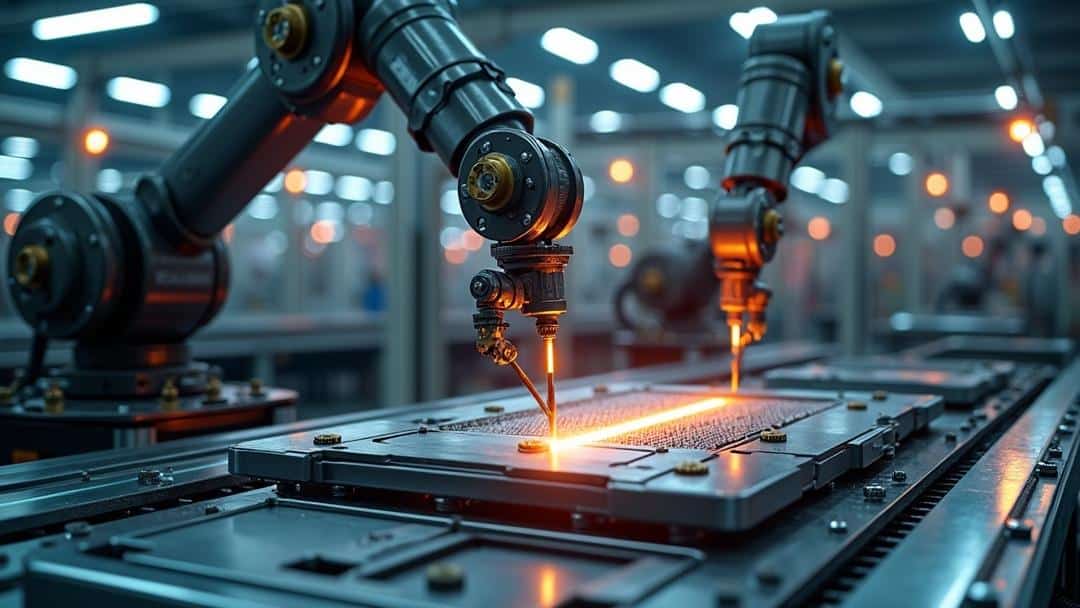
Before automation, factories depended on human precision for every repetitive task. Fatigue, inconsistency, and downtime limited output and quality. Industrial automation changed that; networks of sensors, motors, and control systems now keep production lines running with precise timing and continuous feedback. Today, advanced automation systems powered by rare earth elements (REEs) have transformed how we build everything from cars to computer chips.
Table of Contents
How Do Rare Earth Elements Enhance Industrial Automation?
On the factory floor, everything starts with movement. Conveyor belts glide in perfect rhythm, carrying parts from one station to the next. Their servomotors (opens in a new tab) use neodymium and dysprosium magnets to deliver steady torque and precise control, ensuring each piece stops exactly where it should.
Farther down the line, robotic arms weld metal frames in showers of light. Inside each jointed arm, rare earth magnets convert electrical signals into smooth, repeatable motion. Neodymium provides magnetic strength while dysprosium maintains performance under high heat, allowing continuous precision even in demanding conditions.
At inspection stations, europium and terbium illuminate control panels and displays, giving technicians and algorithms clear, instant feedback. These same elements provide the red and green signals that synchronize equipment across entire production cells.
Meanwhile, lasers and optical sensors guide positioning systems with micrometer accuracy (A micrometer is smaller than a speck of dust, or 1/110th of a human hair.) Their clarity depends on cerium-based polishing compounds that refine lenses and mirrors. Without that precision, the entire feedback network of robots and scanners would lose its accuracy.
The Hidden Heroes of Modern Manufacturing
The story of industrial automation is not only about machinery; it is about the people and materials that made intelligent production possible. Rare earths gave engineers the magnetic strength and temperature stability needed to create machines that move with human-like precision.
Progress came from collaboration. Engineers in the 1960s and 70s designed robotic arms capable of repeatable motion, guided by early servomotors using rare earth magnets. Control theorists refined feedback systems that let machines sense and adjust their movements in real time. Optics specialists later introduced laser-guided positioning, using cerium-polished lenses and sensors to measure accuracy within microns. Together, these innovations transformed factories from rows of machines into coordinated systems that could see, think, and adapt.
Industrial Automation: The Rare Earth Journey from Mine to Machine
Every rare earth component begins its journey in the ground. Mining operations extract mineral-rich ores containing elements like neodymium, praseodymium, and samarium, which form the basis for high-performance magnets. Others such as cerium, yttrium, and lanthanum later support optical sensors, ceramics, and machine-vision lenses.
After extraction, the ore is crushed, concentrated, and chemically separated into individual oxides, then reduced to metals and blended into specialized alloys. Each element gains purpose during these stages: magnetic strength for motion systems, luminescence for displays, or optical clarity for laser alignment.
Manufacturers then shape these materials into precision components such as servomotor rotors, magnetostrictive sensors, optical crystals, and phosphor displays. These parts ultimately power the robots and control systems built by companies including Siemens, ABB, and Fanuc.
Global Impact by the Numbers
Industrial automation continues to expand at record speed. As of 2024, more than 4.28 million industrial robots are operating in factories worldwide, with over 540,000 new installations in 2023 alone (opens in a new tab), according to the International Federation of Robotics. Asia accounts for roughly 70 percent of new deployments, while Europe and the Americas make up about 27 percent combined (opens in a new tab).
The global industrial automation market is valued between 190 and 256 billion USD in 2024, depending on methodology, and is projected to double to more than 500 billion USD (opens in a new tab) by 2033–2034, reflecting an annual growth rate near 9 percent. The acceleration of automation highlights a global reality: rare earth demand is rising sharply, and countries that diversify supply beyond China will capture the lasting value.
Conclusion
Industrial automation depends on more than mechanical precision; it relies on the chemistry and physics of rare earth elements that turn motion into intelligence. From the mine to the factory floor, these materials enable the sensors, optics, and servomotors that define efficiency in the modern age. As recycling, diversification, and new magnet designs evolve, the partnership between rare earths and automation will continue to shape the next generation of manufacturing systems.
FAQs
Are rare earth magnets always necessary in industrial automation motors?
Not always. Ferrite-based motors work for moderate torque and lower temperature swings, but NdFeB or SmCo magnets enable smaller, more efficient servos with tighter control. Robots, cobots, and high-performance axes typically use them for their size, weight, and efficiency advantages.
What happens to magnet performance at high temperatures on the plant floor?
Standard NdFeB magnets lose coercivity and can demagnetize under sustained heat. Adding heavy rare earths such as dysprosium or terbium, using grain-boundary diffusion, or switching to SmCo magnets helps preserve torque and magnetic strength, though at higher cost.
Where do rare earths create the biggest supply risk for industrial automation?
The midstream—separation, metal production, and magnet alloying—remains heavily concentrated in China. Policy or export shifts can affect global motor and sensor supply chains. Diversification and recycling initiatives are underway to reduce that dependency.
Can magnets and phosphors from end-of-life equipment be recycled?
Yes. Processes such as hydrogen processing of magnet scrap (HPMS) can recover NdFeB from motors and drives, while phosphor powders can be reprocessed. Scaling these methods requires better collection, contamination control, and economic feasibility.
