
Highlights
- China Northern Rare Earth Group replaced subjective visual temperature checks and disposable thermocouples with a real-time power consumption model that infers furnace temperature, reducing costs and improving product consistency in NdFeB alloy production.
- The system calculates cumulative energy input to predict internal furnace temperature continuously, eliminating recurring thermocouple expenses and human error while simplifying operator workflows.
- This process-level digitization demonstrates China's competitive strategy of embedding incremental, data-driven optimizations across manufacturing stages rather than relying solely on materials science breakthroughs.
At a neodymium-iron-boron (NdFeB) alloy production line operated by China Northern Rare Earth Group, engineers have deployed a deceptively simple innovation with meaningful operational implications: a real-time power-consumption system that estimates furnace temperature without direct measurement.
Rethinking Temperature: From Operator Judgment to Data Model
In NdFeB rapid solidification alloy production, precise furnace temperature control is essential to both product quality and throughput. Historically, operators relied on visual estimation—subjective and error-prone—or disposable thermocouples, which require preheating, incur recurring costs, and fail to provide continuous monitoring.
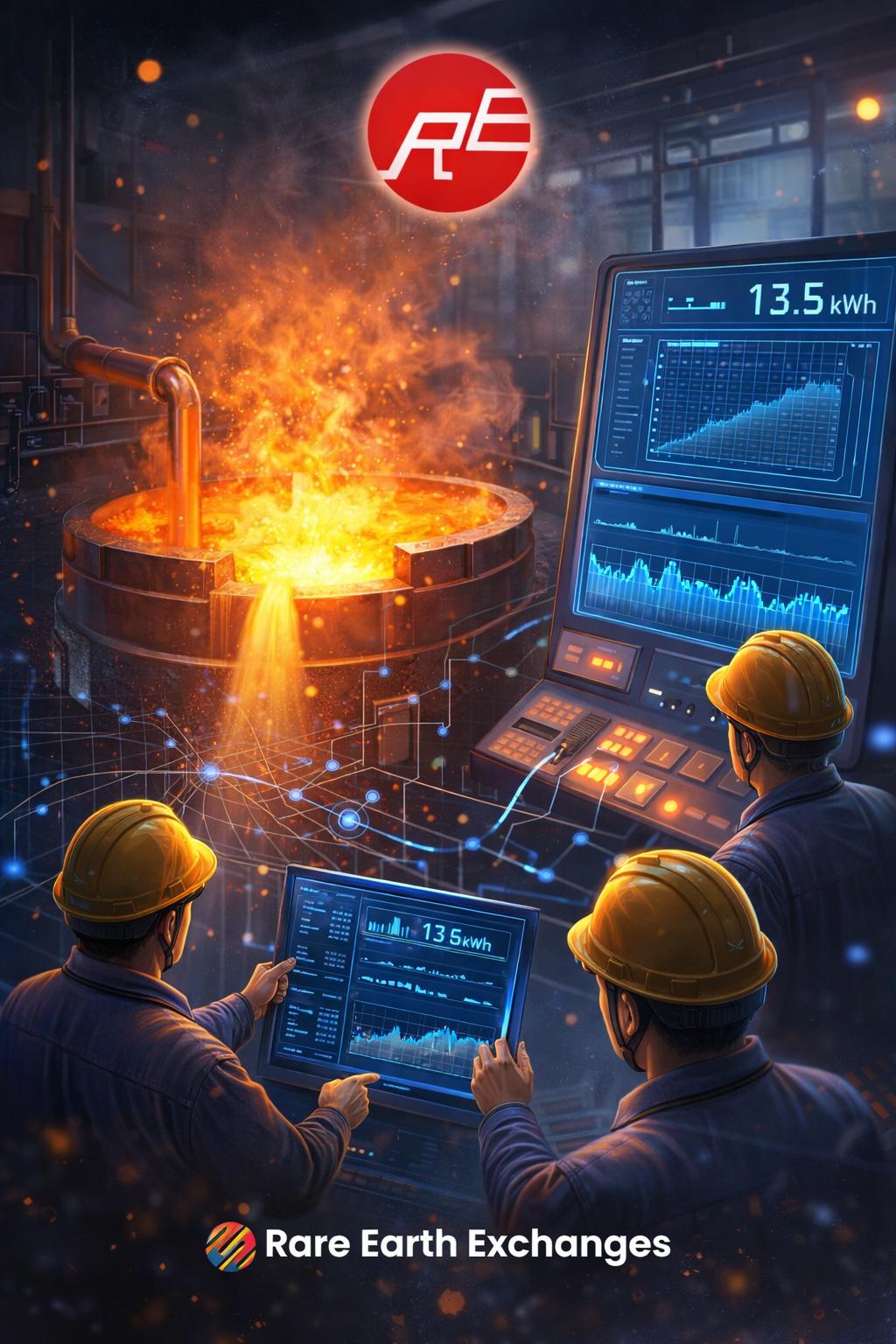
The new system reframes the problem. With furnace charge volumes largely fixed, the energy required to reach target temperatures follows a predictable pattern. By integrating real-time power data and calculating cumulative energy input, engineers can reliably infer internal furnace temperature. This model-driven approach is now embedded into centralized control systems, delivering continuous, real-time visibility to operators.
Results: Cost Reduction Meets Process Stability
Early results point to tangible gains. Product quality consistency has improved, thermocouple usage has declined sharply, and both consumable and maintenance costs have been reduced. At the same time, the simplified workflow lowers operational complexity and reduces the risk of human error.
Importantly, the system is already in stable, ongoing use—indicating a practical deployment rather than a conceptual pilot.
Why It Matters: Process Innovation as Competitive Edge
This is not a breakthrough in materials science—it is something more scalable: process optimization. By translating physical production (in Chinese, they refer to as process dynamics) into computable, real-time data models, the company is achieving low-cost digitization of a critical manufacturing step. For Western producers, the signal is clear. China’s advantage continues to compound not only through scale, but through continuous, incremental improvements at the process level—embedding intelligence directly into production environments.
What Comes Next
The company plans to expand similar data-driven optimization approaches across additional production stages, reinforcing its push toward fully digitized, high-efficiency manufacturing systems.
Disclaimer: This report is based on information published by media affiliated with a Chinese state-owned entity. All technical claims and performance outcomes should be independently verified before informing investment, operational, or policy decisions.


0 Comments
No replies yet
Loading new replies...
Moderator
Join the full discussion at the Rare Earth Exchanges Forum →