
Highlights
- China-Russia-Iran naval drills in the Strait of Hormuz are verified strategic signaling, not pre-war mobilization.
designed to raise the economic cost of conflict at a chokepoint handling 20% of global petroleum flows. - Energy disruptions at Hormuz directly impact rare earth pricing through processing costs, shipping delays, and market
opacity—because REE refining is energy-intensive and China controls 85-90% of capacity. - Geopolitics now functions as a direct input into rare earth price formation and supply continuity, with symbolic
military activity capable of triggering speculative behavior in thin, non-transparent REE markets.
Rare Earth Exchanges™ validates claims surrounding the China–Russia–Iran “Maritime Security Belt 2026” drills using external sources and introduces investor-relevant risk factors. Drawing on data from U.S. Energy Information Administration, International Energy Agency, and Center for Strategic and International Studies, it confirms what is real, flags what is speculative, and explains why energy chokepoints directly impact rare earth pricing, logistics, and supply chain resilience.
Overview
Rare Earth Exchanges has verified joint China–Russia–Iran naval drills in the Strait of Hormuz, designed to raise the perceived economic cost of war. In simple terms, they signal that conflict could disrupt a critical global energy artery—forcing policymakers to reconsider escalation.
Various media framing is supported by external data. The U.S. Energy Information Administration estimates that roughly 20% of global petroleum liquids consumption flows through the Strait of Hormuz, making it the world’s most critical oil transit chokepoint. The International Energy Agency similarly underscores the strait’s centrality to global energy security.
This is not conjecture. It is a widely accepted energy infrastructure reality.
Where Steel Meets Sea Lanes: Verified Reality
The structural argument stands on firm ground.
- The Center for Strategic and International Studies has repeatedly highlighted that energy chokepoints amplify global economic vulnerability, especially during geopolitical tension.
- China’s dependence on imported hydrocarbons—particularly from the Gulf—is well documented, reinforcing its interest in securing maritime routes without direct confrontation. In fact, based on our Great Powers Era 2.0 thesis, we suggest both Venezuela and Iran's moves may have a deeper underlying rationale—namely, leverage over China (assuming the USA remains in the driver’s seat).
- Rare earth processing remains highly energy-intensive, with China controlling ~85–90% of refining capacity—meaning energy shocks translate directly into cost shocks.
The Theater of Power: Signal vs Substance
However, parts of the original narrative of more collaboration among these countries remain interpretive.
There is no publicly verified evidence confirming:
- Deep trilateral intelligence integration across multiple theaters
- Imminent joint war planning involving China and Russia alongside Iran
Even if correct based on what we know today, direct military intervention is unlikely. This aligns with the broader consensus: both China and Russia avoid high-cost, direct confrontation with the United States. Translation for investors: These drills are best understood as strategic signaling—not pre-war mobilization.
The Hidden Lever: Rare Earths Ride Energy
What chatter online tends to omit—but matters most to this audience—is the transmission mechanism:
- Energy prices → REE processing costs (separation is energy-intensive)
- Shipping risk → magnet delivery delays (just-in-time systems exposed)
- Market stress → pricing opacity increases (already a structural flaw in rare earth markets)
This aligns with IEA and CSIS views that energy volatility cascades across industrial supply chains, including critical minerals.
Bottom line: A disruption in Hormuz can propagate into rare earth pricing—even without a single mine being affected.
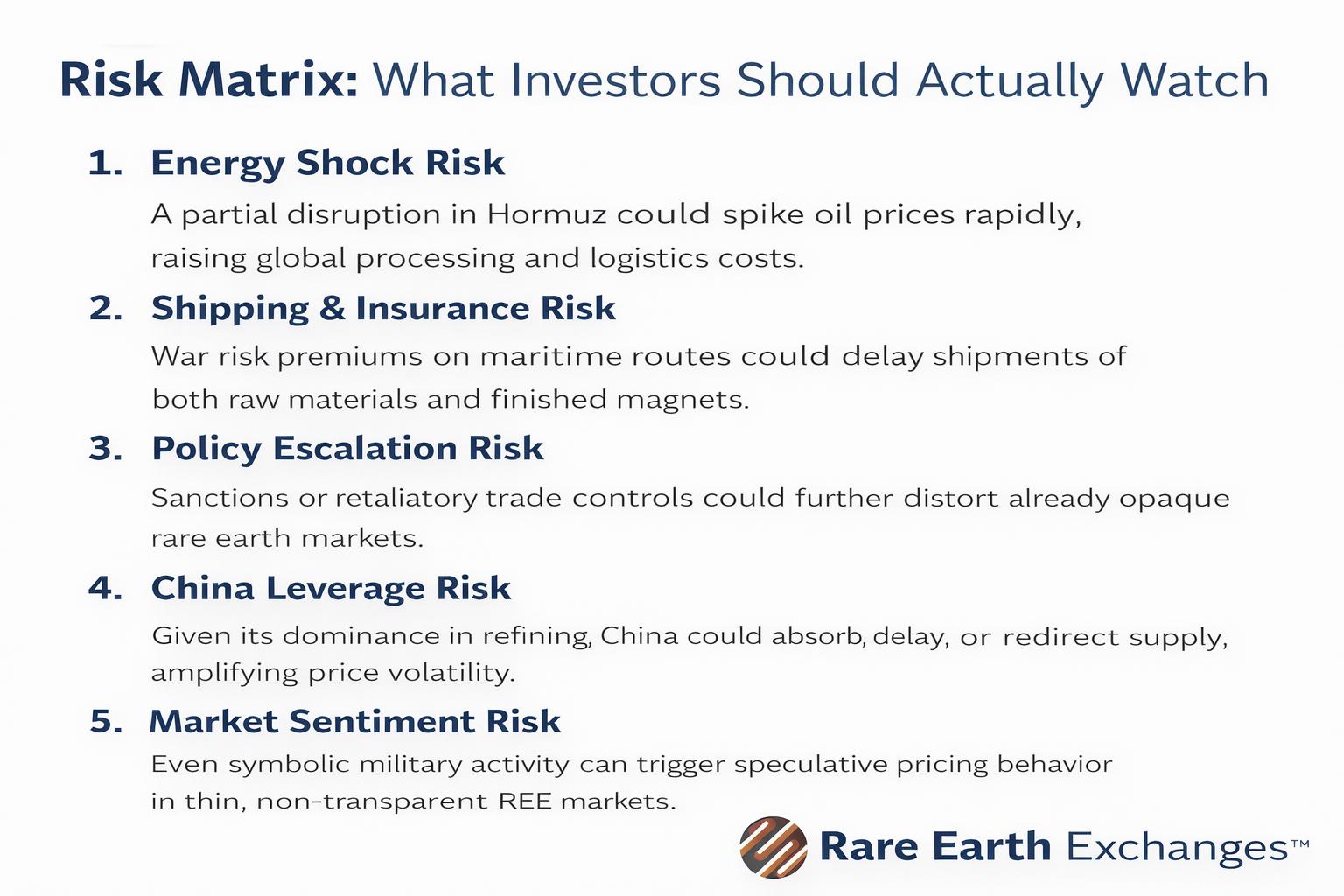
Even symbolic military activity can trigger speculative pricing behavior in thin, non-transparent REE markets.
Final Take: The Cost of War Is Now a Supply Chain Equation
This is not a prelude to war—it is a calibrated economic signal.
Verified data from multiple sources, including REEx, EIA, IEA, and CSIS, confirms the central premise: Hormuz is a pressure point on global industry. Per our Great Powers Era 2.0 thesis with controls come leverage. But what if the incursion spins out of control?
For rare earth investors, the conclusion is sharper: Geopolitics is no longer background noise—it is a direct input into price formation, supply continuity, and industrial risk.


0 Comments
No replies yet
Loading new replies...
Moderator
Join the full discussion at the Rare Earth Exchanges Forum →