
Highlights
- The U.S. Army's FY2027 budget targets 2,798 PAC-3 MSE and 857 THAAD interceptors, but current production capacity falls far short of those procurement objectives.
- China's April 2025 export controls on samarium, dysprosium, and terbium remain active, while a broader suspension of October 2025 controls expires November 10, 2026.
- Starting January 1, 2027, U.S. DFARS rules restrict the full upstream supply chain—mining through finished magnet—for samarium-cobalt and neodymium-iron-boron magnets from covered countries.
- A shortage in an obscure magnet, actuator, or rare-earth material several tiers below the prime contractor can halt a multibillion-dollar missile production program.
- Industrial capacity cannot be created by executive order—factories, separation plants, and qualified suppliers require years to build, creating a dangerous gap between political urgency and physical readiness.
The U.S. Army’s FY2027 budget plan supports production of 2,798 PAC-3 Missile Segment Enhancement interceptors and 857 THAAD interceptors—3,655 missiles combined. The numbers are real, although they are procurement objectives rather than 2027 delivery counts. They arrive as the Pentagon confronts depleted interceptor inventories and presses industry to expand output at extraordinary speed. Yet beneath Lockheed Martin’s assembly lines sits a far less visible industrial system: seekers, propulsion, actuators, electronics, specialty materials, permanent magnets and the rare-earth supply chains behind them. China’s April 2025 export controls remain relevant to samarium, dysprosium and terbium-related products, while the broader October 2025 controls are suspended only through November 10, 2026. Then, on January 1, 2027, U.S. defense sourcing restrictions expand across the full supply chain for covered samarium-cobalt and neodymium-iron-boron magnets from China and other covered countries. America can order thousands of missiles. The harder question is whether it can build the industrial ecosystem beneath them fast enough.
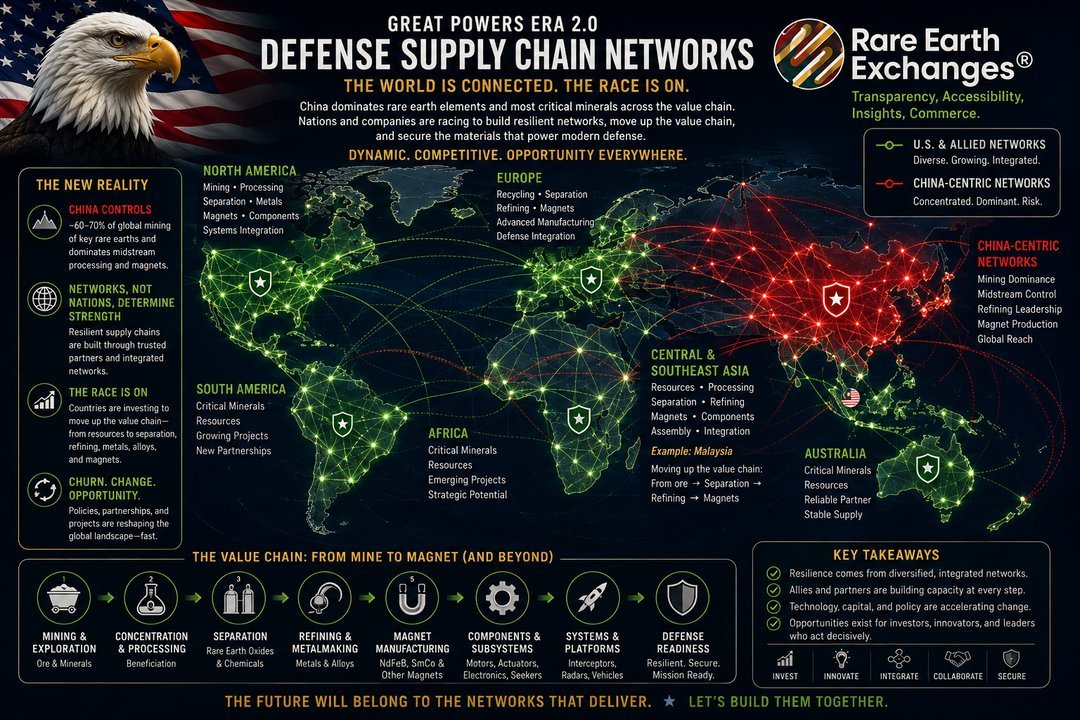
REEx Insight | Washington Can Appropriate Missiles. It Cannot Appropriate a Supply Chain.
Rare Earth Exchanges® (REEx) exists to illuminate vulnerabilities that markets—and sometimes governments—can overlook. We are unapologetically pro-America, pro-democracy, pro-market and fiercely independent. Our first obligation is to the investors, executives and decision-makers who rely on this platform to understand what is actually happening beneath the headlines. And being pro-market does not require pretending geopolitics disappeared. Efficiency, productivity and comparative advantage remain engines of prosperity, but they are no longer enough to judge a strategic supply chain.
In the Great Powers Era 2.0™, a term we have coined to describe the period of globalization we are entering—one that is network driven—resilience and security have become economic variables in their own right. A component that costs 5% less is not cheaper if an authoritarian government can withhold it precisely when America or its allies need it most. The answer is not retreating behind walls or abandoning global markets. It is pricing geopolitical risk honestly, preserving competition, and building enough American and allied capacity that no strategic competitor can hold a veto over our factories, our economy—or our national security.
That is the essence of what REEx calls Great Powers Era 2.0: the post-Cold War assumption that economics and national security could largely inhabit separate worlds is breaking down. Minerals, semiconductors, energy, shipping lanes, artificial intelligence, advanced manufacturing and defense production are again instruments of state power. China has spent decades building formidable positions across critical industrial chains; the United States and its democratic allies are now trying to reconstruct capabilities that markets often shifted offshore because doing so once appeared economically rational. Great Powers Era 2.0 does not require retreating from globalization or free enterprise. It requires something more sophisticated: open markets where possible, allied interdependence where advantageous, and sufficient domestic or trusted-partner capacity where dependence becomes a national-security vulnerability.
And few products demonstrate that new reality more vividly than a missile interceptor.
A Missile Is Not a Missile. It Is a Supply Chain.
From the outside, a PAC-3 Missile Segment Enhancement (opens in a new tab) (MSE) is a sleek cylinder carrying extraordinary technology. From the factory floor, it is a network. Lockheed Martin integrates the interceptor. Boeing produces PAC-3 seekers (opens in a new tab). L3Harris participates in propulsion and control systems. Elsewhere across the missile-defense architecture are advanced sensors, electronics, actuators, motors, specialty alloys and precision components produced by layers of suppliers that most investors—and probably most policymakers—will never see.
Then the supply chain disappears farther underground. An electric actuator may depend upon a permanent magnet. A magnet may require neodymium and praseodymium, potentially with dysprosium or terbium—heavy rare earth elements, for demanding temperature conditions—or another application may favor samarium-cobalt because of its temperature stability. Those materials require mining, cracking, separation, refining, metalmaking, alloying and magnet manufacturing before the component supplier ever sees them. That is why the missile-production challenge cannot be measured merely by Lockheed Martin’s final assembly capacity.
The factory is only the visible end of the supply chain. And the Pentagon is now asking that system to accelerate at breathtaking speed.
3,655 Interceptors: The Mobilization Signal Is Real
The Army's FY2027 budget highlights support production of 2,798 PAC-3 MSE missiles—244 through discretionary funding and 2,554 through mandatory funding—and 857 THAAD interceptors, comprising 27 discretionary and 830 mandatory. That makes 3,655 interceptors across the two programs. Those figures require an important qualification: they are not a promise that 3,655 missiles will roll off production lines during FY2027. Production capacity simply isn't there yet.
Lockheed Martin delivered (opens in a new tab) a record 620 PAC-3 MSE interceptors in 2025. Under its seven-year framework with the U.S. government, annual production capacity is supposed to rise from approximately 600 to 2,000 interceptors per year—more than tripling capacity.
Terminal High Altitude Area Defense (opens in a new tab) (THAAD) presents an even sharper mismatch between procurement ambition and current output. The Center for Strategic and International Studies estimates (opens in a new tab) the present surge rate at roughly 96 interceptors annually, citing Lockheed planning additional facilities and tooling capable of expanding toward 400 per year (opens in a new tab). CSIS also notes that deliveries associated with the Army's 857-interceptor request are projected to begin around mid-2029.
That distinction matters. The budget is sending a massive demand signal. Industry still has to convert money into factories, machines, people, qualified suppliers—and ultimately missiles and related defense systems.
Follow the Missile Down the Supply Chain
The public industrial map reveals where bottlenecks can hide. Lockheed Martin sits at the top as prime contractor and integrator. But beneath the prime sits the seeker supply chain, propulsion and attitude-control equipment, guidance electronics, motors, actuators and specialty materials. Still below those suppliers are still more companies making powders, alloys, electronic materials, precision parts and magnets. And beneath them are processors, as well as separators, and finally the mines.
That is the chain REEx believes Washington must learn to see. A shortage several tiers below Lockheed may appear economically trivial when measured in dollars yet become strategically enormous if it stops delivery of a multimillion-dollar interceptor, especially in what will become a more dangerous world.
In complex weapons systems, the economic value of an input and its strategic value can be radically different.
Research into rare-earth trade networks reinforces that concern. A 2025 study examining 168 rare-earth-related product categories found that vulnerabilities differ substantially by supply-chain tier and argued that mitigation needs to move beyond access to raw materials toward specific chokepoints in intermediate products such as magnets. REEx continues to generate research, original journalism and intelligent aggregation on a daily basis, pounding these points home.
The mine matters. The separator matters. The magnet maker matters. The actuator maker matters. And ultimately the missile factory matters. Lose one sufficiently irreplaceable link and the entire chain can stop.
China's April Controls Never Went Away
This is where the timing becomes uncomfortable. On April 4, 2025, China's Ministry of Commerce and General Administration of Customs imposed export controls on seven medium and heavy rare-earth categories: samarium, gadolinium, terbium, dysprosium, lutetium, scandium and yttrium-related items. Covered categories include certain metals, alloys, compounds and permanent-magnet materials. Exporters of controlled items must obtain licenses.
That should not be described as a blanket Chinese export ban.
It is arguably more strategically interesting than that: a licensing system gives Beijing visibility and discretion over controlled flows. The distinction also matters because China's April 2025 regime is separate from the much broader controls Beijing announced in October 2025.
Following the Trump-Xi agreement later that year, China suspended six October measures—including several rare-earth-related controls—through November 10, 2026. Official Chinese reporting confirms that date. The White House likewise said China agreed to suspend implementation of the expansive new rare-earth controls announced in October.
But that did not erase the underlying structural dependence. November 10 therefore represents a policy cliff, not a prediction of a cutoff. Washington and Beijing could extend the arrangement, modify it or negotiate something new. But companies whose production depends upon these supply chains cannot prudently assume the favorable outcome.
Then Comes January 1. Barely seven weeks later comes America's own deadline. Current Defense Federal Acquisition Regulation Supplement rules restrict covered materials produced in China, Russia, Iran and North Korea. Effective January 1, 2027, the restriction extends farther upstream: covered material generally cannot be mined, refined, separated, melted or produced in a covered country.
For permanent magnets, the language is particularly consequential. For samarium-cobalt magnets, the restriction encompasses the entire supply chain, from mining or production of cobalt and samarium ore or feedstock—including recycled material—through finished magnet production, subject to specified exceptions.
For neodymium-iron-boron magnets, it similarly reaches from mining neodymium, iron and boron through production of the finished magnet.
And that changes the compliance question. Meaning, it is no longer enough to ask: Where was this magnet manufactured? Instead, the question becomes: Where did everything inside it come from?
And answering that question across a multi-tier defense supply chain is considerably harder.
The Magnet Question Requires Precision
There is an important boundary to what the public evidence currently establishes. High-performance NdFeB and SmCo magnets are widely used across aerospace and defense systems. But REEx has not identified an authoritative public bill of materials proving that a particular PAC-3 MSE or THAAD component contains a particular magnet chemistry, nor identifying the manufacturer of such a magnet.
That distinction should be preserved.
It would be tempting to draw a straight line from Chinese samarium controls to a particular THAAD actuator, or from dysprosium to a specific PAC-3 seeker. Yet without authoritative sourcing documentation, we do not. The stronger—and more important—argument is systemic.
Washington is attempting to expand enormously the production of extraordinarily sophisticated weapons while simultaneously tightening rules governing strategic materials that can sit several tiers below the prime contractor.
Whether a particular missile contains one gram or one kilogram of a particular controlled material misses the larger point. A supply chain does not have to be expensive to become strategic. It merely has to be indispensable.
All of this means that as we approach the planned late September meeting in DC with Xi Jinping, the November 10 deadline and additional compliance rules in 2027, the stakes grow.
The Pentagon Is Discovering the Industrial Clock
As REEx continues to report, the urgency is no longer theoretical. The Pentagon is pressing defense manufacturers to accelerate production as years of modest procurement collide with heavy interceptor use and thinning inventories. Patriot and THAAD are no longer simply weapons programs; they are tests of whether America can convert strategic urgency into industrial capacity before the next crisis arrives.
And that exposes a reality Washington must internalize: two clocks are running, and they keep very different time.
With executive order direction, the political clock can move almost overnight. Congress can authorize billions. Presidents can sign executive orders. The Pentagon can announce extraordinary procurement targets. Loans, grants and public-private partnerships can be unveiled beneath bright lights and reassuring headlines.
Yet the industrial clock does not care about the press conference. Factories must be designed and built. Furnaces installed. Separation capacity commissioned. Machine tools delivered. Engineers recruited and trained. Processes stabilized. Feedstocks secured. Suppliers audited. Materials tested. Components qualified. Production yields improved. And only then can finished missile systems be validated and produced reliably at scale.
Capital can be committed in a day. Industrial capability cannot. That is the dangerous gap at the heart of America's reindustrialization challenge. Washington can create demand quickly; rebuilding the physical ecosystem capable of satisfying it will take years. And if one obscure material, magnet, actuator or qualified supplier fails to arrive on schedule, a multibillion-dollar production plan can still stall several tiers below the prime contractor.
This is one of the defining realities of the Great Powers Era 2.0: geopolitical events move at the speed of politics and war, while industrial resilience moves at the speed of factories, chemistry, engineering and qualification. America is racing both clocks. Only one of them can be accelerated by writing a check.
The Market Still Works—But It Must Price Sovereignty
None of this is an argument for autarky, as we continue to advocate. America should not mine, separate, manufacture or subsidize everything merely because it can. Nor should national security become an excuse for permanently protecting inefficient companies from competition.
That would replace one strategic vulnerability with another. The better answer is a resilient market architecture: competition among American and allied producers; transparent price signals; multiple qualified suppliers; appropriate shared services; strategic stockpiles where appropriate; recycling; long-term offtake where markets cannot finance capacity alone; and government intervention concentrated narrowly on genuine chokepoints.
Private capital should still decide winners wherever possible. But national security must help determine which races America cannot afford not to enter. That is a fundamentally pro-market proposition because functioning markets require something easily forgotten during three decades of hyper-globalization:
the ability to obtain the product in the first place.
The $5 Part That Stops the $5 Million Missile
The Pentagon's missile buildup should therefore be viewed as much more than a Lockheed Martin story, or for that matter, any one of the major defense firms. It is a test of whether America understands modern industrial power.
The glamorous assets sit at the top: PAC-3, THAAD, F-35s, submarines, drones and satellites.
The vulnerabilities often sit at the bottom: an oxide, an alloy, a magnet, a bearing, a specialty chemical, a circuit substrate or a machine tool produced by a supplier few people have heard of.
REEx keeps calling them out. America does not need to abandon globalization. It needs to become considerably smarter about dependency. Democracies should trade extensively with one another. Markets should allocate capital. Competition should drive innovation. Efficiency should matter enormously.
But when a strategic supply chain ultimately reaches into an authoritarian state capable of restricting it, resilience stops being merely a national-security concern and becomes an economic asset in its own right.
That is why the Army’s 3,655-interceptor procurement signal is about far more than missiles. It is a warning from the Great Powers Era 2.0. America is rediscovering an old truth: military power rests on industrial power, and industrial power rests on supply chains that extend far beyond the factory floor.
Follow those chains far enough upstream and the complexity eventually gives way to something elemental. Before the missile, the motor or the magnet comes the material itself—neodymium, praseodymium, dysprosium, terbium, samarium and dozens of other strategic inputs.
At the foundation of modern industrial power sits something remarkably simple: the periodic table. And whoever controls access to its most critical elements holds leverage far beyond the mine.
REEx Connect
- Lockheed Martin (opens in a new tab) — PAC-3 MSE and THAAD prime contractor and interceptor integrator.
- Boeing (opens in a new tab) — PAC-3 seeker supplier.
- L3Harris Technologies (opens in a new tab) — propulsion and control-system participant in missile-defense supply chains.
- BAE Systems (opens in a new tab) — THAAD infrared seeker supplier.
- RTX (opens in a new tab) — Raytheon's AN/TPY-2 radar is part of the broader THAAD architecture.
- U.S. Army FY2027 Budget Highlights (opens in a new tab) — primary source for the 2,798 PAC-3 MSE and 857 THAAD procurement figures.
- U.S. Defense Acquisition Regulations / DFARS (opens in a new tab) — primary source for the January 1, 2027 covered-material sourcing restrictions.
- China Ministry of Commerce April 2025 rare-earth controls (opens in a new tab) — primary source for China's samarium, dysprosium, terbium and other controlled rare-earth-related items.
Editorial note: REEx distinguishes confirmed supply-chain facts from reasonable industrial-risk analysis. Public information does not establish the complete material composition or supplier provenance of PAC-3 MSE or THAAD interceptors; claims about specific rare-earth magnet content should therefore not be presented as confirmed without authoritative documentation.


0 Comments
No replies yet
Loading new replies...
Moderator
Join the full discussion at the Rare Earth Exchanges Forum →