
Highlights
- Brazilian Rare Earths reports exceptionally high-grade drill results at Monte Alto with up to 35.3% TREO and significant heavy rare earth content including dysprosium and terbium, with grades far exceeding most global deposits.
- While the drilling data suggests a promising high-grade mineralized system spanning 1.2 kilometers, the project lacks a compliant resource estimate and faces uncertainties around metallurgical recovery, permitting complexity due to uranium content, and scalability.
- Monte Alto could strengthen non-China rare earth supply if proven viable, particularly for strategic heavy rare earths, with a processing partnership through France-based Carester adding credibility to downstream plans.
Brazilian Rare Earths (opens in a new tab) says it has found extremely rich rare earth mineral zones in Brazil, with grades far higher than most global deposits. If confirmed, this could be a major rare earth discovery outside China. But it is still drill data — not yet a defined, bankable mine.
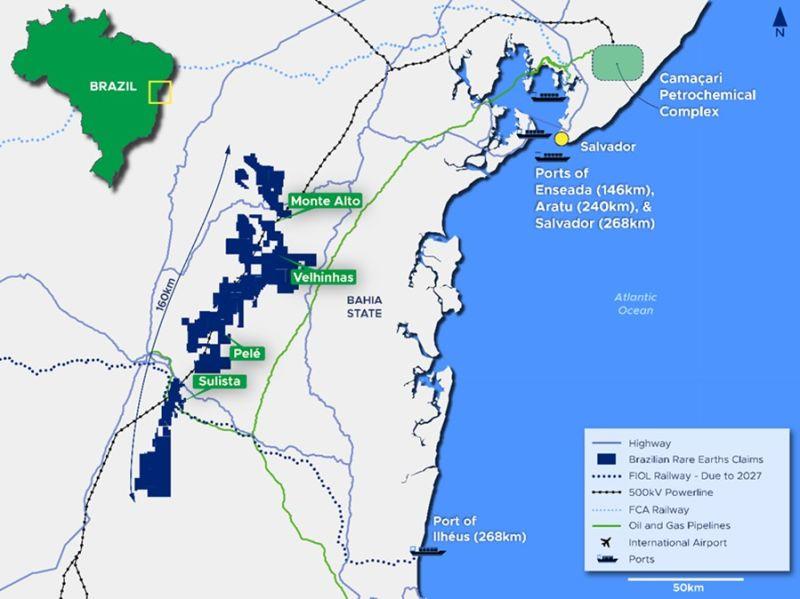
According to the company’s press release (opens in a new tab), BRE’s extended drilling at Monte Alto returned total rare earth oxide (TREO) grades up to 35.3%, with long intercepts including 28 meters at 19.4% TREO and 24 meters at 17.4% TREO. The company reports cumulative central thicknesses of up to 43 meters and a strike extension of 300 meters, bringing the total known length to at least 1.2 kilometers.
Grade Matters — And These Grades Are Unusually High
From a rare earth supply chain perspective, grades above 15% TREO are rare globally. Most Western hard-rock deposits operate below 10% TREO. Ionic clay deposits in southern China are typically much lower in grade but easier to process.
BRE also reports:
- PrNd oxide up to 5.96%
- Dy-Tboxide up to 0.305%
- Niobium oxide up to 1.7%
- Uranium oxide up to 0.4047%
If accurate, the dysprosium-terbium numbers are strategically significant. Heavy rare earth supply outside China remains structurally tight.
What’s Substantiated — And What’s Aspirational
The drilling data appear consistent with a high-grade mineralized system. However:
- These are drill intercepts, not a compliant resource update.
- The deposit’s eastern and deeper extents remain undefined.
- Metallurgical recovery claims (97% TREO recovery, 83–87% heavy rare earth recovery) require independent validation at scale.
- Uranium co-production adds complexity to permitting and downstream processing. Brazil’s potential for a cumbersome regulatory process is well known.
The language describing the project as “one of the world’s most important rare earth discoveries” is promotional and premature. Not bad in and of itself, but investors must understand the stage the company is in the maturity curve.
Why REEx Investors Should Watch This
If Monte Alto proves scalable andmetallurgically viable, it could:
- Strengthen Brazil’s role in the non-China rare earth supply.
- Provide potential heavy rare earth diversification.
- Introduce a polymetallic model combining REEs, niobium, scandium, and uranium.
But scale, capital intensity, environmental permitting, and downstream separation remain unanswered.
High grade alone does not build a supply chain. Processing capacity does. On that note, to BRE’s credit, they inked a deal with France-based Carester, arguably some of the most sophisticated experts in rare earth processing outside of China.
But at least for now, Monte Alto is promising — though it remains an early-stage company.


0 Comments
No replies yet
Loading new replies...
Moderator
Join the full discussion at the Rare Earth Exchanges Forum →