
Highlights
- Xi Jinping reaffirmed Xiong'an New Area as China's flagship development project, positioning it as an innovation hub and primary destination for relocating Beijing's non-capital functions, including major SOEs, universities, and hospitals.
- China is advancing a state-directed industrial strategy in Xiong'an by integrating technology and manufacturing, developing innovation clusters, and piloting policy reforms to accelerate research-to-commercialization pathways.
- While Xiong'an demonstrates coordinated execution at scale, structural risks include potential capital misallocation, forced institutional relocation, efficiency concerns, and the challenge of commanding innovation in administratively designed clusters rather than organic market-driven ecosystems.
Chinese President Xi Jinping visited Xiong’an New Area and reaffirmed its role as a flagship national development project—positioning it as a future innovation hub, industrial cluster, and primary destination for relocating Beijing’s non-capital functions. The message is clear: China is accelerating the buildout of a next-generation economic zone designed to integrate technology, industry, and governance.
From Vision to Execution: Xiong’an Advances
During a high-level inspection and policy meeting, Xi emphasized that Xiong’an must:
- Serve as a concentrated receiver of Beijing’s non-capital functions
- Become a center for innovation
- Act as a model for high-quality development
Progress cited in the visit includes:
- Relocation of major state-owned enterprise functions, including China Huaneng Group (with over 1,000 staff moved)
- Continued buildout of core development zones and infrastructure
- Expansion of public services such as education and urban amenities
Translation: Xiong’an is transitioning from long-term vision to phased, state-driven execution.
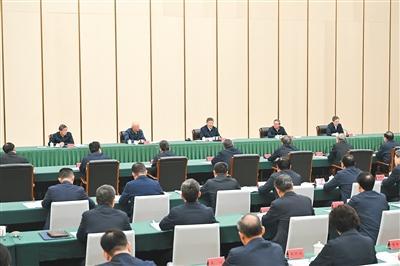
On March 23, Xi Jinping—General Secretary of the Communist Party of China Central Committee, President of the People’s Republic of China, and Chairman of the Central Military Commission—conducted an inspection tour of the Xiong’an New Area in Hebei Province and presided over a symposium on advancing its high-quality development.
Industrial Strategy: Integration Over Fragmentation
Xi’s remarks highlight a familiar but intensifying strategy:
- Integration of technology and industry
- Development of “new productive forces” (advanced manufacturing, emerging sectors)
- Formation of industrial and innovation clusters
- Promotion of commercialization through platforms like Xiong’an Zhongguancun Science Park
China also signaled continued efforts to:
- Pilot policy innovation in finance and technology
- Improve the business environment (market-oriented, rules-based, internationally aligned—per official framing)
This positions Xiong’an as a policy and industrial testing ground, not just a city.
The Structural Shift: Moving the Center of Gravity
A central pillar remains the orderly relocation of institutions from Beijing, including:
- State-owned enterprises
- Universities and hospitals
- Financial and research institutions
This is not decentralization—it is state-directed redistribution of economic function and capacity.
Why This Matters for the U.S. and the West
Xiong’an reflects a broader strategic pattern:
1. Coordinated Industrial Clustering
China is aligning infrastructure, talent, capital, and policy within a single geography.
2. Policy-Enabled Innovation Cycles
Co-location of institutions may accelerate research-to-commercialization pathways, though outcomes remain to be proven.
3. Execution vs. Debate
While Western economies continue to shape industrial policy frameworks, China is implementing large-scale, place-based development strategies.
Bottom Line: Ambition Meets Execution Risk
Xiong’an represents China’s attempt to build a future-oriented urban and industrial system. Not just infrastructure—but a coordinated platform for innovation, governance, and economic restructuring.
However, it remains a long-term project, dependent on sustained policy support, successful relocation, and real economic activity following infrastructure buildout.
Another POV
While Xiong’an reflects an ambitious, highly coordinated model of state-led development, the same features that give it strength may also introduce structural risks. Centralized planning and top-down relocation can accelerate buildout, but they may also misallocate capital if demand fails to materialize organically, leading to underutilized infrastructure or “policy-driven” rather than market-driven growth. The forced or incentivized movement of enterprises, universities, and talent raises questions about efficiency and productivity, particularly if institutions perform better within existing ecosystems like Beijing.
Innovation itself is difficult to command—true breakthroughs often emerge from decentralized, competitive environments rather than from administratively designed clusters. There is also the risk of financial strain, as large-scale infrastructure and industrial investment require sustained funding, potentially compounding debt or fiscal pressure if returns lag. Finally, governance integration—while efficient—may limit flexibility, transparency, and private-sector dynamism, which are critical to long-term innovation. In dialectical terms, Xiong’an’s greatest strength—state coordination at scale—may also be its core vulnerability if execution fails to align with real economic activity.
Disclaimer: This report is based on Chinese state-affiliated media (People’s Daily and official government sources). While consistent with publicly stated policy direction, readers should independently verify key claims and interpret statements within the context of official state messaging.


0 Comments
No replies yet
Loading new replies...
Moderator
Join the full discussion at the Rare Earth Exchanges Forum →