
Highlights
- China Minmetals is extending beyond traditional mining, functioning as a vertically integrated arm of national policy.
- The company has end-to-end control over exploration, processing, logistics, and finance within China's critical metals system.
- Minmetals has strategic partnerships with the Bank of China and regional governments.
- These partnerships allow Minmetals to leverage state-backed capital and deploy faster than private competitors.
- The company embeds itself into technology standards and engineering processes where Western supply chains are weak.
- Minmetals has over 200,000 employees and generates $100-120 billion in annual revenue.
- It operates more than 800 subsidiaries across 60 countries.
- Minmetals represents a state-aligned industrial system competing on institutional coordination rather than market-driven metrics alone.
A State Miner Moves Like a System
In late November, China Minmetals (opens in a new tab)—the country’s largest state-backed metals conglomerate—was not announcing discoveries or quarterly earnings. Instead, it was doing something more consequential: tightening institutional, financial, and regional control across China’s critical metals system. A series of meetings across Guangxi, Chongqing, Beijing, and Hechi reveals a company operating less like a miner and more like a vertically integrated arm of national industrial policy.
This is not noise. It is architecture.
Table of Contents
State-owned resource extraction and refining capital meets state-owned finance capital
From Ore to Order: The Regional Lock-In
Talks with Guangxi’s vice governor and Hechi’s municipal leadership underscore Minmetals’ strategic focus on key metals clusters, particularly the Nandan Key Metals High-Quality Development Comprehensive Pilot Zone. Guangxi is already one of China’s most important non-ferrous regions. What Minmetals brings is not just capital, but end-to-end control—exploration, processing, logistics, storage, and financing—aligned explicitly with the 15th Five-Year Plan.
The language is familiar, but the scale is not. These are not local partnerships of convenience; they are long-horizon commitments that bind provincial development goals to a central SOE with national security mandates.
Engineering the Next Chokepoint
Zhu Kebing’s inspection of CISDI in Chongqing points to where Minmetals is placing its real bets: advanced materials, core equipment, and process control. By accelerating pilot lines and industrializing new materials, Minmetals is aiming upstream of finished products and downstream of raw ore—precisely where Western supply chains remain weakest.
The emphasis on digital integration, system-level solutions, and self-sufficiency in core technologies is not aspirational rhetoric. It reflects a clear lesson Beijing has internalized: dominance is secured not by mines alone, but by engineering standards, equipment IP, and scalable processes.
Finance as Force Multiplier
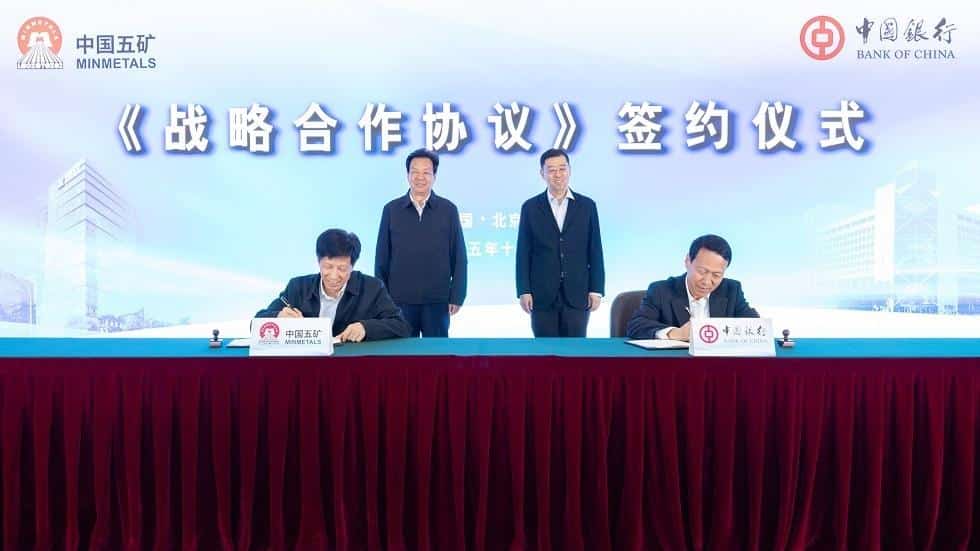
The strategic cooperation agreement with Bank of China completes the picture. Access to project finance, bond issuance, global cash management, and M&A funding ensures Minmetals can move faster—and with less friction—than private competitors. This is state–bank–enterprise coordination, formalized.
For investors outside China, this matters. Minmetals’ cost of capital, risk tolerance, and time horizon are structurally different from market-driven peers. Comparing it to Western miners on conventional metrics misses the point.
Discipline, Not Just Expansion
The November financial performance review adds another layer: internal discipline. The focus on “rectification,” financial supervision, and curbing superficial performance signals suggests Beijing is tightening controls even as it expands ambition. This is not reckless growth. It is managed consolidation.
Why This Matters Globally
What’s notable is not any single announcement—it’s the pattern. China Minmetals is embedding itself deeper into regions, technologies, and financial systems that define future critical metals supply. For the global rare earth and critical minerals market, this reinforces a hard truth: China’s advantage is systemic, not accidental.
Breaking that advantage will require more than new mines. It will require competing systems.
China Minmetals: An Industrial Colossus Behind Beijing’s Metals Strategy
China Minmetals Corporation is one of the largest and most powerful mining and metals conglomerates in the world. It is a centrally administered state-owned enterprise (SOE) directly supervised by China’s State-owned Assets Supervision and Administration Commission (SASAC). Unlike listed miners that answer to shareholders, Minmetals answers first to the Chinese state.
By scale alone, it sits in a different category than most Western peers.
Size, Scope, and Reach
China Minmetals employs roughly 200,000–220,000 people worldwide and generates annual revenues exceeding US$100–120 billion, depending on metal prices and trading activity. It consistently ranks among the Fortune Global 500, typically within the top 70–100 companies globally.
Its operations span more than 60 countries, with assets across China, Africa, South America, Australia, Europe, and Southeast Asia. Minmetals is not just a miner—it is vertically integrated across exploration, mining, smelting, processing, materials engineering, trading, logistics, and finance.
How Many Companies Sit Under Minmetals?
The group controls a vast corporate ecosystem, not a simple subsidiary tree.
At the top level, China Minmetals directly manages around 20–25 major subsidiary groups, which themselves control hundreds of operating companies. Conservative estimates put the total number of consolidated subsidiaries and controlled entities at over 800, with dozens publicly listed in China, Hong Kong, Australia, and other markets.
Key flagship subsidiaries include:
- China Minmetals Non-Ferrous Metals Co.
- Minmetals Resources (MMG) – listed in Hong Kong, major global copper and base metals producer
- China Metallurgical Group Corporation (MCC) – a massive engineering, construction, and metallurgical services arm (merged into Minmetals in 2015)
- Minmetals Development Co.
- CISDI Group – advanced materials and industrial systems engineering
- Multiple regional mining, smelting, rare metals, and materials technology companies
This structure allows Minmetals to operate simultaneously as resource owner, process designer, equipment provider, EPC contractor, trader, and financier.
Strategic Metals, Not Just Volume
Minmetals’ portfolio includes copper, aluminum, zinc, lead, tungsten, antimony, lithium, rare earth–adjacent materials, and specialty alloys, with increasing emphasis on critical and strategic metals tied to energy transition, defense, and advanced manufacturing.
Crucially, Minmetals’ power does not come from mining volume alone. It comes from system control—engineering standards, processing know-how, logistics, financing, and state coordination embedded in Five-Year Plans.
Why Minmetals Matters
For rare earth and critical minerals markets, China Minmetals represents a reality Western investors often underestimate: China’s advantage is institutional and integrated, not merely geological. Competing with Minmetals means competing with a state-aligned industrial system, not just a mining company.
© 2025 Rare Earth Exchanges™ – Accelerating Transparency, Accuracy, and Insight Across the Rare Earth & Critical Minerals Supply Chain.


0 Comments