
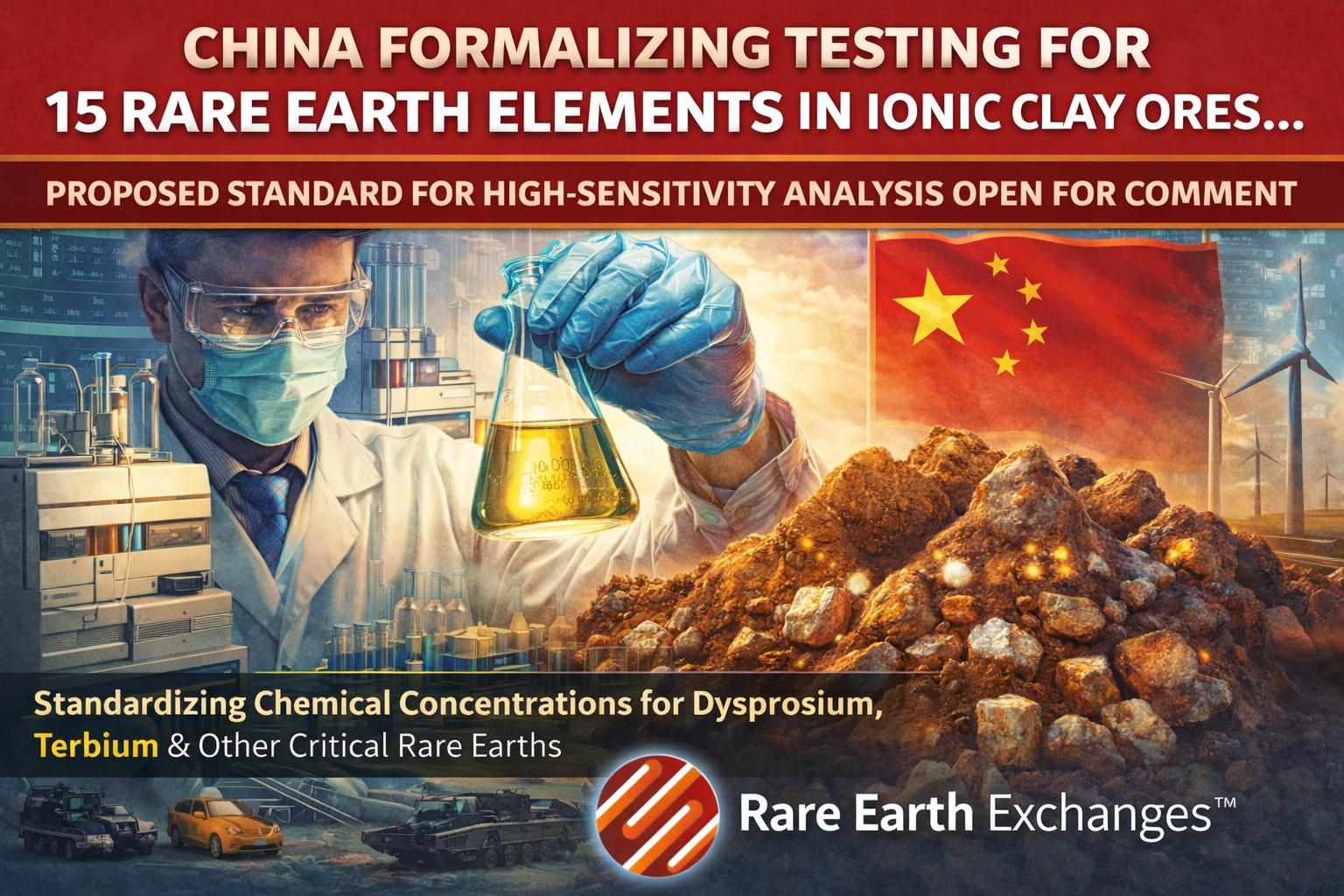
- China's Rare Earth Society is standardizing how 15 rare earth elements are measured in ionic clay leach solutions—the primary global source of heavy rare earths like dysprosium and terbium critical for EVs, wind turbines, and defense systems.
- The formalized HPLC testing protocol strengthens China's institutional control over ore verification, export documentation, environmental compliance, and pricing—adding another layer of technical governance beyond existing production quotas and export reviews.
- Western and non-Chinese ionic clay developers may need to align with Chinese analytical benchmarks to access global separation markets, as procedural standards increasingly define quality, compliance, and market access in rare earth trade.
On February 27, 2026, the Chinese Rare Earth Society (CRES) released a formal notice soliciting public comment on a proposed industry group standard titled: “Determination of 15 Rare Earth Elements Including Lanthanum and Cerium in Ionic Rare Earth Leach Solutions — Post-Column Derivatization High-Performance Liquid Chromatography (HPLC) Method.”
The draft was jointly prepared by the Chinese Academy of Sciences’ Ganjiang Innovation Research Institute and the Lanzhou Institute of Chemical Physics, among others. Public comments are due by March 27, 2026. If adopted, the document would become an official “group standard” governing analytical testing protocols.
In straightforward terms: China is formalizing the measurement of 15 rare earth elements in ionic clay leach solutions—the core feedstock for global heavy rare earth supply.
Why This Is Business-Relevant
Ionic clay deposits—concentrated in southern China and extending through Myanmar and into parts of Brazil and Africa—are the world’s primary source of heavy rare-earth elements such as dysprosium and terbium. These elements are indispensable for high-performance permanent magnets used in EV motors, wind turbines, robotics, aerospace systems, and advanced defense platforms.
This proposal does not introduce a new mining method. It standardizes measurement.
By codifying a unified post-column derivatization HPLC protocol, China is tightening quality control and analytical consistency in ionic clay production. That matters because measurement governs:
- Ore grade verification
- Environmental compliance monitoring
- Export documentation
- Downstream pricing negotiations
- Taxation and quota enforcement
Standards may appear technical, but they shape markets.
The Technical Angle
Post-column derivatization HPLC is a sensitive analytical technique capable of separating and quantifyingmultiple rare earth elements in complex solution matrices. Standardizing this method allows simultaneous, reproducible quantification of lanthanum, cerium, and 13 additional rare earths in leach solutions.
For China’s ionic clay operations—where in-situ leaching dominates—precise control of solution chemistry is critical. A formalized testing standard improves regulatory oversight and potentially strengthens Beijing’s ability to manage production data, enforce compliance, and harmonize export-grade specifications.
Strategic Implications for the West
This is not a breakthrough in extraction chemistry. It is a consolidation of institutional control.
China has already centralized mining quotas, consolidated producers into the “Big Six,” and tightened export review mechanisms. Formalizing analytical standards adds another layer of technical governance across the value chain.
For Western, Brazilian, or African developers attempting to build non-Chinese ionic clay supply chains, alignment with Chinese testing benchmarks could become commercially necessary—particularly when selling into global separation markets accustomed to Chinese specifications.
Standards often determine who speaks the “language” of trade.
Bottom Line
This announcement signals procedural discipline, not technological disruption. But in rare earths, procedural control is strategic power. Measurement is not neutral. It defines quality, compliance, and ultimately market access.
Disclaimer: This report is based on a public notice issued by the Chinese Rare Earth Society, an industry body operating within China’s state-affiliated framework. The information should be independently verified before being relied upon for investment, policy, or commercial decisions.


0 Comments
No replies yet
Loading new replies...
Moderator
Join the full discussion at the Rare Earth Exchanges Forum →