
Highlights
- China's Rare Earth Price Index reached 295.4 on March 6, 2026—nearly triple the 2010 baseline—driven by demand from EVs, wind turbines, and defense tech.
- Heavy rare earth prices diverged: dysprosium and terbium declined while holmium, ytterbium, and NdPr oxide rose, signaling fragmented supply dynamics.
- NdPr metal remained stable at ¥1,030-1,050/kg despite oxide price increases, reflecting tight supply conditions but steady downstream conversion pricing.
China’s Rare Earth Price Index rose to 295.4 on March 6, 2026, according to the China Rare Earth Industry Association (CREIA), signaling continued strength in the broader rare earth market even as price movements diverge across individual elements.

The index—calculated using daily transaction data reported by Chinese rare earth enterprises—uses 2010 as its base year (index = 100). The latest reading places the market at nearly three times the 2010 baseline, reflecting the structural growth of rare earth demand tied to electric vehicles, wind turbines, electronics, and defense technologies.
Price trends over the past year, shown in CREIA’s index chart, reveal steady upward momentum beginning in mid-2025, accelerating into early 2026.
Diverging Trends Across the Magnet Metals
Despite the rising headline index, prices across the rare earth basket reveal mixed market signals.
Several heavy rare-earth magnet stabilizers weakened slightly:
- Dysprosium oxide: ¥6,270–6,330/kg (down)
- Dysprosium metal: ¥7,850–7,950/kg (down)
- Terbium oxide: ¥1,480–1,520/kg (down)
- Terbium metal: ¥1,890–1,910/kg (down)
At the same time, selective strength appeared in other materials:
- Holmium oxide: ¥546–566/kg (up)
- Ytterbium oxide: ¥71.5–75.5/kg (up)
- NdPr oxide: ¥837.5–857.5/kg (up)
Notably,NdPr metal—the primary feedstock for permanent magnetproduction—remains stable at ¥1,030–1,050/kg, suggesting tight oxide supply but stable downstream conversion pricing.
What the Market Signals
The data highlights a fragmented rare earth market, where individual elements respond differently to industrial demand, export licensing conditions, and inventory levels.
Heavy rare earth elements such as dysprosium and terbium, essential for improving magnet heat resistance in electric vehicles and defense systems, are experiencing modest short-term price declines.
Meanwhile, niche heavy elements and key oxide feedstocks show signs of tightening supply.
For investors and industrial buyers, the takeaway is clear: the rising Rare Earth Price Index masks significant divergence across the element basket, reflecting the complex supply dynamics of the global magnet materials market.
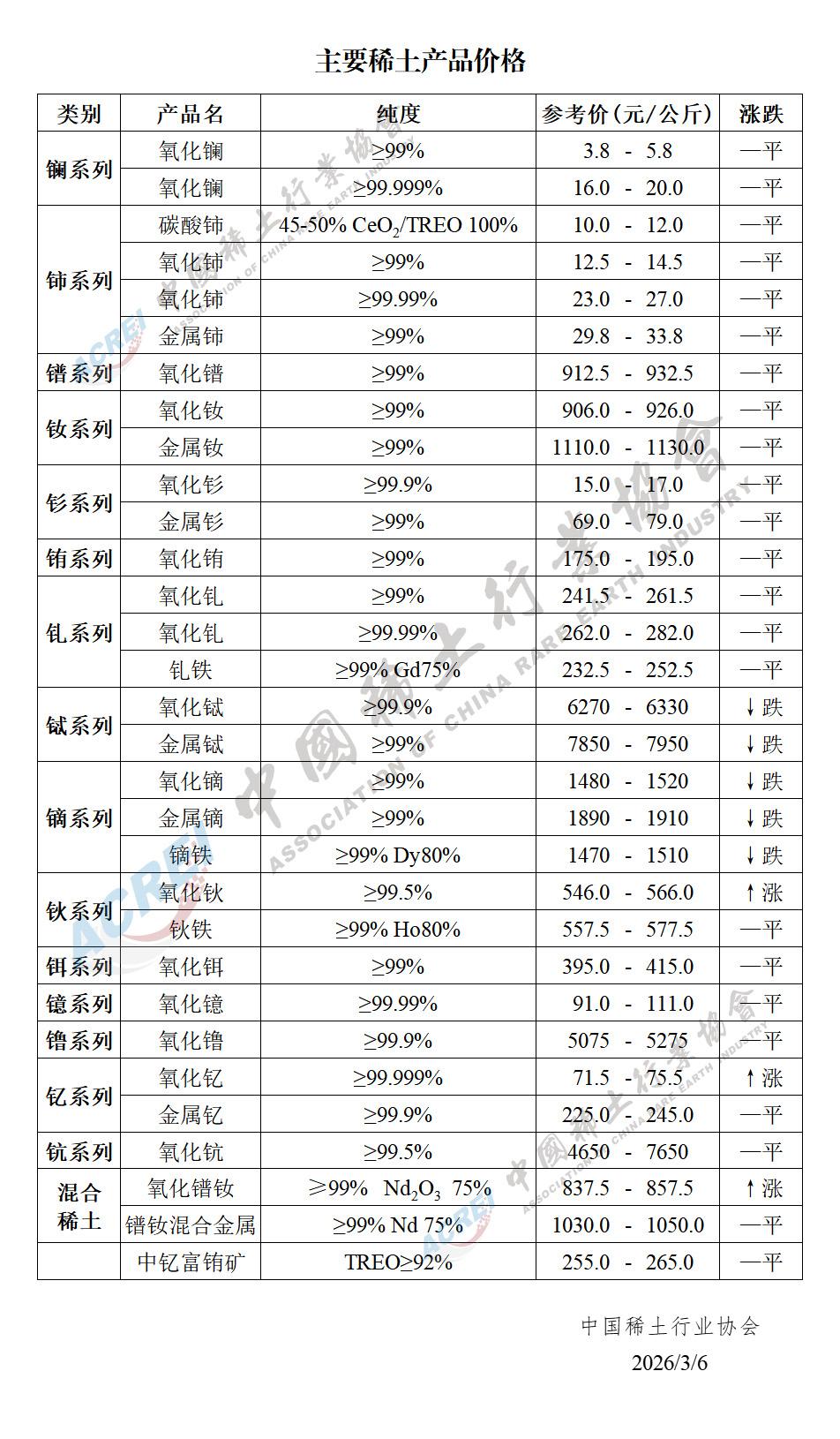
Source: China Rare Earth Industry Association (CREIA), March 6, 2026.
Disclaimer: CREIA states that these price figures are collected from industry enterprises for reference purposes only and do not constitute investment advice.


0 Comments
No replies yet
Loading new replies...
Moderator
Join the full discussion at the Rare Earth Exchanges Forum →