
Highlights
- China's rare earth price index stands at 256.3 (March 2026), down from an early-2026 peak above 300 but still structurally elevated, with NdPr magnet inputs holding firm while heavy rare earths weaken across the board.
- Despite Western industrial policy efforts, China retains global pricing power by controlling 90%+ of NdFeB magnet production and the majority of separation, refining, and midstream capacity.
- Chinese rare earth pricing operates within a state-shaped system with production quotas, dual pricing structures, and policy-driven movements—making it directionally important but not fully transparent or market-based.
China’s rare earth price index registered 256.3 on March 25, 2026, according to the China Rare Earth Industry Association. The index uses 2010 transaction data as a base (100) and aggregates current domestic trading activity. The trendline shows a recent pullback from an early-2026 peak above ~300, but prices remain structurally elevated versus 2024–2025 levels. In plain terms: the market hassoftened—but it is still tight.
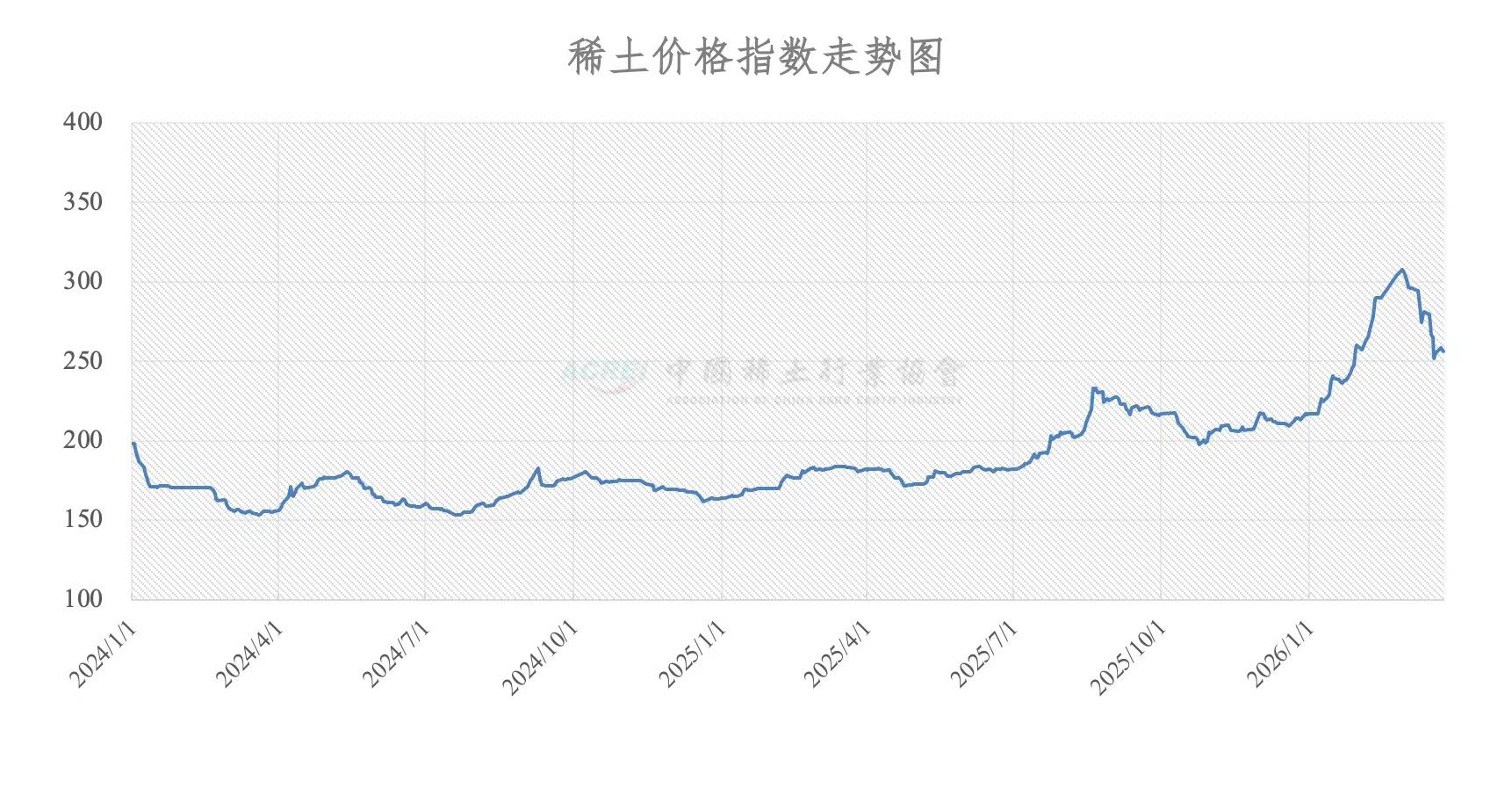
Reading the Tape: Stability Up Front, Weakness in the Back End
The accompanying pricing sheet confirms a largely stable NdPr complex, with softness concentrated in heavier elements.
Key verified figures:
- Praseodymium oxide: 393–413 yuan/kg (flat)
- Neodymium oxide: 5,075–5,275 yuan/kg (corrected; earlier draft understated by factor of 10)
- NdPr oxide (75% TREO): 702.5–722.5 yuan/kg (flat)
- NdPr metal: 875–895 yuan/kg (flat)
Across the board, heavy rare earths are weakening, with declines noted in:
- Dysprosium oxide
- Terbium oxide
- Gadolinium, holmium, erbium, and lutetium oxides
Translation: magnet inputs (NdPr) are holding firm; high-value heavy elements are under pressure—a divergence worth watching.
Does China Still Price the World
This matters because China remains the reference market for global rare earth pricing.
Despite Western industrial policy momentum, China still controls:
- The majority of the separation and refining capacity
- The overwhelming share of NdFeB magnet production (~90%+)
- Critical steps in metal, alloy, and magnet fabrication
Mines can be built outside Chin
Pricing power still lives inside China’s midstream and downstream.
NdPr oxide pricing out of China continues to function as the global benchmark, regardless of where the feedstock originates.
But this is changing with nascent industrial policy in the West. Examples include NdPr price floors between the U.S. Department of War and MP Materials (and equity) as well as other emerging deals.
The Bottom Line: A Softer Market, Not a Weaker System
Does the pricing in China evidence any material signals?
Prices are easing at the margin, particularly in heavy rare earths. But the structure of the market has not changed. Of course, in the West, heavy rare earths are becoming scarcer, meaning prices may go up.
Bottom line for investors:
Ultimately, in the world of the rare earth supply chain, does China still set the price, in part because it still controls the system? Until the West builds true midstream depth and magnet scale, pricing power will remain anchored in China.
Note on Prices in China
Chinese rare earth pricing is useful—but not fully reliable as a transparent, market-based signal. The sector operates within a state-shaped system, where production quotas, state-backed consolidation, and export controls influence supply as much as underlying demand. Pricing data itself lacks full transparency, typically derived from selected domestic transactions, industry surveys, and non-public contracts, meaning investors see only a partial view rather than a complete, volume-weighted global market.
Compounding this, China often maintains a dual pricing structure, where domestic prices (commonly reported) can diverge from export prices or strategically adjusted deals, creating distortions for international buyers. Price movements are also frequently policy-driven rather than purely market-driven, reacting to export restrictions, environmental enforcement, or geopolitical signaling. Additionally, because much of the data is released through state-affiliated channels, there are inherent incentives to stabilize perception or project control, which may smooth or shape reported trends. The result is a pricing system that is directionally important and globally influential—but not fully transparent or neutral. For investors, Chinese pricing should be treated as a reference signal, not a definitive reflection of true market dynamics.
Disclaimer: This report is based on pricing data published by a Chinese state-affiliated industry association. Figures should be independently verified and are not investment advice.


0 Comments
No replies yet
Loading new replies...
Moderator
Join the full discussion at the Rare Earth Exchanges Forum →