
Highlights
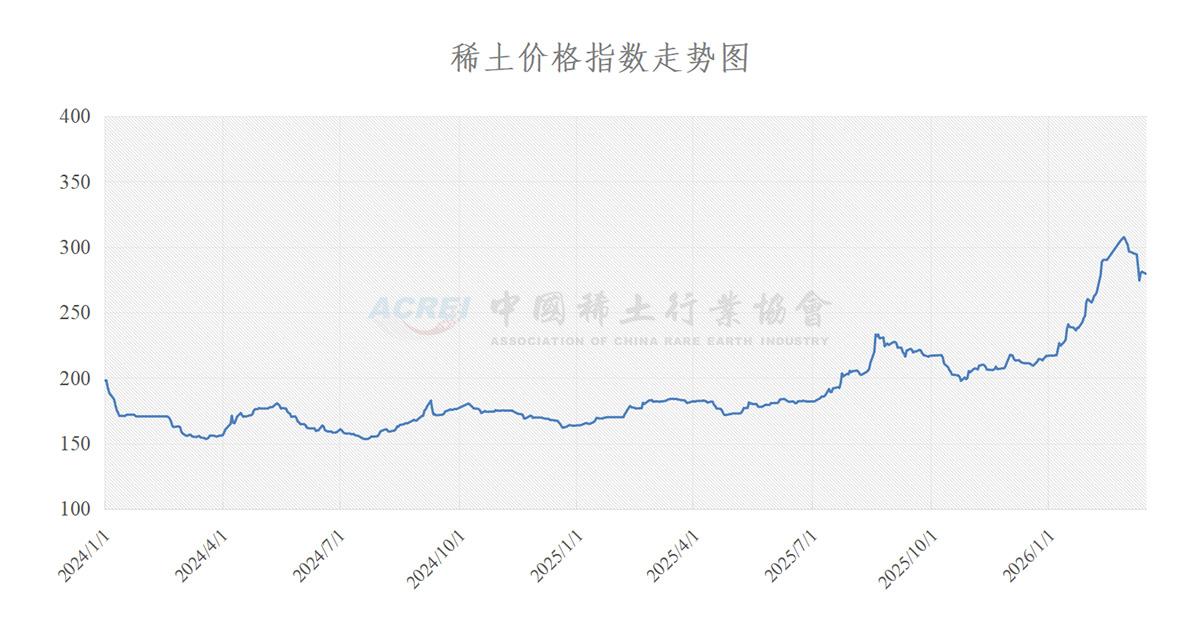
- China's Rare Earth Price Index registered 279.6 on March 16, 2026, remaining 2.8 times the 2010 baseline despite easing from recent highs above 300.
- Magnet-critical materials showed selective declines: dysprosium oxide dropped to $204-$210/kg, NdPr oxide fell to $113-$116/kg, while cerium carbonate gained.
- Pricing differentiation in China's rare earth market may modestly relieve cost pressure for Western EV, wind turbine, and defense manufacturers dependent on NdPr and dysprosium.
China’s Rare Earth Price Index came in at 279.6 on March 16, 2026, according to the China Rare Earth Industry Association. In plain English, that means China’s domestic rare earth price basket remains about 2.8 times the 2010 base level of 100. Based on the chart, the index appears to have eased from a recent high slightly above 300, though it remains historically elevated.
What Actually Moved
This was not a broad-based rally. It was a selective market.
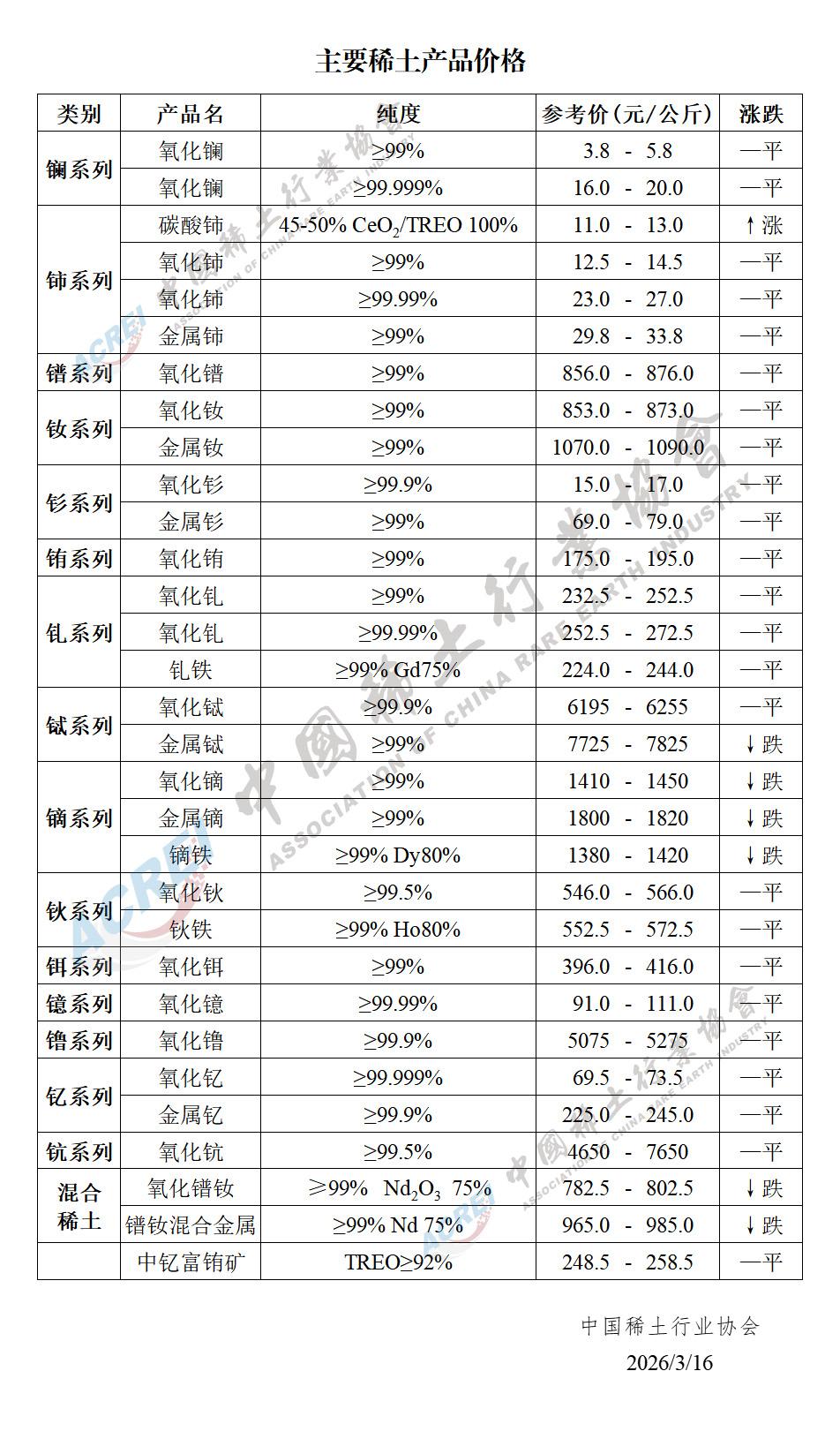
The clearest gain was cerium carbonate, quoted at 11.0–13.0 yuan/kg (about $1.59–$1.88/kg), and marked up. Most other products were listed as flat, including lanthanum oxide at 3.8–5.8 yuan/kg, cerium oxide at 12.5–14.5 yuan/kg, gadolinium oxide at 232.5–252.5 yuan/kg (about $33.69–$36.59/kg), holmium oxide at 546.0–566.0 yuan/kg, erbium oxide at 856.0–876.0 yuan/kg, and yttrium oxide at 853.0–873.0 yuan/kg.
Heavy Rare Earths Slip Where It Counts
The more important move for Western industry showed up in magnet-related materials. Dysprosium oxide was quoted at 1,410–1,450 yuan/kg (about $204–$210/kg), dysprosium metal at 1,800–1,820 yuan/kg (about $261–$264/kg), and ferrodysprosium at 1,380–1,420 yuan/kg (about $200–$206/kg), all marked down. The mixed rare earth products NdPr oxide at 782.5–802.5 yuan/kg (about $113–$116/kg) and NdPr alloy metal at 965.0–985.0 yuan/kg (about $140–$143/kg) were also marked down.
Why This Matters in the U.S.
There is no breakthrough or policy bombshell here. The real news is subtler: China’s rare earth complex remains expensive overall, but pricing is becoming more differentiated. For U.S. and European buyers, that matters because NdPr and dysprosium sit at the core of high-performance permanent magnets used in EVs, wind turbines, robotics, and defense systems. A pullback in those inputs may modestly relieve downstream cost pressure, but the broader index still signals that China retains powerful influence over pricing across the mine-to-magnet chain.
Disclaimer: This item is based on pricing published by the China Rare Earth Industry Association, an industry body operating within China’s state-directed system. It should be treated as reference material only and verified independently before being used for investment, procurement, or policy decisions.


0 Comments
No replies yet
Loading new replies...
Moderator
Join the full discussion at the Rare Earth Exchanges Forum →