
Highlights
- China's Rare Earth Price Index fell 3.1% to 285.2 on March 10, with heavy rare earths like dysprosium and terbium leading the decline while light rare earths remained stable.
- Strategically critical magnet materials—dysprosium oxide, terbium oxide, and NdPr—all posted price drops, though the market remains well above long-term baseline levels.
- The price softening reflects potential demand cooling or supply rebalancing in China's dominant rare earth market, which remains the global pricing reference point for Western manufacturers and defense planners.
Beijing’s latest pricing data (opens in a new tab) hints at a softer market—but not a weaker strategic position. A review of the latest data points out that China’s rare earth market posted a noticeable one-day pullback on March 10, with the China Rare Earth Price Index falling to 285.2 from 294.3 on March 9, according to data published by the Association of China Rare Earth Industry. That is a drop of roughly 3.1% in a single day.
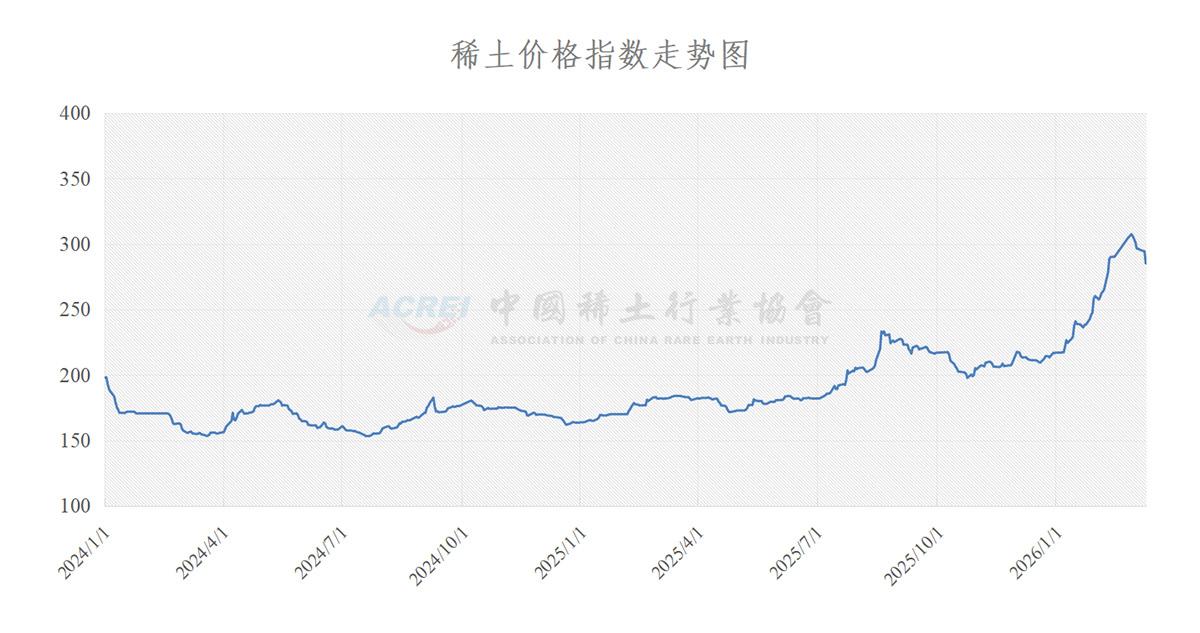
The index is calculated from daily transaction data collected from domestic rare earth enterprises, using 2010 as the base year at 100. In plain English, the market remains well above its long-term baseline even after the decline. The message is not collapse. It is moderation.
Heavy Rare Earths Lead the Move Lower
The sharper signal came from individual product prices, where several higher-value rare earth products moved down.
Among the notable March 10 reference prices:
- Terbium oxide: 6,245–6,305 yuan/kg, down
- Dysprosium oxide: 1,460–1,500 yuan/kg, down
- Dysprosium metal: 1,865–1,885 yuan/kg, down
- Dysprosium-iron alloy: 1,440–1,480 yuan/kg, down
- Gadolinium oxide: 236–256 yuan/kg, down
- Gadolinium-iron alloy: 227–247 yuan/kg, down
- Holmium oxide: 546–566 yuan/kg, unchanged
- Holmium-iron alloy: 552.5–572.5 yuan/kg, unchanged
For Western readers, the key takeaway is that dysprosium and terbium—two of the most strategically important magnet inputs—both weakened on the day. These materials help permanent magnets retain performance under high heat, making them critical for EV drivetrains, wind turbines, robotics, and defense systems.
NdPr Holds Up Better Than the Heavies
The benchmark mixed rare earth product for magnet markets, NdPr oxide, was quoted at 800–820 yuan/kg, down, while NdPr metal was 990–1,010 yuan/kg, also down. That matters because NdPr remains the commercial backbone of the global permanent magnet business.
By contrast, lower-value light rare earths were mostly flat. Lanthanum oxide, cerium carbonate, cerium oxide, and metal cerium all showed little change. That suggests the day’s weakness was more concentrated in magnet-linked materials than across the entire rare earth complex.
Why This Matters Outside China
This update is worth watching not because it signals a breakthrough, but because it offers a real-time glimpse into China’s internal pricing power. China still dominates rare earth separation and magnet manufacturing. When prices for key heavy rare earths move lower inside China, Western developers, automakers, defense planners, and investors should ask whether demand is cooling, supply is loosening, or Beijing’s market is rebalancing ahead of another strategic move.
The broader implication is straightforward: even when prices soften, China remains the reference market the rest of the world watches.
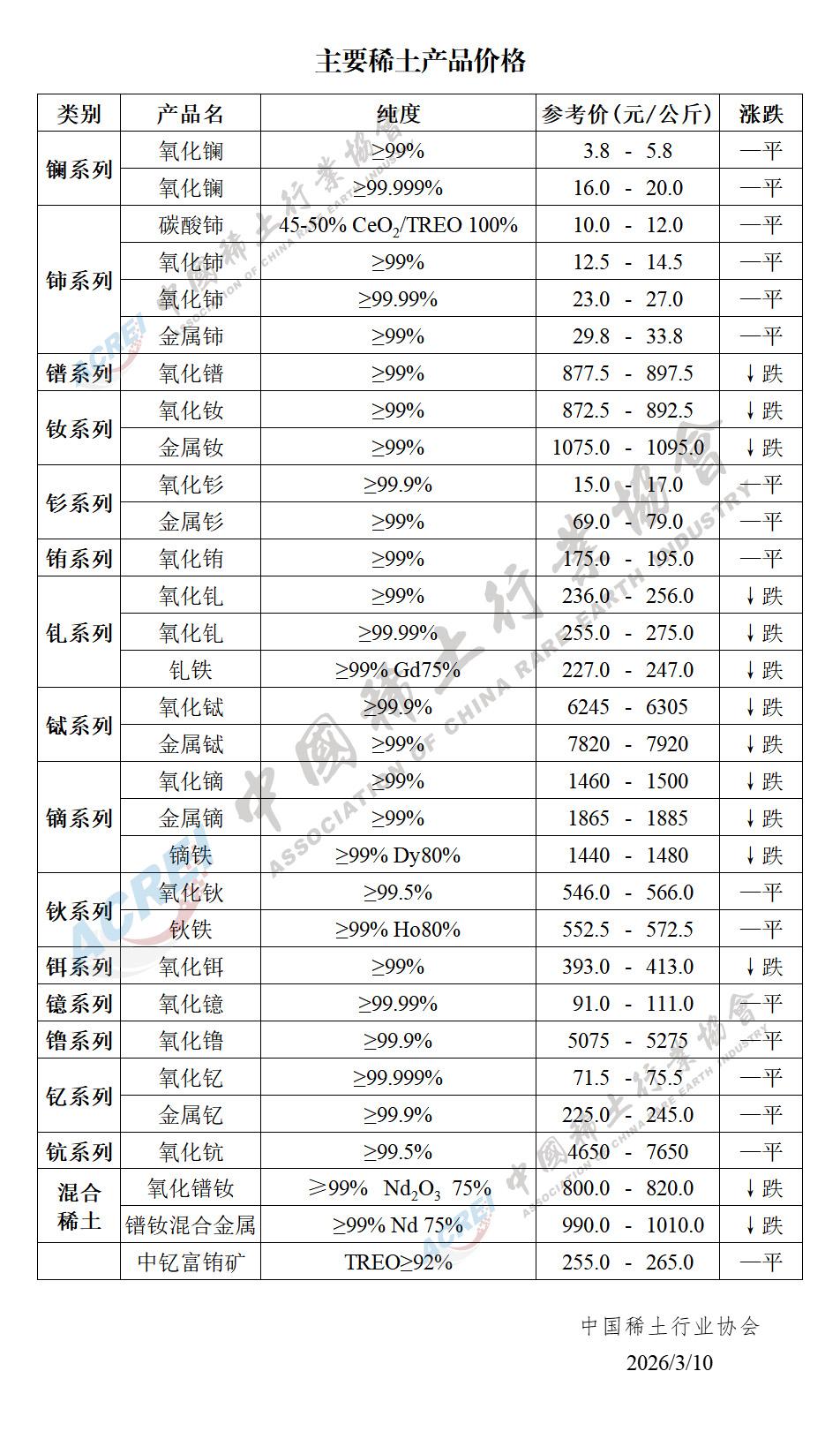
Source Note: This pricing information originates from the Association of China Rare Earth Industry, a Chinese industry body tied to the country’s state-linked rare earth ecosystem. The data is useful and market-relevant, but it should be independently verified before being used for investment or procurement decisions.


0 Comments
No replies yet
Loading new replies...
Moderator
Join the full discussion at the Rare Earth Exchanges Forum →