
Highlights
- A 2026 review by NC State researchers surveys deep eutectic solvents (DES) as potentially cleaner alternatives for biomass processing, battery recycling, and hydrometallurgy, though most applications remain at lab scale with uncertain commercial viability.
- DES show strongest promise in biorefinery applications and battery materials recovery, including cobalt, lithium, and rare earths from spent batteries and magnets, but face hurdles including high viscosity, uncertain toxicity profiles, and difficult recovery economics.
- For rare earth investors, DES represent a watch-list platform technology at TRL 3-4 rather than near-term disruption, with specialized recycling and niche applications offering more realistic opportunities than wholesale displacement of industrial separation processes.
A major 2026 review led by Karthik Ananth Mani (opens in a new tab) a postdoctoral researcher at North Carolina State University (opens in a new tab), with co-authors including Lokesh Kumar, Nelson Barrios, Hasan Jameel, Lucian Lucia, and Lokendra Pal, surveys the fast-growing science of deep eutectic solvents (DES)—customizable liquids that could eventually influence biomass processing, battery recycling, hydrometallurgy, and parts of the critical minerals supply chain. Published in Progress in Materials Science, the paper argues that DES offer a potentially cleaner alternative to many conventional solvents because they can be tuned for specific tasks, often exhibit low volatility, and may reduce reliance on harsher process chemistry. For investors, however, the real takeaway is more restrained: DES are scientifically promising, but most of the cited work remains early-stage, fragmented, and far from broad commercial adoption, especially in rare earths and critical minerals.
What This Review Actually Is
This is not a new experimental breakthrough. It is a large review article synthesizing literature from roughly 2012 to 2025, including bibliometric analysis and thematic clustering. The authors examine DES chemistry, preparation methods, recyclability, biomass pretreatment, electrochemical energy uses, hydrometallurgy, pharmaceuticals, and textile applications.
That matters for investors. Reviews are useful for mapping a field, but they do not prove commercial viability. They show where the science is moving, not whether industry has crossed the engineering and cost hurdles.
What Looks Most Promising
The strongest case in the review is in biorefinery and biomass fractionation. Many DES systems appear effective at lignin extraction,biomass delignification, and selective fractionation under milderconditions than some legacy methods. The paper also identifies interesting applications in battery materials recovery, including cobalt and lithium from spent lithium-ion batteries, and cites prior work showing DES can leach rare earths such as Nd, Dy, Pr, and Gd from NdFeB magnet materials.
That is strategically important. If DES-based leaching or separation could be industrialized, it might eventually support greener recycling flows for permanent magnets, battery metals, and selected industrial wastes.
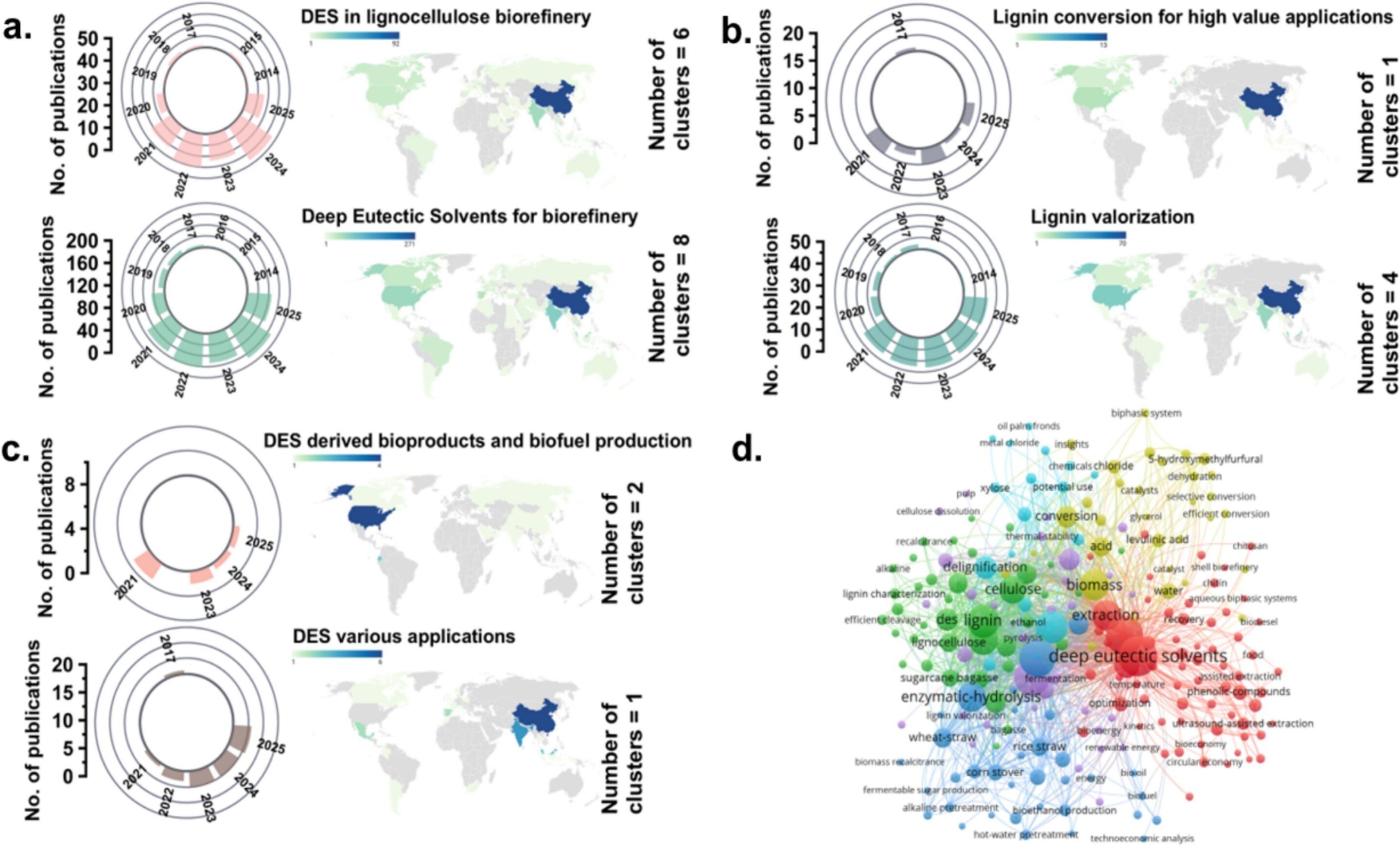
Overview of published literature on DES applications in biorefineries (2012–2025), showing publication trends (by year and country) and keyword network visualization (number of clusters included), illustrating: (a) DES in lignocellulose biorefinery and biorefinery applications. (b) Lignin conversion for high-value applications and lignin valorization. (c) DES-derived bioproducts, biofuel production, and related applications. (d) keyword network visualization of DES in biorefineries.
Where Investors Should Be Cautious
This field is not close to broad commercialization in the way solvent extraction is commercialized in rare earth separation. Most DES applications described here remain at lab scale, proof-of-concept, or limited pilot relevance. The paper itself repeatedly flags the following issues:
- uncertain toxicity and environmental profile across different DES formulations
- difficult solvent recovery and recycling economics
- high viscosity, which hurts pumping, mixing, and mass transfer
- Inconsistent reproducibility is tied to water content, purity, and preparation method
- weak thermodynamic databases and limited predictive models
- low technology readiness in many applications, explicitly around TRL 3–4 in parts of the field
For rare earth investors, that last point is critical. DES may help in leaching, recycling, or niche hydrometallurgical steps, but the review does not show that DES are ready to displace industrial-scale solvent extraction circuits for primary rare earth separation. On current evidence, they are better viewed as adjacent enabling chemistry than as a near-term replacement for the incumbent flowsheet.
Bottom Line for REEx Investors
DES is real science, not hype. The field is generating useful results across biomass valorization, battery recycling, and specialty materials recovery. But investors should separate scientific versatility from commercial readiness.
Today, DES looks more like a watch-list platform technology than an investable industrial certainty. The near-term opportunity may lie in specialized recycling, process intensification, or high-value niche applications, rather than in wholesale disruption of large-scale rare-earth separation or critical minerals refining.
Citation: Mani, K. A., Kumar, L., Barrios, N., Agate, S., Mittal, A., Yarbrough, J., Jameel, H., Lucia, L., & Pal, L. (2026). Emergence of deep eutectic solvents (DES): Chemistry, preparation, properties, and applications in biorefineries and critical materials. Progress in Materials Science, 157, 101586. https://doi.org/10.1016/j.pmatsci.2025.101586 (opens in a new tab)


0 Comments
No replies yet
Loading new replies...
Moderator
Join the full discussion at the Rare Earth Exchanges Forum →