
Highlights
- China's dominance in critical minerals stems not just from geology but from systematic exploitation of regulatory gaps, environmental externalization to Myanmar/DRC/Indonesia, smuggling networks, and WTO-ruled trade violations that concentrate value-added processing domestically.
- Documented ESG failures include child labor in DRC cobalt mines, fatal accidents at Indonesian nickel facilities, radioactive contamination risks, deforestation in Guinea's bauxite sector, and pollution displacement as China tightened domestic enforcement while sourcing from weaker-governed nations.
- The West must shift from exposure to execution: enforce due diligence standards, build in-country beneficiation capacity in resource-rich nations, deploy ESG-linked financing, and coordinate US-EU-Japan industrial policy to create transparent, compliant alternative supply chains over the next decade.
This Rare Earth Exchanges™ report confronts a difficult but unavoidable reality: China’s rise to dominance in rare earth elements and critical minerals has not been driven by geology or industrial policy alone, but by a complex system that has, at times, exploited regulatory gaps, externalized environmental and labor costs, and leveraged opaque trade practices across global supply chains. From documented environmental degradation in places like Myanmar and labor concerns in the Democratic Republic of the Congo (DRC), to persistent allegations of smuggling, corruption, and weak ESG enforcement, the evidence suggests a system that has prioritized scale and control over transparency and accountability. The purpose of this article is not merely to introduce some of these failures, but to make a broader point: the current global critical minerals system is structurally imbalanced—and unlessthe West and its allies act decisively to enforce standards, buildalternative supply chains, and partner with resource-rich nations, that imbalance will persist, with profound economic, ethical, and national security consequences.
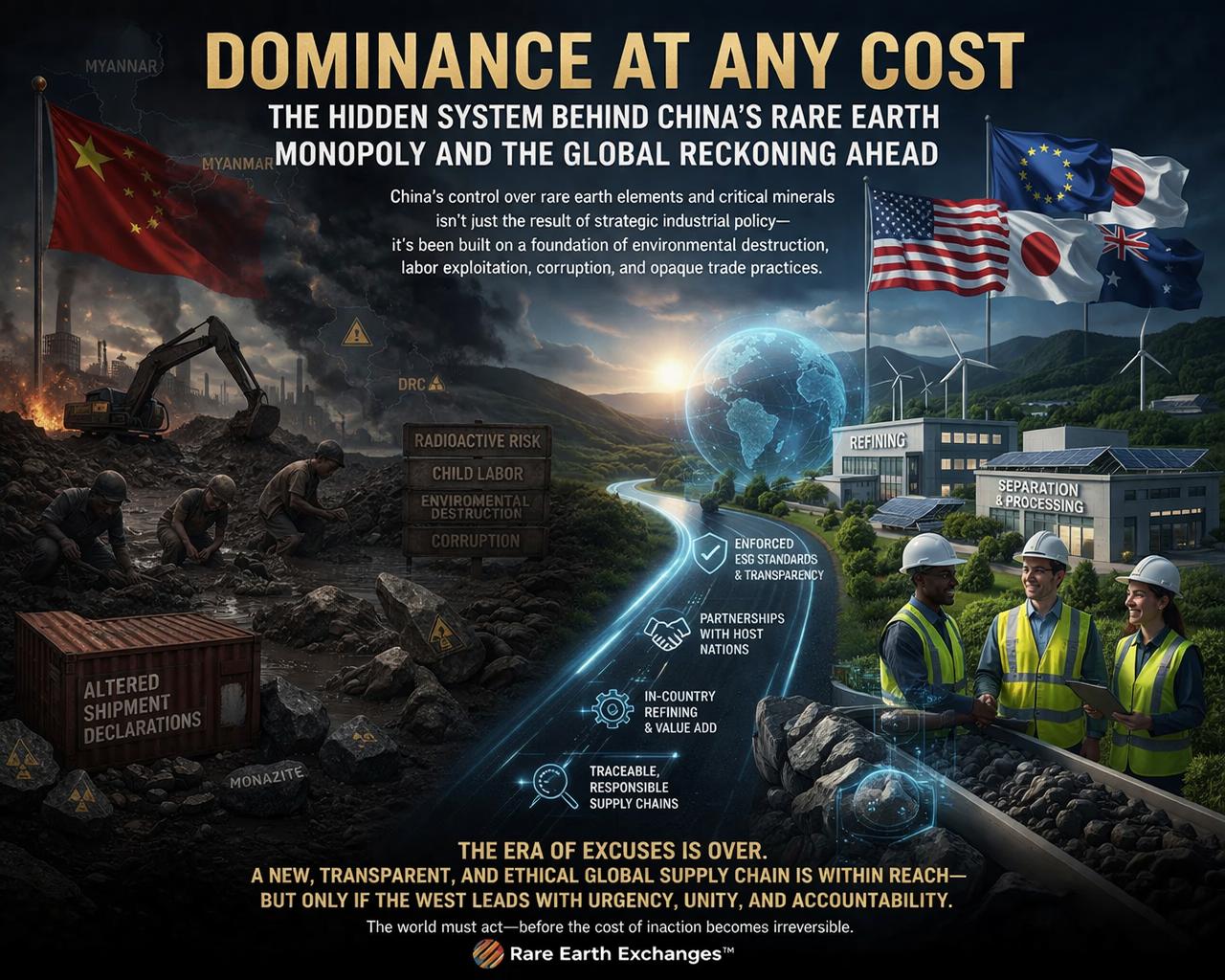
This survey covers 2010 through March 2026 and examines how China-linked rare earth and critical-mineral supply chains interact with trade rules, enforcement, and ESG outcomes. Unnamed-source claims—such as radioactive ore being routinely declared “non‑radioactive”—are treated as unverified risks unless corroborated by regulators, courts, or verifiable shipping and testing documentation.
Trade-system violations and strategic leverage
A litigated example of trade-rule breach is China’s former use of export duties, export quotas, and export licensing/trading-right restrictions on rare earths. In disputes brought by the United States, the European Union, and Japan, the World Trade Organization found key measures inconsistent with China’s WTO obligations and rejected key defenses under GATT in its 2014 Panel and Appellate Body findings (opens in a new tab).
The strategic edge is simple: upstream export restraints can bias material toward domestic processors and magnet makers, shaping where value-added supply chains concentrate. Supply concentration remains extreme; Rare Earth Exchanges has cited myriad reports, (opens in a new tab) such as from the International Energy Agency (IEA), pointing to China as the leading refiner for most strategic minerals.
Illicit supply, smuggling, and consolidation dynamics inside China
Investigations since 2010 document an illegal supply chain in which rogue mining feeds unauthorized separation plants and finished products are concealed and shipped abroad, with repeated customs and police crackdowns on smuggling rings. Per Reuters (opens in a new tab) reports back to 2015, Chinese officials also acknowledged illegal production and smuggling as “still rife (opens in a new tab),” while reporting on crackdowns noted that consolidation strengthened large, state-backed producers’ control over official output.
Externalizing ESG harms through overseas sourcing
China tightened domestic rare-earth enforcement and cleanup during the 2010s, but investigations indicate (opens in a new tab) that environmental and human-rights burdens have shifted into overseas supply chains where oversight is weaker. Put simply, China has outsourced the nastier parts of the supply chain’s business from environmental degradation to human labor exploitation (including childlabor).
The clearest heavy-rare-earth case is Myanmar. Global Witness documented (opens in a new tab) the rapid growth of unregulated mining tied to cross-border trade into China, with severe contamination and governance risks after the 2021 coup. Separate reporting from multiple media, including Rare Earth Exchanges in 2025, similarly describes ecosystem and community health harms around illicit extraction in Kachin State near the China border.
In DRC, Amnesty International (opens in a new tab) documented (opens in a new tab) hazardous artisanal cobalt mining involving child labor and traced it into battery supply chains, highlighting Zhejiang Huayou Cobalt (opens in a new tab) as a key intermediary connecting DRC cobalt into downstream markets. In industrial mining, a March 2026 investigation (opens in a new tab) alleged that CMOC Group Limited (opens in a new tab) operations at the Tenke Fungurume mine polluted the air, violated national environmental laws, and displaced communities; it reported that the DRC government announced inspections following the report, while the operator disputed the pollution allegations.
Corruption risk is also documented in resource-backed mining arrangements. In DRC’s copper-cobalt “minerals-for-infrastructure” deal centered on Sino-Congolaise des Mines (opens in a new tab), The Carter Center and later reporting described significant transparency weaknesses and contested accounting (opens in a new tab) around infrastructure spending.
In Indonesia, repeated fatal accidents at the nickel hub (opens in a new tab) centered on PT Indonesia Morowali Industrial Park (opens in a new tab)—linked to Tsingshan Holding Group (opens in a new tab)—have been reported since 2023, including 2023–2024 furnace incidents that killed dozens and triggered criminal investigations. NGO investigations also link the nickel rush to deforestation, land-rights disputes, and pollution risks, according to GlobalWitness (opens in a new tab).
In Guinea, Human Rights Watch documented (opens in a new tab) water, dust, and livelihood harms from the bauxite boom and noted that Guinea is a major bauxite supplier to China.
Radioactivity, misdeclaration risks, and enforcement gaps
Rare-earth mineral sands and concentrates can carry “naturally occurring radioactive material” risk: thorium-bearing monazite is produced for rare-earth compounds, and thorium/uranium content can trigger hazardous-material controls. Public, court-grade evidence (2010–2026)that Chinese rare-earth exporters systematically relabel radioactive ores as “non‑radioactive” is limited in open sources. However, according to multiple sources, Chinese companies, or their intermediaries, have been involved in the relabeling of ore, for example, that might contain thorium as non-radioactive. Rare Earth Exchanges reminds the community, however, that these are allegations unless proven.
What is documented is the broader toolkit for trade fraud and concealment: reporting and official Chinese directives have described smuggling networks using concealment and “false documentation” to evade customs checks (opens in a new tab). Separate enforcement shows radioactivity-related incidents can propagate across borders when controls fail (for example, a 2025–2026 Indonesian contamination investigation involving a Chinese national director) per a recent Reuters account.
Implications for accountability and coordinated response
China’s critical-mineral dominance is multi-causal—geology, scale, and industrial policy matter—but the 2010–2026 record also contains enforceable rule breaches, persistent illicit channels, and ESG risk externalization into fragile jurisdictions.
A workable accountability agenda requires coordinated controls: enforceable due diligence aligned with OECD guidance on child labor and high-risk mineral sourcing; tougher customs cooperation on document fraud and trade-based money-laundering typologies highlighted by UN Office on Drugs and Crime; and harmonized radiation/NORM screening and classification standards for mineral sands and concentrates traded internationally.
The West’s Path Forward—From Exposure to Execution
The next phase of the rare earth and critical minerals era will not be defined by outrage—but by new visions, strategy, and execution. The evidence is now clear: systemic ESG gaps, regulatory arbitrage, and supply chain concentration have enabled a dominant position that is unlikely to unwind on its own. The response must be structural, coordinated, and sustained.
First, ESG must evolve from marketing language to enforceable infrastructure. Platforms like _Rare Earth Exchanges_—through REEx Insights—point to what comes next: multi-factor supply chain rankings that integrate environmental impact, labor practices, governance transparency, traceability, and geopolitical risk. Investors, OEMs, and governments must demand this level of granularity. Anything less perpetuates opacity.
Second, standards must move from voluntary to operational. Alignment with frameworks from the OECD and enforcement collaboration with bodies like the UN Office on Drugs and Crime should be paired with real penalties, real audits, and real customs enforcement. This includes harmonized tracking of radioactive materials, digital chain-of-custody systems, and trade-based money laundering controls.
Third—and most critically—the West must rethink its role in upstream nations. The current model, where raw materials are extracted and shipped to China for value-added processing, is no longer viable. Instead, the strategy must focus on in-country beneficiation: building separation, refining, and even magnet production capacity in Africa, Latin America, and Southeast Asia. More value must remain at home in host upstream nations.
This is not theoretical. Multiple African nations, including both government and private-sector contacts, have approached Rare Earth Exchanges directly seeking help to package, position, and sell their mineral value beyond China. Why do they want to diversify? Because they understand the reality: China, as a dominant buyer, sets the terms—compressing margins, limiting transparency, and leaving producers with few, actually no alternatives.
A new model is emerging:
- Western-backed financing tied to ESG compliance, dynamic partnership
- Technology transfer for separation and refining as the West emerges itself as competent in this discipline (note it is not there yet)
- Transparent offtake agreements with price discovery; digital markets for transparency
- Formalization of artisanal and small-scale mining (ASM) through ESG, business network, and business development frameworks
Even at the grassroots level, REEx sees opportunity: organizing artisanal brokers, improving traceability, and connecting them to Western markets willing to pay for compliant supply. This is how ESG becomes not just a constraint—but a competitive advantage.
Finally, collaboration—not competition—will define success. As we have repeatedly called for, the United States, European Union, Japan, and aligned partners must act in concert—aligning financing, standards, and industrial policy. Fragmentation of the type emerging in the Great Powers Era 2.0 thesis will only reinforce the status quo.
This transition will not be easy. Building midstream capacity outside China will take a decade, billions in capital, and sustained political will. But the alternative—continued dependence on opaque, high-risk supply chains—is no longer acceptable.
The choice is now clear: build a mutually beneficial, transparent, ESG-aligned global supply chain—or remain exposed, and increasingly subjected to one that is not.


0 Comments
No replies yet
Loading new replies...
Moderator
Join the full discussion at the Rare Earth Exchanges Forum →