
Highlights
- KU Leuven's SOLVOMET R&I Centre signed a groundbreaking services agreement with Uzbekistan's Technological Metals Complex.
- The agreement focuses on extracting rare earth elements and rhenium from U-depleted pregnant leach solutions.
- The partnership represents strategic friendshoring for the EU.
- It creates non-Chinese REE pathways and diversifies critical rhenium supply for aerospace and defense applications.
- The collaboration starts in January 2026.
- This partnership exports European hydrometallurgical expertise.
- It aims to build long-term strategic supply networks outside China's dominance.
A quiet but strategically significant deal emerged from EU Critical Raw Materials Week 2025: KU Leuven’s SOLVOMET R&I Centre (opens in a new tab) has signed a first-ever services agreement with Uzbekistan’s Technological Metals Complex (TMK), (opens in a new tab) marking a new vector of cooperation in rare earth and rhenium recovery.
Table of Contents
The agreement—announced during the “Critical Raw Materials Investment Opportunities in Uzbekistan” session hosted by EIT RawMaterials (opens in a new tab) and the European Commission’s DG INTPA (opens in a new tab)—focuses on extracting rare earth elements (REEs) and rhenium from U-depleted pregnant leach solutions originating from Uzbekistan’s U-REE-Re deposits. For the West, this is not merely a research collaboration; it is a strategic diversification play.
Inking the Deal
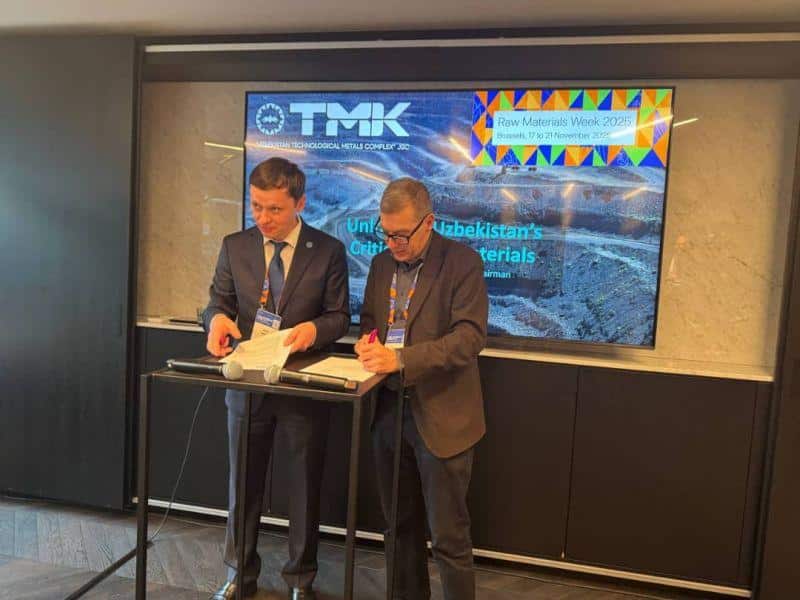
A Technological Bridge to a Resource-Rich Partner
Uzbekistan’s TMK called the partnership “historic,” positioning it as the country’s entry into world-class hydrometallurgical innovation. But the implications extend beyond Central Asia. Europe’s CRM deficit is structural—its geology cannot meet its industrial demand for magnet metals or critical superalloys. Partnerships with resource-rich, geopolitically stable states are the only viable path to resilience.
Enter Uzbekistan: a country with underexploited U-REE-Re resources, willing government partners, and a desire to ascend the critical minerals value chain. With SOLVOMET’s expertise in selective leaching and advanced metal recovery, the project offers a credible path to unlocking previously overlooked feedstocks.
Why It Matters for the West
This agreement is a tangible example of friendshoring—a cornerstone of the EU’s external CRM strategy. It reinforces three critical Western priorities:
1. Non-Chinese REE pathways:
Uzbekistan offers REE-bearing ores that bypass the China-centric supply chain.
2. Rhenium supply diversification:
Rhenium—essential for superalloys in aerospace and defense—remains rare, expensive, and geopolitically sensitive. New recovery routes are strategically meaningful.
3. Technology transfer tied to Western standards:
By anchoring the project in KU Leuven’s hydrometallurgical expertise, Europe exports know-how while maintaining environmental and governance benchmarks.
A Small Contract, A Big Signal
The project begins in January 2026. It is not a mine, not a refinery, not a megaton REE play—but it is exactly the type of early-stage, technically credible partnership that often seeds long-term strategic supply networks. In an era where the West must rebuild critical mineral independence step by step, Uzbekistan’s willingness to align with EU institutions is a meaningful geopolitical win—and a reminder that not all strategic advances come in billion-dollar headlines.
© 2025 Rare Earth Exchanges™ – Accelerating Transparency, Accuracy, and Insight Across the Rare Earth & Critical Minerals Supply Chain.


0 Comments
Discuss this article