
Highlights
- China successfully launched its 10th batch of low-Earth-orbit (LEO) internet constellation satellites.
- The launch utilized a Long March-8A rocket.
- The launch demonstrates improved launch pad efficiency.
- The initiative is part of a state-directed strategy to build a ~13,000 satellite network comparable to Starlink.
- The satellite program has significant geopolitical and technological implications for global broadband communications.
- The program also affects rare earth supply chains.
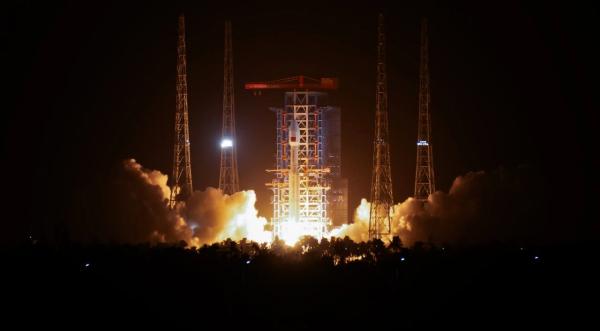
China’s state asset owner State-owned Assets Supervision and Administration Commission of the State Council (SASAC) just flagged another step in Beijing’s state-led satellite push (opens in a new tab): at 3:08 a.m. (Beijing time) on Aug. 26, a Long March-8A lifted the 10th batch of low-Earth-orbit (LEO) “internet constellation” satellites from the Hainan commercial launch site. The launcher—50.5 meters tall, ~371 metric tons at liftoff—carried the group developed by China Aerospace Science and Technology Corporation (opens in a new tab) (CASC) subsidiaries (CALT for the rocket, CAST for the spacecraft).
Notably, SASAC says a new “dual-rocket parallel operations” test mode cut typical pad flow by roughly five days, signaling a deliberate move toward higher launch cadence.
China successfully launched a new group of low Earth orbit satellites from the Hainan commercial spacecraft launch site in Hainan Province on August 26
Why Newsworthy?
This appears to be China’s state “Guowang/SatNet” broadband network quietly expanding. Independent trackers list this mission as “SatNet LEO Group 10” within a plan that targets ~13,000 spacecraft—China’s structural answer to Starlink. Rapid, repeatable operations at a coastal commercial spaceport point to an industrialized production model—and a race for global LEO broadband markets and influence across Belt-and-Road corridors.
Operational Breakthrough to Watch
Hainan’s new commercial spaceport now operates with two pads and has been stress-tested by multiple internet-satellite launches this month, laying the foundation for a sustained tempo. For U.S. and allied operators, this increases spectrum, de-orbit, and orbital-traffic considerations—and foreshadows more resilient Chinese communications for both civilian and government users, as the Chinese government reported (opens in a new tab) earlier this year.
Rare-Earth Elements?
LEO spacecraft ride on rare-earth permanent magnets. Reaction wheels and other attitude-control actuators commonly use neodymium-iron-boron (NdFeB) rotors, often performance-stabilized with heavy rare earths dysprosium and terbium for high-temperature coercivity—exactly the materials where non-China supply is thinnest and Pentagon programs are trying to diversify.
A faster Chinese LEO build-out tightens the link between satellite cadence and magnet-metal security for the U.S. industry, according to the U.S. Department of Defense (opens in a new tab).
Bottom Line
SASAC’s notice isn’t just another launch blurb. It advertises a maturing, state-directed LEO broadband program, improved pad efficiency, and a scale signal to markets—and it reinforces why NdPr-Dy-Tb supply chains are not an abstract policy debate but a near-term competitiveness issue for Western satcom and space suppliers.
Disclaimer: This item originates from media affiliated with a Chinese state-owned entity. Key claims—especially constellation details and process innovations—should be independently verified.
©!-- /wp:paragraph -->


0 Comments