
Highlights
- Pakistan presents a $500 million minerals pact with potential rare earth element exports from Balochistan.
- Despite glittering photo opportunities, significant geopolitical and industrial obstacles remain in developing a viable mineral supply chain.
- China still dominates global rare earth processing, making independent mineral development challenging for emerging markets.
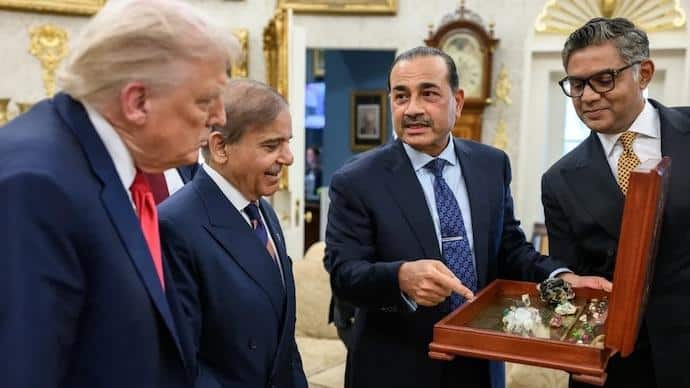
The photograph was irresistible: Donald Trump, eyes fixed on a neat wooden box of “rare earth minerals,” presented with flourish by Pakistan’s Army Chief Asim Munir (opens in a new tab) while Prime Minister Shehbaz Sharif beamed like a man who had just sold Manhattan back to the Dutch. India Today splashed it as proof of Islamabad’s newfound mineral magnetism. But investors—and Washington policymakers—should know better. Boxes of shiny stones do not make a supply chain.
The Grounded Truths
To be fair, some substance underpins the spectacle. As reported by Rare Earth Exchanges (REEx), a $500 million pact between Missouri-based U.S. Strategic Metals and Pakistan’s military-run Frontier Works Organisation (opens in a new tab) is genuine, intended to build a polymetallic refinery. Official communiqués confirm early plans to export antimony, copper, gold, tungsten, and rare earth elements. And yes, Balochistan—the rugged, troubled province in Pakistan’s southwest—holds untapped mineral deposits. These facts, unlike the glittering display, are real.
The Real Thing—Rare Earths in Pakistan
The Mirage of Trillions
Where the story veers into fantasy is in the proclamations of a “rare earth treasure” worth “trillions.” Pakistan has played this game before. Recall 2019, when Imran Khan’s government teased “Asia’s largest oil and gas reserve”—a mirage that dissolved once the drills came up dry. The current rhetoric risks recycling that same hall of mirrors. Without independent geological surveys, feasibility studies, or pilot plants, treasure remains little more than a slogan.
The Quiet Danger No One Mentions
Lurking beneath the pomp is the most inconvenient truth: security. Balochistan is not Nevada. Separatist insurgencies, terror designations, and chronic instability have haunted foreign operators for decades. Investors know this, even if photo-ops from the Oval Office pretend otherwise. Rocks can be polished for display; geopolitical landmines cannot.
The Real Supply Chain Chessboard
And there’s another reality we must face: even if Pakistan delivers ore, China still dominates the middle and endgame—separation, refining, alloys, and magnet production. Beijing controls roughly 90% of global magnet output (for heavies, it’s over 95%). Trump deserves credit for doing more than any U.S. president to claw back control from China, but without midstream and downstream investment, America risks trading one dependency for another. Pakistan’s stones may sparkle under White House lights, but unless they’re part of a full industrial strategy (and we mean full---we have elaborated on this many times), they are little more than glitter on the surface.
Citation: Sayan Ganguly, India Today, “Pak’s rock show at White House to seduce Trump (opens in a new tab),” Sept. 28, 2025.
©!-- /wp:paragraph -->


Smoke and Mirrors! Way too much negative history between the US and Pakistan over just housing O B Laden and insurgents flowing back and forth into Afghanistan for two decades. It’s the nukes the US is concerned about, not RE feedstock. JOHO! GLTA – REI