
Highlights
- Luoyang Bajia Electrical Technology is scaling production of vacuum furnaces used in rare earth magnet and advanced materials manufacturing, highlighting China’s dominance in industrial processing equipment—not just raw materials.
- China’s strategic advantage extends beyond mining and refining to the capital equipment layer: specialized furnaces and thermal systems that control throughput, cost, and scalability of materials processing.
- Western supply chain strategies focus on mining and separation but overlook equipment ecosystems, creating indirect dependence on Chinese thermal processing technology suppliers.
A Chinese manufacturer in Luoyang is scaling production of advanced vacuum thermal processing equipment used in rare earth and advanced materials manufacturing—highlighting a less visible but critical layer of China’s dominance: industrial equipment for materials processing. While not a headline breakthrough, the development underscores sustained investment in the machinery that underpins rare earth value chains.
The Factory Floor Where Materials Become Magnets
At a production facility in Luoyang, Henan Province, workers are assembling and testing vacuum furnaces used in high-temperature materials processing. These systems support processes such as vacuum melting and rapid solidification—important steps in producing alloys and precursor materials used in rare earth permanent magnets and other advanced materials.
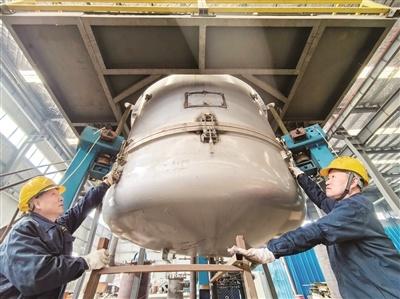
The company, Luoyang Bajia Electrical Technology, is identified as a provincial-level “specialized and innovative” enterprise, supported by an engineering center focused on intelligent vacuum thermal equipment.
The Quiet Layer of Dominance: Process Equipment
This is not a mining story. It is not even a refining story. It is an equipment story.
China’s advantage in rare earths extends beyond extraction and separation into the capital equipment layer—furnaces, kilns, and metallurgical systems required to convert materials into functional forms.
The company’s large-scale vacuum melting and rapid solidification systems are reportedly deployed across:
- Rare earth materials and magnet-related supply chains
- Advanced materials manufacturing
- New energy applications
Control the equipment, and you shape the throughput, cost, and scalability of the entire system.
Incremental News, Strategic Signal
There is no discrete breakthrough here—no disclosed capacity expansion, patent, or export contract. That absence is telling.
China’s position is not built on singular leaps, but on continuous, distributed innovation across its industrial base—including second- and third-tier equipment suppliers.
These incremental gains compound into structural advantage.
REEx Insight: The Machinery Behind the Advantage
This is the layer Western strategies often overlook. Building ex-China supply chains has focused on mining and separation—but equipment ecosystems remain underdeveloped.
Without domestic access to specialized thermal processing systems, scaling downstream manufacturing becomes slower, more expensive, and often indirectly dependent on Chinese suppliers.
REEx Reflection
This is not a headline event—but it is a signal. In Great Powers Era 2.0, control is not just about resources (although they are important)—it is about the supply chains and machines that make those resources usable.
Company Profile — Luoyang Bajia Electrical Technology Co., Ltd.
Luoyang Bajia Electrical Technology Co., Ltd. is a China-based industrial equipment manufacturer located in the High-Tech Development Zone of Luoyang, Henan Province—one of the country’s established hubs for materials engineering and heavy industry. The company focuses on the research, development, and manufacturing of vacuum and high-temperature thermal processing equipment, including graphite resistance-type heat treatment furnaces used in advanced materials production. Its patent portfolio includes specialized designs such as thermal field systems for high-temperature graphite resistance furnaces (e.g., CN103994665B), indicating technical capability in precision thermal control—critical for applications spanning rare earth materials, metallurgy, and new energy components. Bajia is described as a provincial-level “specialized and innovative” enterprise, suggesting government recognition for niche industrial capabilities.
Source Transparency Notice: This news item originates from reporting
published via a Chinese state-affiliated platform. The information should be independently verified before making investment or policy decisions.


0 Comments