
Highlights
- Private investors are securing strategic minerals supply chains through equity stakes, project financing, and asset control rather than physical stockpiling—evidenced by billions in recent deals including Serra Verde's $565M financing and Hancock Prospecting's 8.4% MP Materials stake.
- Thin markets show accelerated buying of heavy rare earths like terbium and antimony, with U.S. customs data revealing Thailand/Mexico antimony imports exceeding nearly three years of volume in just four months, signaling defense-linked procurement.
- Trump's $12 billion Project Vault faces criticism as a “taxpayer-backed golf club” that could enable private front-running of government purchases, tightening already illiquid markets and concentrating supply among traders rather than stabilizing strategic reserves.
Over the last year the strongest evidence of private-sector activity in rare earths and strategic minerals appears not in large speculative stockpiles but in equity stakes, project financing, and selective inventory accumulation in thin markets, particularly for heavy rare earth elements (HREEs) and related defense metals. Private equity firms, family offices, and institutional investors have increasingly deployed capital into mining assets, magnet manufacturing, and upstream supply chains. What remains difficult to verify is large-scale speculative hoarding of physical rare earth inventories. Because the rare-earth market is largely opaque and over-the-counter, reliable data on privately held inventories remains limited.
Private Capital Is Locking Up Supply — But Mostly Through Assets
Evidence from the past nine months suggests private investors are increasingly securing control over supply rather than warehousing materials.
Examples include:
- A private-equity consortium (opens in a new tab) seeking a 40% stake in copper-cobalt operations in the Democratic Republic of Congo valued around $9 billion including debt.
- Brazil’s Serra Verde rare earth project, backed by private equity firms (opens in a new tab) including Denham Capital and Energy & Minerals Group, securing $565 million in financing and targeting 6,500 tonnes per year of TREO production by 2027 (note we incorrectly reported a lower number recently so announce correction)
- North American supply-chain investments such as USA Rare Earth’s $1.5 billion PIPE financing (opens in a new tab) and Noveon Magnetics’ $215 million Series C to scale domestic magnet production (opens in a new tab).
- Australia’s Hancock Prospecting, controlled by billionaire Gina Rinehart, increasing its stake in MP Materials to roughly 8.4% (opens in a new tab), highlighting family-office style capital targeting strategic mineral assets.
These moves illustrate a pattern: investors are attempting to secure future supply chains rather than speculate purely on physical inventories.
Thin Markets Are Still Seeing Strategic Stockpiling
While evidence of large speculative REE stockpiles is limited, signs of accelerated buying in tight secondary markets do exist. European traders report heavy rare earths such as terbium moving significantly faster to U.S. buyers than to European industrial users—suggesting defense-linked sourcing and growing competition for material already outside China.
Other critical minerals show similar patterns.
U.S. customs data revealed 3,834 tonnes of antimony oxide imported from Thailand and Mexico over the past four months, nearly the total for the previous three years combined.
These spikes indicate inventory accumulation driven by supply-chain shocks and export restrictions, even if the ultimate buyers are difficult to identify.
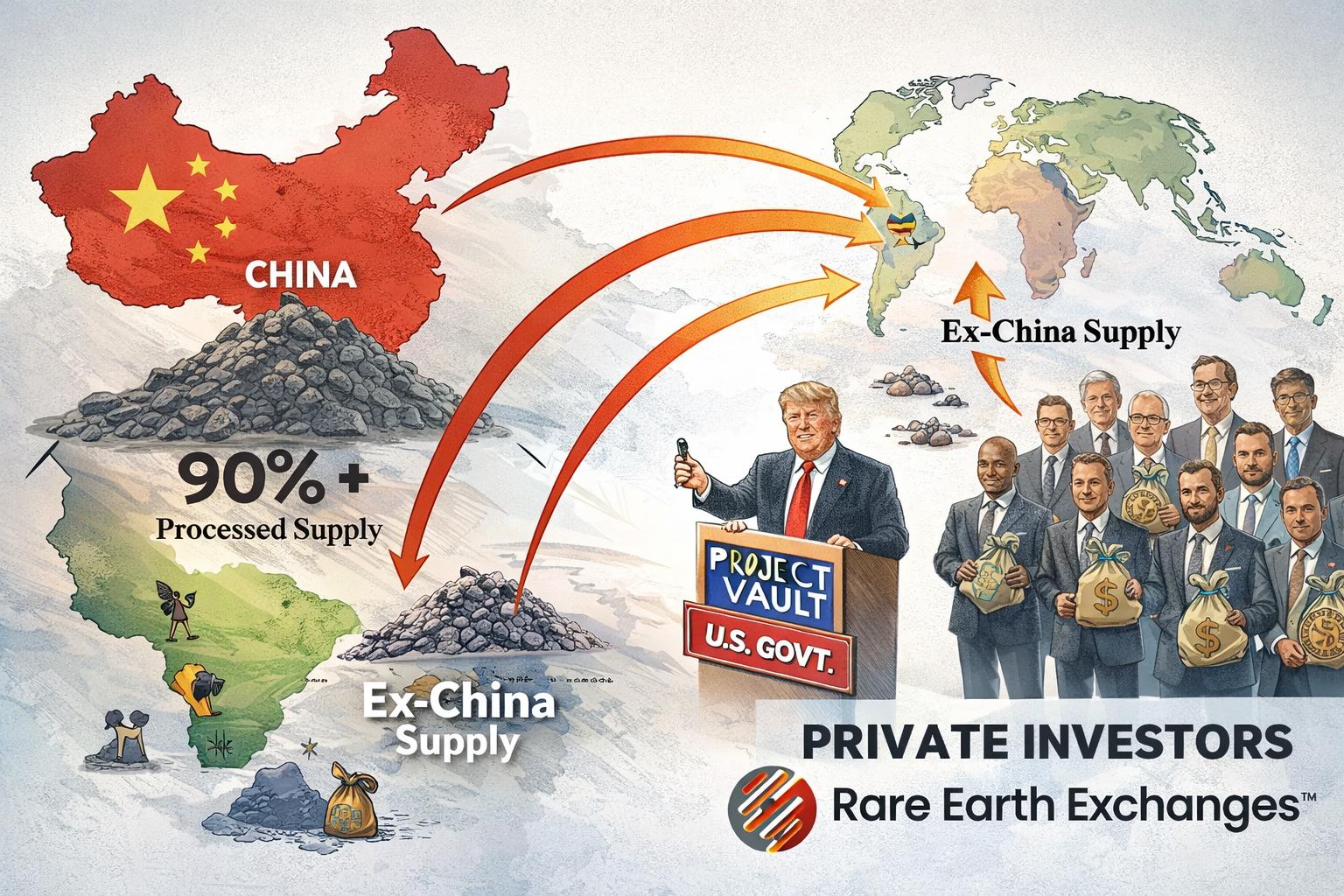
The Project Vault Complication
This trend intersects awkwardly with the Trump administration’s Project Vault, a proposed $12 billion strategic critical-minerals reserve backed by roughly $10 billion in export-credit financing and about $2 billion in private capital.
If private investors accumulate supply ahead of government purchases, several unintended effects could emerge:
- Thin markets tighten further, raising prices for government stockpiling programs.
- Smaller manufacturers may struggle to access feedstock during the multi-year ramp-up of new non-Chinese processing capacity.
- Strategic materials could become concentrated among a small network of traders, investors, and defense contractors.
In effect, private capital could front-run or arbitrage strategic reserves, amplifying volatility in already illiquid markets.
Singapore-based rare earth expert and trader the Rare Earth Observer (opens in a new tab) argues that “Project Vault” is not a true national strategic reserve, but more like a members-only, taxpayer-backed “golf club” that mainly benefits large corporates and commodity traders rather than the broader economy. In the view of this expert, a real reserve must be sovereign, impartial, and market-stabilizing—able to buffer supply shocks and smooth price spikes—whereas Vault functions like a private inventory program financed with public capital: members pay carrying costs, commit to repurchase at fixed prices, and are effectively compelled to “replace what they take,” while traders capture fees and margins.
The critique also stresses that rare earths are not interchangeable commodities (oxides vs metals vs alloys vs finished magnets), so stockpiling generic material without precise product specs, grades, and end-use mapping is misguided—especially when several “members” allegedly don’t meaningfully consume rare earths. An important point this expert, Thomas Kruemmer (opens in a new tab) raises—along with a warning that the timing could induce mindless hoarding, distort markets, and even prompt counter-hoarding in China, worsening artificial shortages instead of strengthening “ex-China” supply-chain resilience.
Strategic Risk for Western Supply Chains
Private investment is essential for building ex-China supply chains. But in extremely thin markets and specialty markets—especially for dysprosium, terbium, and other heavy rare earths—capital flows can unintentionally tighten supply before new mines, separation plants, and magnet factories reach scale.
The result could be a paradox:
Western governments funding new supply chains while financial investors temporarily absorb the limited material already outside China. The challenge for policymakers will be designing stockpiling and financing programs that leverage private capital without allowing supply concentration to recreate the scarcity they are trying to solve.


0 Comments
No replies yet
Loading new replies...
Moderator
Join the full discussion at the Rare Earth Exchanges Forum →