
Highlights
- Lynas Rare Earths announces an expanded Heavy Rare Earths Facility in Malaysia, with Samarium production starting April 2026 and an initial flowsheet to include Sm, Gd, Dy, Tb, Y, and Lu within 2 years.
- The company operates the only major commercial-scale rare earth separation facility outside China, combining the Mt Weld mine with processing in Australia and Malaysia under its Towards 2030 strategy.
- Lynas exclusively serves long-term strategic customers without spot market sales, benefits from improved NdPr pricing at US$110/kg, and actively engages governments on policies supporting non-Chinese supply chains.
Rare Earth Exchanges™ recently was able to conduct an email interview with Lynas Rare Earths (opens in a new tab) (LYC.AX). The Australian company stands as the largest and most strategically significant rare earth mining and separation company outside China. Anchored by its high-grade Mt Weld mine in Western Australia and both the Kalgoorlie processing facility and its Lynas Advanced Materials Plant (LAMP) in Malaysia, the company operates the only major commercial-scale rare earth separation facility beyond Chinese control.
REEx points out that California’s Mountain Pass, owned by MP Materials, is now emerging as a number two ex-China separation facility at commercial scale. That distinction matters: separation—not just mining—is the real choke point in the supply chain. Lynas produces both light and heavy rare earth materials essential for electric vehicles, wind turbines, defense systems, and advanced electronics, making it a cornerstone of non-Chinese supply.
While U.S.-based MP Materials is an important miner and is building downstream capacity, Lynas remains the most established integrated producer outside China, combining mining scale with proven refining capability—an increasingly rare and strategically valuable combination in today’s geopolitical environment.
Jennifer Parker, VP Corporate Affairs
Jennifer Parker, Vice President of Corporate Affairs facilitated the questions and answer which are reported below.

Q1 — Broadening the product suite (within existing assets)
The Towards 2030 strategy highlights expanding heavy rare earth separation capacity and broadening the HRE product range produced in Malaysia. Beyond the recent step into Dy and Tb, does Lynas intend to further expand its separated product suite by developing flowsheet capability for samarium, europium and gadolinium already contained within the Mt Weld orebody — and what are the key gating factors for doing so (customer demand, pricing, orprocessing economics)?
Lynas response:
On 29 October 2025, Lynas announced an expanded Heavy Rare Earths Facility at Lynas Malaysia. You can read the announcement at this link: https://wcsecure.weblink.com.au/pdf/LYC/03015215.pdf (opens in a new tab)
The phased construction of the facility will deliver priority products first, with the first production of Samarium from Mt Weld feedstock forecast for April 2026.
Processing capacity will be progressively added, with the capacity for the initial suite of separated HREs forecast to be available within 2 years. The initial flowsheet includes separated Samarium (Sm), Gadolinium (Gd), Dysprosium (Dy), Terbium (Tb), Yttrium (Y), and Lutetium (Lu).
Offtake agreements for the new HRE production will be negotiated on a price floor basis, and priority will be given to customers where Lynas is servicing 100% of their requirements. Lynas will prioritise market segments where pricing is more favourable, such as the electronics industry.
Investment in further flowsheet enhancements to produce additional HRE products, in particular Europium (Eu), Holmium (Ho), Ytterbium (Yb), and Erbium (Er), will be considered based on commercial agreements that provide an appropriate return on the additional investment.
Q2 — Feedstock strategy vs Mt Weld limitations.
The strategy also refers to adding new feedstock sources, most likely ionic clay feedstock, to complement Mt Weld. Given Mt Weld’s structural weighting toward light rare earths and limited exposure to yttrium and the heavier HREEs, does Lynas see acquisitions or partnerships with Y/HREE-rich deposits as a logical extension of this feedstock strategy, or is the focus on maximizing value from Mt Weld and downstream processing alone?
Lynas response:
As noted in the announcement, feedstock for the new HRE facility will come from Lynas’ high-grade Mt Weld rare earths deposit, which contains both Light and Heavy Rare Earths, and from other sources to be developed, such as ionic clay rare earth deposits in Malaysia.
Each of Lynas’ facilities has been designed with the capacity to process third-party feedstocks, where it meets our technical and ESG standards.
Q3 — Sales mix, spot exposure, and price signals
Lynas emphasizes strengthening long-term strategic customer relationships, while also expanding its non-China customer portfolio. Outside long-term offtake agreements, who are the typical customers purchasing smaller or shorter-term volumes, and how does Lynas view the role of spot or near-spot sales in price discovery, margin optimization, and market transparency?
Lynas response:
Lynas does not sell into the spot market. All of our product is sold to long-term strategic customers.
As the only commercial producer of light and heavy rare-earth oxides outside of China, there is strong demand for the materials Lynas produces.
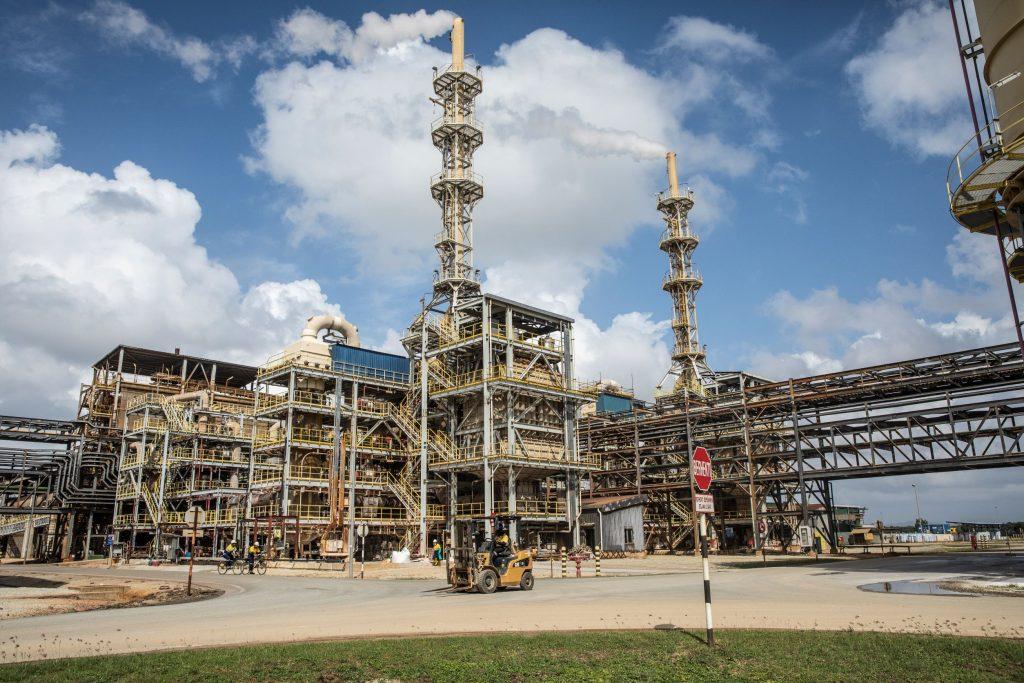
Lynas Malaysia Advanced Materials Plant
Q4 — Reagents, chemicals, and ionic clay ambitions
Rare-earth processing competitiveness depends heavily on secure access to reagents and solvents, and the strategy explicitly references adding ionic clay feedstock. Where does Lynas currently source its critical reagents? How geographically diversified is that supply chain? Are there any areas of material China exposure, particularly if Lynas were to process ionic clay feedstocks, where China has historically dominated both chemistry and know-how?
Lynas response:
Lynas has built in-house IP that has been instrumental to our success as a commercial rare earths producer and supplier to global manufacturing supply chains for 13 years. As noted in Lynas’ Quarterly Report on 30 October 2025, Lynas has identified alternate supply sources for all key inputs. (https://wcsecure.weblink.com.au/pdf/LYC/03016158.pdf (opens in a new tab))
Q5 — Capital allocation and Australian policy alignment
The Towards 2030 strategy highlights enhanced government engagement, yet current Australian policy tools — including proposed rare earth price floors, production-linked incentives, and concessional finance — appear more targeted at new or incremental domestic projects. As Lynas deploys the recent A$750 million capital raise, would the company consider an Australian acquisition or greenfield investment to align more directly with these policy settings, or does Lynas view its existing asset base as sufficient without relying on such incentives?
Lynas response:
Governments around the world are focused on policies that immediately address market dysfunction and support the development of a properly functioning outside-China rare earths supply chain for the benefit of upstream and downstream participants.
Price protection is most relevant for current producers, as it immediately addresses market dysfunction. Other policy instruments are available for, and have been applied to, early-stage projects.
In the past six months, since the US Government's Price Protection Agreement with MP Materials was announced, the market price has increased to US$110/kg NdPr. Lynas, as the only firm producing both the light and heavy rare earth oxides required by our customers, is already benefiting from the improved market pricing.
Other governments have acknowledged the importance of coordinated government policies across all producing and consuming nations to improve market function and supply chain security. Lynas is actively engaged with governments on pricing and other initiatives that will support the development of the outside China Rare Earths industry.
Q6 — CEO Succession and the Future
Amanda has led Lynas through a long period of transformation — from survival, to scale-up, to strategic relevance outside China — and the company is now entering a very different phase under the Towards 2030 strategy. As part of normal succession planning, what type of leadership profile is the Board likely to prioritize for the next CEO — for example, operational execution, downstream integration, M&A and partnerships, or government and geopolitical engagement — and should shareholders expect continuity of strategy or the potential for a strategic shift as Lynas moves into its next phase?
Lynas response:
The Board has initiated a search process to select a new CEO to lead the company through its next stage of growth. The process will consider both internal and external candidates. No additional information has been disclosed at this time.


0 Comments
No replies yet
Loading new replies...
Moderator
Join the full discussion at the Rare Earth Exchanges Forum →