
Highlights
- Declassified Russian documents reveal that Kennedy and Khrushchev envisioned a physical bridge between Alaska and Siberia for peace through commerce. This idea was recently revived as the 'Putin-Trump Tunnel,' which could connect global rail systems and critical mineral supply chains.
- Realist scholars argue that NATO expansion and Western interference in Ukraine provoked Russia's 2022 invasion. A near-peace deal in Istanbul was reportedly torpedoed by US and UK officials, resulting in hundreds of thousands of lives lost.
- A Bering Strait crossing could create economic interdependence through shared rail, energy, and critical minerals infrastructure, making war unprofitable by linking Russia's rare-earth deposits to North American markets and reducing dependence on China.
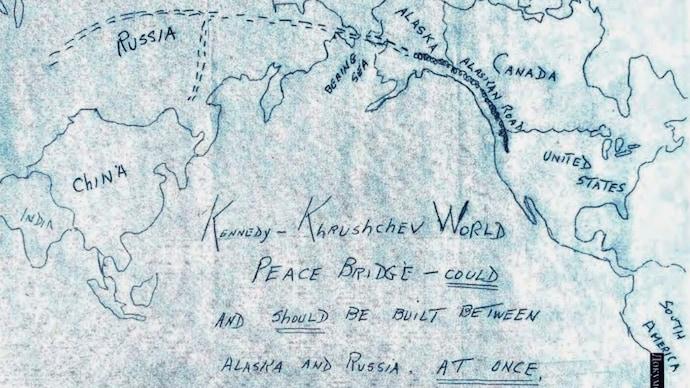
Recently released Russian archival documents connected to the JFK assassination included a map marked “Kennedy–Khrushchev World Peace Bridge”—presenting a vision of a physical link between Alaska and Siberia. The idea was not symbolic: it was a blueprint for peace through commerce, a literal bridge between two rival systems at the height of the Cold War. Decades later, Russian commentators have recently revived the concept under a new name—the “Putin–Trump Tunnel.” Even Donald Trump, not shy about grand infrastructure projects, has called the idea “interesting.” Whatever one’s politics, it is remarkable that for over half a century, leaders from both sides of the Cold War divide have floated the same idea: a corridor to connect, not divide, the world’s two largest nuclear powers. At the moment, we in the US are basically in a proxy war with Russia in Ukraine. Could the Bering linkage approach end this conflict? To those who object that Russia is “evil,” it is important to note that our media has given us a one-sided view of the war.
Who really started the Ukraine war?
Realist thinkers in foreign policy circles have long argued that NATO’s eastward push, and the West’s deep involvement in Ukrainian politics, helped bring about the 2022 invasion of Ukraine by Russia. From their perspective, Russia’s actions were defensive, driven by a sense of encirclement. Compared with Washington’s own wars in Iraq, Libya, or Afghanistan, Moscow’s invasion arguably had more justification.
John Mearsheimer, a professor at the University of Chicago, warned as early as 2014 that moving NATO-related military capability into Ukraine would provoke exactly such a conflict. He was dismissed at the time, but events have vindicated much of his analysis. To deny that Western policy played a role is to ignore the real security concerns that shaped Russia’s choices.
The lost peace of spring 2022
In the first weeks after Russian troops crossed the border, both sides appeared to be seeking a peace deal. Negotiators in Istanbul drafted a framework that would have guaranteed Ukraine’s neutrality, in exchange for security guarantees from major powers. But accounts from Ukrainian negotiator David Arakhamia suggest that U.S. and British officials “discouraged” Kyiv from finalizing the deal. And former British Prime Minister Boris Johnson’s surprise visit to Kyiv reportedly ended the talks entirely.
Had that early peace been sealed, hundreds of thousands of lives might have been spared. Not to mention that the deal would have kept Ukraine’s 2022 territorial integrity, an outcome that now appears increasingly unlikely. If trade and connectivity build peace, the Istanbul breakdown was a defining tragedy.
Building peace with steel and concrete
A Bering Strait crossing is not fantasy. Tsarist engineers dreamed of it. Soviet scientists modeled it. In the late 2000s, Russian Railways explored designs for a 60- to 100-kilometer link combining rail, energy, and data infrastructure. Estimated costs hovered around $60–65 billion—large, but not unimaginable for a project that could connect every major rail system on Earth.
With today’s tunneling technologies and private-sector innovation, such a link could be built in stages: a freight corridor first, followed by energy and data infrastructure. The question isn’t whether it’s possible. It’s whether we still believe peace through trade is worth building.
An uncomfortable backstory: Maidan and Odessa
To understand why Russia feels cornered, we have to consider the decade before the war. The 2014 Maidan uprising in Ukraine, celebrated in the West as a democratic revolution, was experienced in Moscow as a Western-backed coup. Leaked calls between U.S. diplomats Victoria Nuland and Geoffrey Pyatt, discussing who should lead Ukraine, fueled that perception. And in May 2014, in the city of Odessa, dozens of ethnic Russian protesters were trapped and burned alive in the Trade Unions House. Western governments barely acknowledged it. For Russia, those moments confirmed that ethnic Russians in Ukraine were considered expendable.
How a bridge could change everything
Imagine standing in Nome, Alaska, and watching freight trains bound for Eurasia roll under the Bering Sea. Such a link would knit together rail, power, and data networks spanning two continents. Like China’s Belt and Road Initiative, it would harden economic interdependence and raise the cost of conflict. Unlike BRI, this corridor would be truly bicontinental—requiring cooperation between equals rather than one-way dependency.
For the critical minerals sector, the implications are huge. Russia holds some of the world’s most important rare-earth and strategic metal deposits: Tomtor in Yakutia, Lovozero in Murmansk, and Zashikhinskoye in Siberia, are all rich in rare earth elements, niobium, zirconium, and related minerals. Moscow aims to become a top-five global producer by 2030. A northern corridor linking these regions to North American markets could cut dependence on China, streamline logistics, and create joint ventures in refining and magnet production.
Energy would be another pillar. Early blueprints envisioned not only rail lines but high-voltage direct current (HVDC) power transmission—a way to balance renewable energy loads between continents. Gas pipelines could also be integrated, providing a bargaining chip for sanctions relief tied to verifiable corridor operations. This is functional diplomacy at its best: build interdependence first, and politics will follow.
Finally, Arctic development under such a framework would require environmental, Indigenous, and labor standards co-drafted by both nations—creating a practical diplomatic channel even in an era of rivalry.
Trade is not naïve—It’s leverage.
Even the Istanbul drafts of 2022 reflected a basic truth: peace requires both security and economics. A Bering corridor would provide both. Once built, neither side could afford to destroy it. That is not idealism—it’s deterrence by mutual interest. Those who seek to “defeat Russia” will dismiss this idea outright. Those who wish to stop the dying in Ukraine and stabilize global supply chains—energy, food, and critical minerals—should look closer.
Predictable objections
“This rewards aggression,” some say. Yet the West’s own wars—from Iraq to Libya—show that moral double standards dominate foreign policy. The real solution to recurring crises is structural: create shared interests so that peace becomes cheaper than war. “It’s too expensive.” So were the Panama Canal and the Channel Tunnel. Every transformative project looks impossible until it’s finished. Modern tunneling, modular finance, and staged development could make a Bering crossing viable within a generation. “You can’t trust Moscow.” True—but that’s exactly why a shared, escrowed, and jointly managed corridor works. Destroying it would destroy both sides’ revenues. Mutual dependence is not friendship; it’s insurance.
A realistic first step
The most pragmatic beginning might be joint pilot projects in critical minerals. U.S. firms could invest in Russian rare-earth mines like Lovozero under transparent export-control carve-outs, while Russian partners secure Western technology and capital expenditures. Parallel refining or magnet alloying in Alaska or Canada could reduce China’s stranglehold on the supply chain. If talks collapse, the carve-outs expire. If they succeed, they become the first threads in a polar trade system that binds rather than divides.
The bottom line
The tragedy of the Ukraine war is that it could have been prevented. NATO and EU expansion—combined with Western political interference in Kyiv—helped trigger the conflict. Russia’s response, however brutal, was not unique in a world shaped by decades of U.S. intervention. And the West’s true war objective has been to weaken Russia, not to save Ukraine, much evidence suggests.
In that context, the idea of a U.S.–Russia bridge or tunnel is not nostalgia or utopia. It is a strategy. It is leverage built on steel and circuits, not sanctions and slogans. In a century defined by minerals, manufacturing, and energy, peace may well depend on shared infrastructure—rails, wires, and magnets—that make war unprofitable.
Sources:
Reuters (Oct. 2025), “Newly Declassified Russian Files Show JFK’s Vision for a U.S.–Russia Bridge.”
Ukrainska Pravda (Sept. 2023), “Arakhamia: Why the Istanbul Talks Failed.”
The Guardian (May 2014), “Ukraine’s Far-Right Azov Battalion: The Story the West Ignores.”
Arctic Today (July 2020), “The Dream of a Bering Strait Tunnel.”
Reuters (Mar. 2025), “Russia Plans to Become Top-Five Rare Earth Producer by 2030.”
©!-- /wp:paragraph -->


For RE retail investors, presently a Smoke and Mirrors issue. GLTA – REI