
Highlights
- China-Pakistan collaboration produces the first national-scale Rare Earth Element (REE) geochemical map covering 360,000 km² with over 4,400 stream-sediment samples.
- The map reveals REE concentrations of up to 1,400 mg/kg in northern geological belts.
- Himalayan Fold-and-Thrust Belt, Karakoram Terrane, and Kohistan Island Arc are identified as prime REE exploration targets.
- The areas are dominated by light rare earths with a 3.08 LREE/HREE ratio (Light Rare Earth Elements to Heavy Rare Earth Elements).
- China-funded mapping provides geological intelligence strengthening Beijing's upstream advantage in global REE supply chains.
- Pakistan lacks domestic processing capacity to capitalize independently on these findings.
In a landmark scientific collaboration led by Dr. Zhihua Wang of the China Geological Survey (CGS), working closely with Asad Ali Narejo and colleagues at the Geological Survey of Pakistan (opens in a new tab) (GSP) along with a consortium of Chinese and Pakistani researchers, the first national-scale geochemical map of rare earth elements (REEs) across Pakistan has now been published.
Appearing in the Journal of Geochemical Exploration (2024), the study compiles more than 4,400 stream-sediment samples spanning 360,000 km², offering the most comprehensive baseline of REE distribution ever assembled for the country. In clear, accessible terms, the research identifies where REEs naturally concentrate, which geological forces shape those patterns, and how Pakistan may possess far greater strategic mineral potential than previously understood.
Table of Contents
The topline takeaway is striking: REE concentrations range from 10 mg/kg to over 1,400 mg/kg, with the richest anomalies occurring in Pakistan’s northern geological belts—specifically the Himalayan Fold-and-Thrust Belt, the Karakoram Terrane, and the Kohistan Island Arc. These clusters point to newly recognized target zones that may host economically meaningful REE mineralization. Though published last year, these insights remain sharply relevant as global competition for REEs intensifies in 2025.
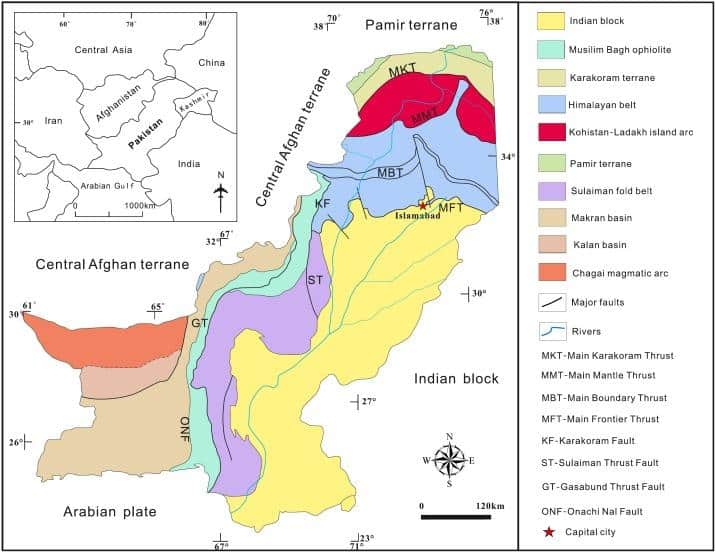
How the Mapping Was Done—And Why It Matters
The researchers executed the first truly national geochemical survey in Pakistan’s history, collecting stream sediments on a consistent 10 km × 10 km grid to generate a dense, geochemically rich dataset. Stream sediments were chosen because REEs weather out of rocks slowly and accumulate in predictable patterns. Where sediments show anomalously high REE concentrations, the underlying geology often includes carbonatites, alkaline igneous bodies, pegmatites, or clay-rich weathering zones—the same environments that host many of the world’s major REE deposits.
This is not just academic data. It is economic intelligence, offering a mineral-system fingerprint for a country that has never before mapped REEs at scale.
Key Findings: Clear Patterns, New Possibilities
- Total REEs: 10.22 to 1,403.1 mg/kg, averaging 132.5 mg/kg—moderate overall, but with compelling anomalies.
- LREE dominance: Light rare earths (La–Eu) are enriched relative to HREEs (Gd–Lu, Y) at a ratio of 3.08, a hallmark of carbonatite-linked and arc-related mineralization.
- Northern belts as hotspots: Pakistan’s tectonically active northern regions host the highest REE concentrations.
- Strong geologic controls: Bedrock lithology and mineralogy shape the REE patterns, suggesting multiple underexplored igneous systems.
For a country better known for gold, copper, antimony, cobalt, and chromite, this represents a strategic revelation: multiple new REE targets, none yet systematically explored.
The China Factor: When Geology Meets Geopolitics
Scientific as this work is, the geopolitical context is impossible to ignore. The mapping was completed under the National-scale Geochemical Survey of South and Central Asia (NGSSCA)—a China-funded initiative conducted with Pakistan as part of a broader regional geoscience push. China already controls 85–90% of global REE refining and separation capacity, and its leadership in upstream geological mapping is consistent with a long-term strategy: map the resources, guide exploration, and secure future feedstock.
The more geological intelligence Beijing gathers across Belt and Road partner countries, the more leverage it holds over upstream flows—even before a single drill rig enters the field.
This study deepens Pakistan’s understanding of its mineral wealth. It also deepens China’s informational advantage, reinforcing its position atop the global REE value chain.
Implications for Industry, Investors, and Policymakers
- Pakistan may be an emerging REE frontier, particularly for LREEs like La, Ce, Nd, and Pr.
- Exploration partnerships—Chinese, Western, or joint—are likely to follow, now that target belts are defined.
- Without domestic REE processing, Pakistan will remain reliant on foreign refiners—almost certainly China, unless alternative partnerships develop.
- For Western investors, this early geological intelligence signals where future tenders, JVs, and competitive bids may surface.
As the U.S., EU, Japan, and India race to diversify supply chains, such mapping gives China a head start in securing upstream opportunities in Pakistan unless counterbalanced by new entrants.
Limitations
The authors are clear about what this study does not provide:
- Stream sediments reflect anomalies, not deposits.
- No mineralogy, metallurgy, grade–tonnage modeling, or economic viability assessments.
- Security, infrastructure, and political risk remain substantial unknowns.
This is a beginning—not a feasibility study.
Conclusion
Pakistan’s first national REE geochemical map is both a scientific milestone and a strategic wake-up call. It reveals meaningful geological potential, new exploration targets, and a foundation on which Pakistan could one day build participation in the global REE economy. Yet because China guided, financed, and co-executed the work—and still dominates global processing—Pakistan’s path forward will require careful planning to avoid simply feeding another spoke into Beijing’s mineral ecosystem.
Citation: Wang, Z., Hong, J., Lin, X. et al. “Concentration and distribution patterns of rare earth elements (REEs) in stream sediments of Pakistan (opens in a new tab).” Journal of Geochemical Exploration, Volume 258 (2024).
© 2025 Rare Earth Exchanges™ – Accelerating Transparency, Accuracy, and Insight Across the Rare Earth & Critical Minerals Supply Chain.


This is strange, where are the REEs being marked on the map provided? The map only shows geological features rather than REEs