
- Boehringer Ingelheim's CEO claims pharma doesn't need rare earths, but healthcare systems depend on them for MRI contrast agents, diagnostic imaging, and radiotherapy—while China controls 90% of processing.
- Boehringer has systematically deepened its China dependency through strategic alliances for pharmaceutical intermediates, Chinese-sourced fluorochemicals for Jardiance, and localized production feeding US and EU markets.
- The pharma industry's concentrated supply chains represent a critical vulnerability: India sources 90% of its API ingredients from China, and for one in ten US drug inputs, China's market share exceeds 99%.
Boehringer Ingelheim’s CEO headline may be factual right for his company—but is dangerously wrong.
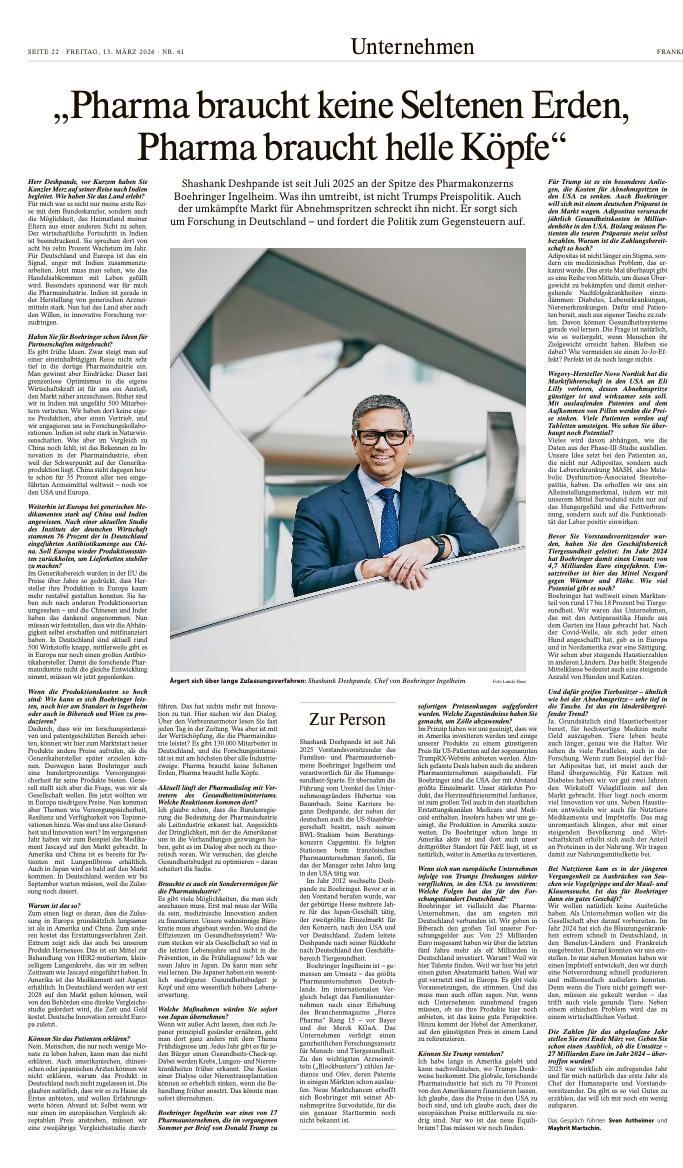
When Shashank Deshpande, CEO of Boehringer Ingelheim, told the Frankfurter Allgemeine Zeitung that “Pharma doesn’t need rare earths, pharma needs bright minds,”1 he delivered a quote tailor-made for a headline. And the FAZ obliged, splashing it across page 22. The statement is catchy, reassuring, and, in the narrowest technical sense, defensible. No patient swallows a Jardiance tablet laced with neodymium.
But the statement, elevated to headline status, reveals something far more troubling than a CEO simplifying for a newspaper interview. It exposes a persistent blind spot in the life sciences industry. A refusal to look honestly at the full breadth of supply chain dependencies, including those running through Boehringer Ingelheim’s own operations.
Rare Earths: Not in the Pill, But Everywhere Around It
Deshpande is correct that Boehringer Ingelheim does not incorporate rare earth elements into its drug formulations. But the healthcare ecosystem in which those drugs are developed, tested, prescribed, and monitored is saturated with rare earth dependencies. Gadolinium is the backbone of MRI contrast imaging, used in roughly 40 percent of all MRI scans and 60 percent of neuro-MRIs.2 Many of those scans diagnose the very conditions Boehringer’s drugs treat. Europium and terbium power phosphor detectors in imaging equipment.Yttrium-90 is an emerging radiotherapy for liver cancers. Cerium oxidenanoparticles show promise in oncology. Dysprosium is being explored for pharmaceutical quality assurance.
China controls approximately 70 percent of global rare earth mining and 90 percent of processing.3 In 2025 alone, Beijing escalated export controls twice. First, restricting seven heavy rare earth elements, then expanding to twelve, directly targeting elements critical to medical imaging and diagnostics.4 Dismissing these elements as irrelevant to pharma is like an airline CEO declaring aviation doesn’t need air traffic control. The planes fly without it, until they don’t.
Boehringer Ingelheim’s Own China Dependencies
Yet the more striking irony lies not in what Deshpande said about rare earths, but in what he left unsaid about his own company’s supply chain. Boehringer Ingelheim has spent years deliberately deepening its dependence on China and on single-source arrangements. This is for products far more central to its business than rare earths.
Consider Jardiance (empagliflozin), Boehringer’s blockbuster diabetes and heart failure drug. As an SGLT2 inhibitor, its synthesis depends on fluorination intermediates—a chemical class overwhelmingly dominated by Chinese producers. China’s near-monopoly on fluorochemical production means that the starting materials for one of Boehringer’s most commercially important molecules flow through a supply chain with limited alternatives. Pradaxa (dabigatran), the company’s anticoagulant, requires complex synthesis with specialized intermediates sourced from a small number of global suppliers. Ofev (nintedanib) and Gilotrif (afatinib), both tyrosine kinase inhibitors used in pulmonary fibrosis and oncology, face similar concentration risks. APIs in these therapeutic classes typically have very few manufacturing sites worldwide.
Then there are the strategic decisions Boehringer has made to move toward China rather than away from it. In 2008, the company formed a strategic alliance with Hisoar in Zhejiang Province specifically to produce pharmaceutical intermediates that feed Boehringer’s manufacturing facilities in Germany, Italy, Spain, and the United States.5 In 2025, Boehringer localized production of Trajenta (linagliptin) at its Shanghai Zhangjiang facility. Its BioChina facility has received regulatory approval to supply both the EU and the US markets. Each of these moves is commercially rational in isolation. Together, they represent a systematic deepening of single-country dependency for critical inputs.
A Fragility That Extends Far Beyond Boehringer
Boehringer Ingelheim is not unique, rather it is representative. The entire pharmaceutical industry has built its supply chains on a foundation of concentrated geographic risk. India, which supplies nearly half of the US's generic drug imports, sources up to 90 percent of its own key pharmaceutical ingredients from China. For one in ten critical drug inputs imported by the United States, China’s market share exceeds 99 percent.6 Diversifying a single API supply chain takes 18 to 30 months.
Deshpande’s remarks are symptomatic of a mindset that has dominated the sector for decades: optimize for cost, concentrate production where prices are lowest, and treat supply chain resilience as overhead rather than strategy. The COVID-19 pandemic exposed this fragility. The lessons, it seems, have faded with remarkable speed. When a recent industry survey asked pharmaceutical executives to name the most impactful emerging trend, supply chain challenges topped the list at 15 percent; nearly double the figure from six months earlier. The concern is rising. The action is not keeping pace.
Bright Minds Need Resilient Supply Chains
Deshpande is right that pharma needs bright minds. Boehringer Ingelheim’s investment in research, reportedly 4.7 billion euros in 2024, is commendable. But bright minds developing therapies in MRI suites powered by gadolinium, testing drugs with europium-based assays, and manufacturing blockbusters from Chinese-sourced fluorination intermediates processed through single-supplier partnerships in Zhejiang Province are only as effective as the supply chains that sustain them.
The European Commission has recognized the urgency with its Critical Raw Materials Act and the RESourceEU action plan. But policy frameworks cannot substitute for corporate accountability. Life sciences companies with Boehringer Ingelheim very much included, must map their full dependency networks: not just the APIs in their tablets, but the intermediates from Zhejiang, the fluorochemicals from Chinese monopolies, the specialized solvents from single suppliers, the rare earth elements in every MRI scanner and diagnostic device their drugs depend on.
The FAZ headline was revealing not because it was wrong, but because it captured a dangerous way of thinking. A way of thinking shared by many leaders across the industry. Life sciences are not a silo. It is an ecosystem, and ecosystems fail when leaders mistake their own input list for the full picture. The next disruption, whether a geopolitical escalation, an export ban, or a quality failure at a single Chinese facility, will not send a polite advance notice. When it arrives, “we don’t use rare earths” will be cold comfort to the patients who depend on a healthcare system that most certainly does, and on supply chains that are far more fragile than any CEO cares to admit in a newspaper interview.
The views expressed in this article are the author’s own and do not represent the position of any institution or organization.
- Frankfurter Allgemeine Zeitung, March 13, 2026, Nr. 61, p. 22: “Pharma braucht keine Seltenen Erden, Pharma braucht helle Köpfe.” ↩︎
- Gadolinium-based contrast agents are used in approximately 40% of all MRIs and 60% of neuro-MRIs worldwide. ↩︎
- China controls approximately 70% of global rare earth mining and 90% of processing capacity (U.S. Geological Survey, 2025). ↩︎
- China’s Ministry of Commerce expanded export controls to twelve rare earth elements by November 2025, including europium, erbium, and ytterbium—elements critical to medical imaging and diagnostics. ↩︎
- Boehringer Ingelheim and Hisoar established a strategic alliance in 2008 for pharmaceutical intermediates production at Chuannan, Zhejiang Province, feeding BI’s facilities in Germany, Italy, Spain, and the US. ↩︎
- India sources up to 90% of its key pharmaceutical ingredients from China. For one in ten critical drug inputs imported by the US, China’s market share exceeds 99% (Atlantic Council, 2025). ↩︎


0 Comments
No replies yet
Loading new replies...
Moderator
Join the full discussion at the Rare Earth Exchanges Forum →