
Highlights
- GRINM Group, China's top state-owned nonferrous metals research body, held strategic talks with the Beijing Humanoid Robot Innovation Center on July 9 to explore advanced materials collaboration for humanoid robots.
- Chinese officials framed both organizations as members of a national industrial team, with GRINM's specialty materials expertise positioned to solve critical bottlenecks in next-generation humanoid robot development.
- The meeting signals China's coordinated strategy to integrate rare earth technologies, advanced alloys, composites, embodied AI, and robotics manufacturing under a unified national ecosystem ahead of the 15th Five-Year Plan.
- No commercial agreements or financial commitments were announced, but the alignment of state-backed institutions underscores a systemic competitive challenge for Western manufacturers and investors in robotics supply chains.
China is tightening the link between advanced materials and humanoid robotics. On July 9, GRINM Group (General Research Institute for Nonferrous Metals)—China's leading state-owned nonferrous materials research organization—met with the Beijing Humanoid Robot Innovation Center, one of the country's flagship government-backed robotics innovation platforms, to explore collaboration on advanced materials, embodied artificial intelligence (AI), and real-world humanoid robot deployment. While no commercial agreements were announced, the meeting illustrates Beijing's increasingly coordinated industrial strategy: integrating materials science, robotics, AI, and advanced manufacturing under national strategic priorities. For Western manufacturers and investors, the message is unmistakable—China is building industrial ecosystems, not isolated technologies.
When Materials Science Meets Embodied Intelligence
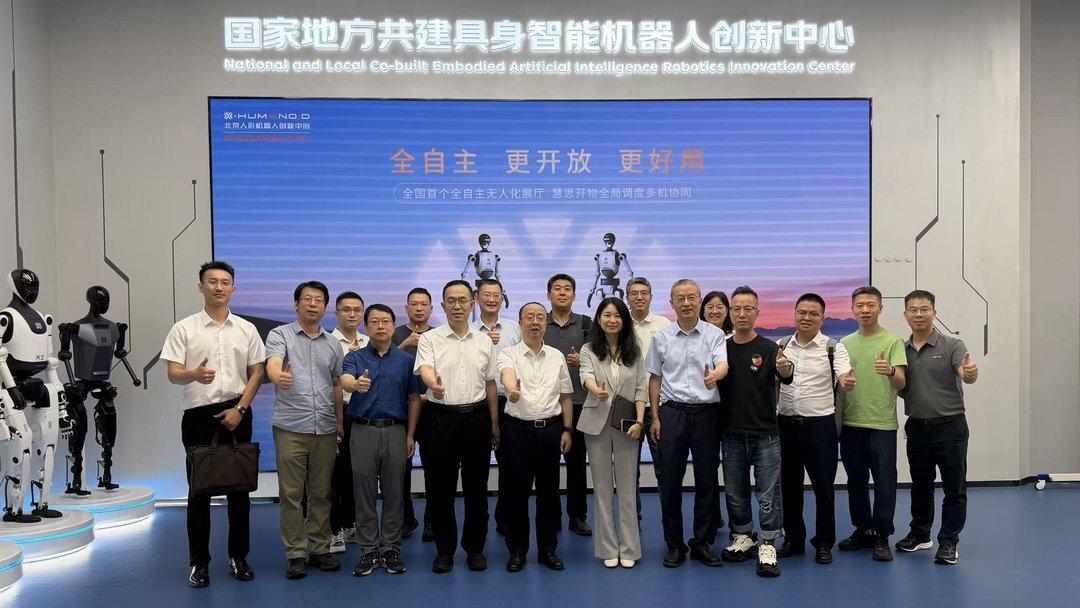
Mao Changhui, Deputy General Manager of GRINM Group, led a delegation to the Beijing Humanoid Robot Innovation Center, where officials reviewed the evolution of embodied AI, core robotics technologies, and recent research achievements.
Mao met with Li Chunzhi, Chief Operating Officer of the Beijing Humanoid Robot Innovation Center, to discuss joint research in advanced materials, collaborative technology development, and expanding commercial application scenarios for humanoid robots.
Li described both organizations as members of China's industrial "national team," arguing that GRINM's decades of expertise in advanced nonferrous metals and specialty materials can help solve critical material bottlenecks limiting next-generation humanoid robots.
A National Strategy Taking Shape
Mao emphasized that China is entering a pivotal period as preparations begin for the 15th Five-Year Plan, describing embodied intelligence as one of the country's highest-priority strategic emerging industries. He noted that rapid advances in humanoid robotics are creating unprecedented performance requirements for advanced materials while simultaneously opening new opportunities for materials innovation. Participating organizations included GRINM Advanced Materials, GRIPM Advanced Materials, GRINM Composites, the GRINM Research Institute, the National Union Research Institute, the GRINM Resources & Environment Institute, and the GRINM Guangdong Institute, alongside executives responsible for product development, robotic joints, structural engineering, and supply chain management at the Beijing Humanoid Robot Innovation Center.
Why This Matters Beyond China
No products, joint ventures, or financial commitments emerged from the meeting. That is not the story.
The significance lies in China's increasingly integrated industrial model. Beijing continues aligning advanced materials, rare earth technologies, embodied AI, robotics, and manufacturing through coordinated, state-supported institutions.
For the United States and Europe, the competitive challenge extends well beyond software. Future leadership in humanoid robotics will increasingly depend on secure access to rare earth permanent magnets, advanced alloys, specialty powders, lightweight composites, sensors, precision manufacturing, and integrated supply chains. China is investing across that entire ecosystem simultaneously.
Disclaimer: This report is based on information released by GRINM Group, a Chinese state-owned research organization. The announcement reflects the organization's account of the meeting. No commercial agreements, financial commitments, or product launches were announced, and readers should seek independent verification of any future collaborations or project outcomes.


0 Comments
No replies yet
Loading new replies...
Moderator
Join the full discussion at the Rare Earth Exchanges Forum →