
Highlights
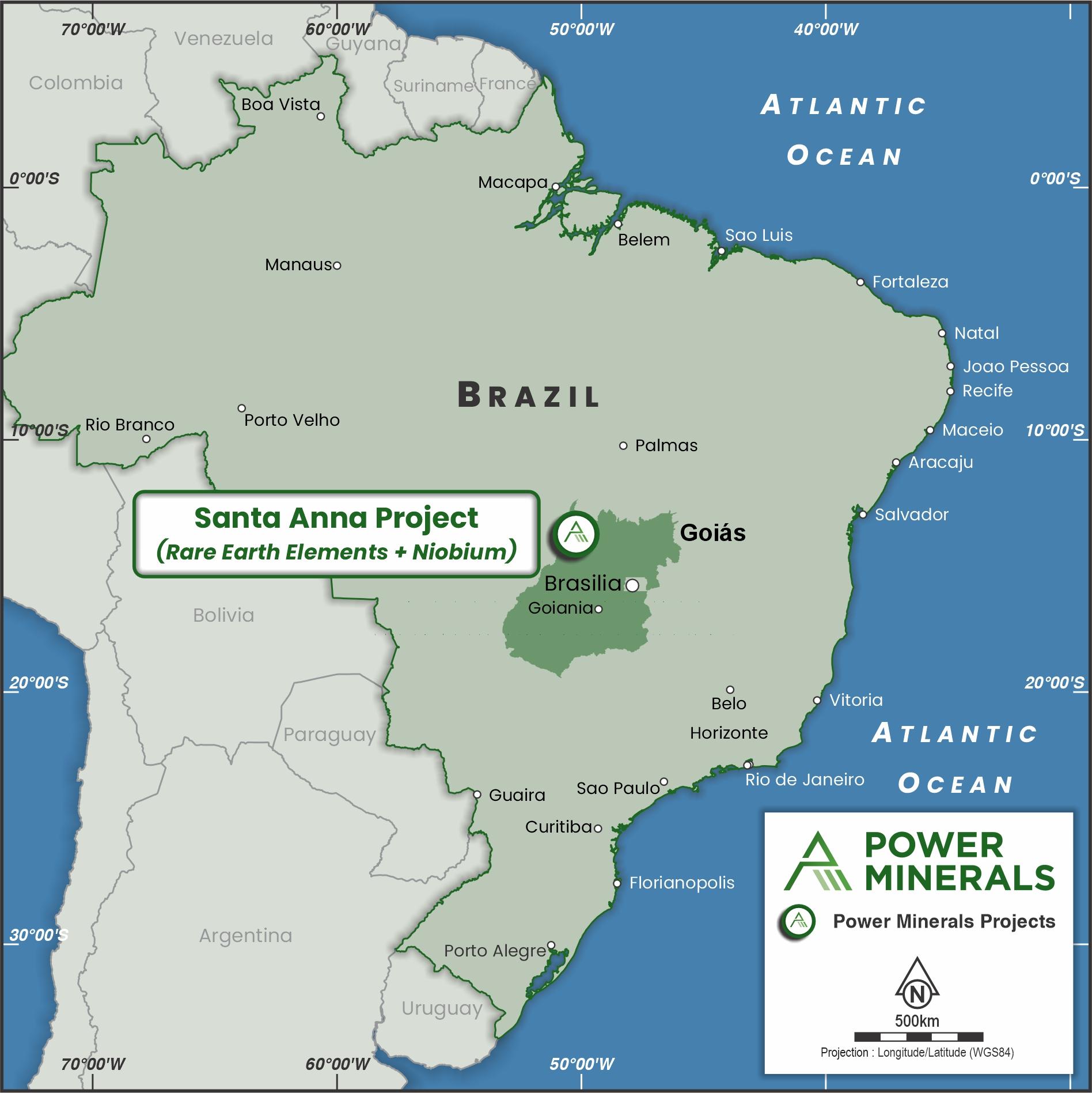
- Power Minerals discovers high-grade niobium and rare earth intersections in shallow auger drilling at the Santa Anna project in Goiás, Brazil.
- Initial results show grades up to 43,385 ppm TREO and 7,748 ppm Nb₂O₅.
- The findings suggest potential for a significant Mineral Resource Estimate.
- The company has cautioned against managing investor expectations.
- Depth continuity and metallurgical recoveries still require comprehensive testing.
Power Minerals (ASX: PNN (opens in a new tab)) has delivered headline-worthy intersections from its Santa Anna niobium–REE project (opens in a new tab) in Goiás, Brazil. Grades up to 43,385 ppm TREO (4.34%) and strong niobium (Nb₂O₅ up to 7,748 ppm) are indeed exceptional for shallow auger drilling. The company is correct to highlight that these grades bolster the case for a significant Mineral Resource Estimate (MRE) down the line. Goiás is a mining-friendly jurisdiction, and the absence of immediate environmental red flags is a fair claim. On the factual side, the numbers are robust and independently assayed by SGS Geosol (opens in a new tab)—lending technical credibility.
The Champagne Effect: Where Optimism Bubbles Over
Describing Santa Anna as “world-class” at this stage is more marketing than science. Investors should note: the current program is limited to shallow auger holes capped at 15 meters, abandoned when the drill rig could go no deeper. Continuity at depth remains untested. Similarly, the statement that the project is “not encumbered by adjoining projects” simplifies the reality of Brazilian mineral tenure—yes, PNN holds the full alkaline complex footprint, but regional competition for infrastructure and permitting inevitably looms.
Subtle Bias in the Bedrock?
Management quotes such as “spectacular results” and “compelling validation” are classic ASX flourish. The subtext is obvious: this release is timed to amplify market enthusiasm as PNN finalizes its acquisition option on Santa Anna. Investors should weigh the difference between drill highlights and resource-scale economics. No metallurgical recoveries from ionic clay testing have been published yet, and those will be decisive. Until processing viability is confirmed, lofty “world-class” labels should be treated with caution.
The company’s press release does not quantify how representative these high-grade zones are across the deposit, nor does it detail potential impurities or deleterious elements that could complicate metallurgy. Investors should see the announcement as a promising datapoint, not a finished story.
Company Profile
Power Minerals Limited is an Australia-listed exploration and development company with a diversified portfolio: lithium brines in Argentina, Australian assets, and its flagship push into Brazil’s critical minerals. The Santa Anna Project—a carbonatite-hosted niobium-REE system—represents its most ambitious attempt to position within the global rare earths and niobium race. Success hinges on proving resource scale, metallurgical recoverability, and financing execution.
Citation: Power Minerals Limited, ASX Release, 25 August 2025.
©!-- /wp:paragraph -->


0 Comments