
Highlights
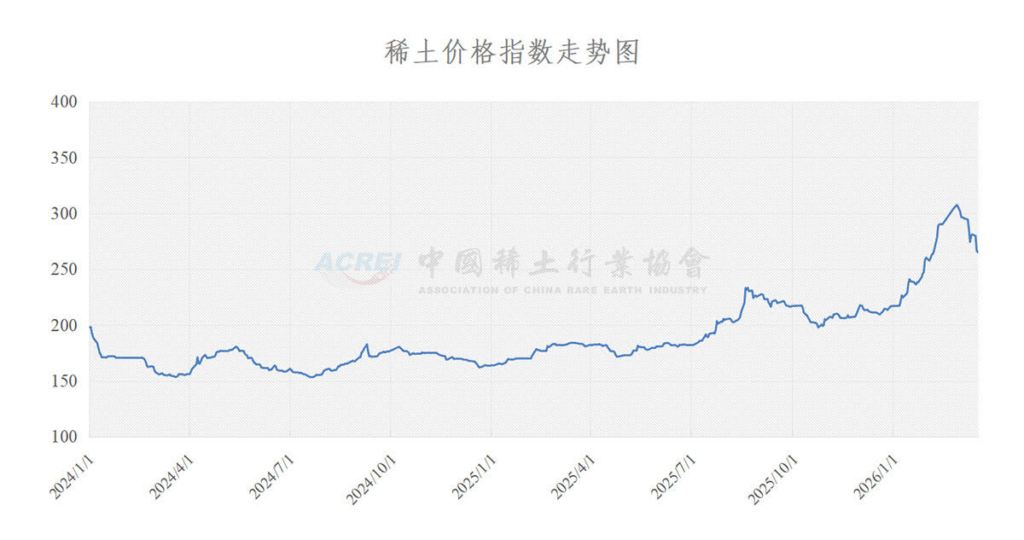
- China's rare earth price index stands at 265.2 on March 18, 2026—down from recent highs near 300 but still materially elevated, reflecting active market management rather than demand collapse.
- Heavy rare earths like dysprosium and terbium show tactical easing at strategically high levels, while light rare earths remain stable, pointing to state-aligned supply calibration across the complex.
- A parallel ex-China pricing system is emerging with government-backed floors (~$110/kg NdPr in U.S.), creating a two-track market—but China still controls physical supply and sets global price reality.
China’s official rare earth price index registered 265.2 on March 18, 2026, according to the China Rare Earth Industry Association. That level remains materially elevated versus 2024–2025 averages, even after a modest pullback from recent highs near the ~300 range.
The index—benchmarked to 2010 (base = 100) and derived from daily domestic transaction data—confirms a key reality: rare earth pricing remains structurally high, but increasingly managed.
The Curve: Strong Run-Up, Controlled Pullback
The trajectory is clear and consistent with the chart:
- Gradual recovery through 2024
- Firm upward trend across 2025
- Sharp acceleration into early 2026
- Recent moderation to 265.2
For Western buyers, this is not a reversal. It’s volatility within an elevated band—suggesting active market management rather than demand collapse.
Heavy Rare Earths Ease—But Stay Strategically Tight
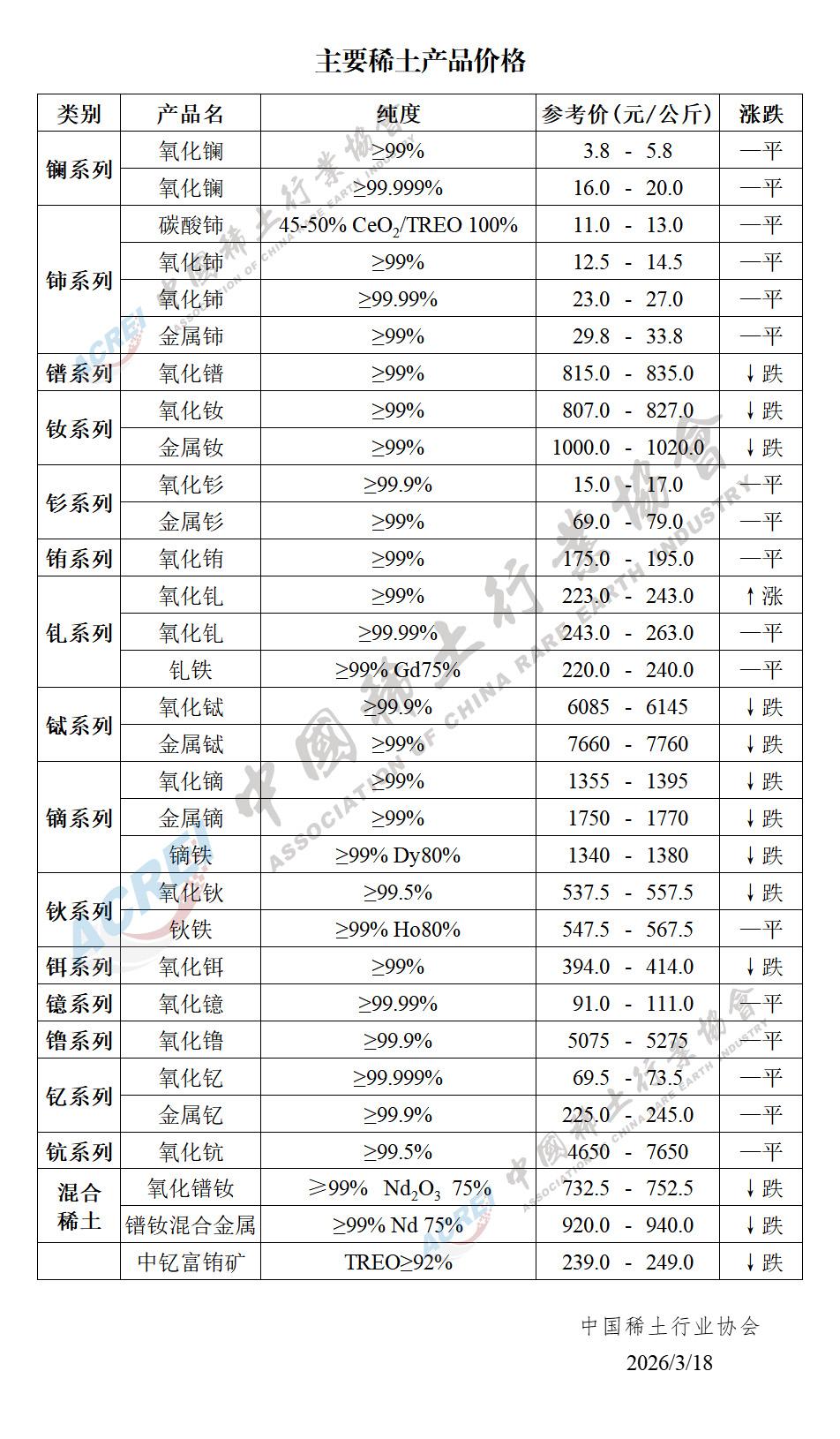
Price data confirms broad softness in heavy rare earths, but at still-high levels:
- Dysprosium oxide: ~1,355–1,395 RMB/kg ↓
- Terbium oxide: ~6,085–6,145 RMB/kg ↓
- Holmium oxide: ~537–557 RMB/kg ↓
- Gadolinium oxide: ~223–243 RMB/kg ↑ (mixed, slight strength)
These moves point to selective easing, not structural weakness. Likely drivers include:
- Tactical inventory release
- Demand digestion after prior spikes
- Ongoing state-aligned supply calibration
Important: these materials remain among the most supply-constrained globally.
Light Rare Earths: Stability With a Slight Drift Lower
Light rare earth pricing is notably stable:
- PrNd oxide: ~732.5–752.5 RMB/kg ↓
- NdFeB alloy (Nd 75%): ~920–940 RMB/kg ↓
- Cerium/lanthanum products: broadly flat
This reflects steady magnet demand with no major supply shock—yet no upward pressure strong enough to push prices higher in the short term.
A New Reality: The Ex-China Market Emerges
Here is the structural shift most Western observers are missing:
A parallel, ex-China rare earth pricing system is forming—but it is:
- Nascent
- Contract-driven (not spot-driven)
- Anchored by a couple of government-backed price floors (for one company)---but policy direction appears headed to ubiquitous floor prices
Key examples:
- U.S. (MP Materials): ~$110/kg NdPr floor tied to government support
- Japan (Lynas): similar strategic pricing frameworks
This creates a bifurcated, two-track market:
- China market: liquid, dominant, policy-influenced
- Ex-China market: illiquid, strategic, contract-based—with intensifying government policy
However—and this is critical—
China still controls the majority of physical supply, especially in separation and heavy rare earths. So even as a Western pricing architecture emerges, China’s domestic price signals still anchor global reality.
No Breakthrough—But Clear Strategic Intent
There are no new supply shocks or technical breakthroughs in this update.
Instead, the message is unmistakable:
China is actively managing price bands across the rare earth complex, balancing:
- Industrial stability
- Export leverage
- Strategic positioning
Bottom Line: Two Markets, One Center of Gravity
Yes, a Western rare earth pricing system is forming.
But today, the center of gravity remains unchanged:
China still sets the market, because it still controls the material.
Disclaimer: This report is based on pricing data published by the China Rare Earth Industry Association, a state-linked industry body. The information reflects domestic transaction data and official industry inputs and should be independently verified before making investment or procurement decisions.


0 Comments
No replies yet
Loading new replies...
Moderator
Join the full discussion at the Rare Earth Exchanges Forum →