
Highlights
- China's Supreme People's Court now treats rare earth smuggling as a national security issue, not just economic crime, signaling Beijing's intent to maintain firm control over strategic resources critical to global industries.
- Supreme Court President Zhang Jun announced courts will punish rare earth smuggling overseas as part of building a 'judicial barrier' protecting national strategic resources, elevating the issue within China's strategic competition framework.
- The policy shift threatens Western efforts to build independent supply chains for magnets, EVs, wind turbines, and defense systems, as China tightens control over materials it dominates from mining through magnet production.
China’s Supreme People’s Court has sent aclear signal: rare earth smuggling is no longer just an economiccrime—it is now being treated as a national security issue. In a work report delivered during the annual National People’s Congress, Supreme People’s Court President Zhang Jun said Chinese courts will continue to punish crimes involving the smuggling of rare earths overseas, framing such enforcement as part of a broader effort to protect the country’s strategic resources. For the United States, Europe, and other economies trying to build independent supply chains for magnets, electric vehicles, wind turbines, and defense systems, the message is unmistakable: Beijing intends to keep a firm grip on materials it views as central to industrial power. The timing and context are of significant importance.
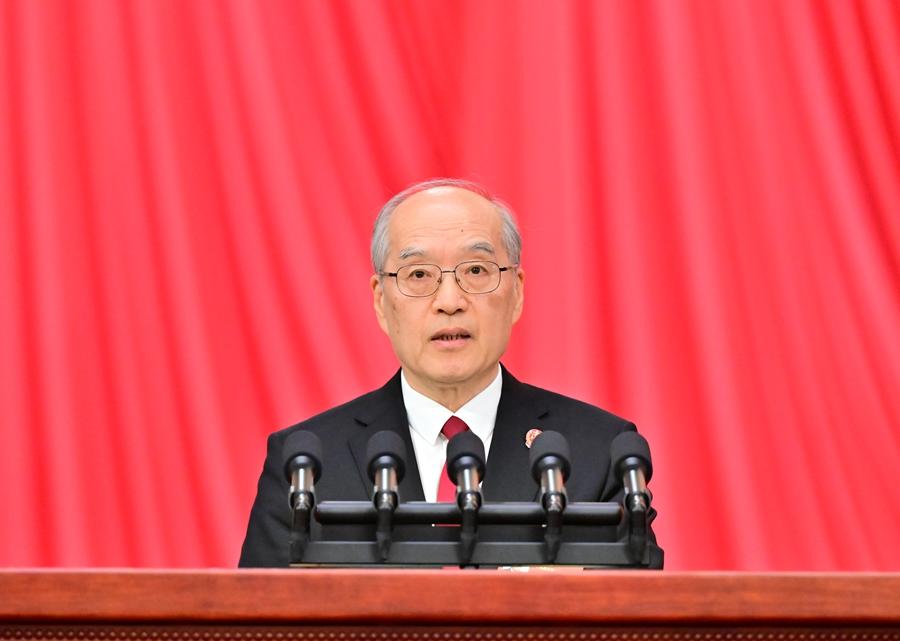
President and Chief Justice of China’s Supreme People’s Court
A Courtroom Warning With Strategic Weight
Speaking at the second plenary meeting of the Fourth Session of the 14th National People’s Congress on March 9, Zhang Jun presented the Supreme People’s Court’s annual work report. Buried inside the section on safeguarding national security was a short but consequential line: China will “punish crimes such as smuggling rare earths abroad according to law, and build a judicial barrier protecting the security of national strategic resources.”
That wording matters. In the original Chinese, the emphasis is not simply on export enforcement, but on creating a “judicial safeguard” around strategic resources. In other words, Beijing is placing the courts more explicitly behind the resource control policy.
A Small Line, a Big Message
The rare earth reference occupies only a brief portion of a sweeping judicial report covering everything from anti-corruption and cybercrime to financial fraud and public safety. Zhang said the Supreme People’s Court handled more than 31,900 cases in 2025, while courts nationwide concluded more than 36 million cases. He also reported 36,000 corruption and bribery cases involving 40,000 people.
Yet the inclusion of rare earth smuggling in the national security section is what makes this a business story. It suggests the issue has risen in political importance and is now being treated as part of China’s wider strategic competition toolkit.
Why the West Should Pay Attention
China already holds commanding influence across rare earth mining, separation, refining, and magnet production. A tougher crackdown on illicit outflows could further tighten control over material leaving the country, especially at a time when Western governments are trying to reduce dependence on Chinese supply.
The implication is straightforward: China is not treating rare earths as ordinary commodities. It is treating them as state-protected strategic assets.
Profile
Zhang Jun, born in October 1956 in Shandong province, is the President and Chief Justice of China’s Supreme People’s Court, a position he assumed in March 2023 after being elected by the 14th National People’s Congress. A member of the 20th Central Committee of the Chinese Communist Party, Zhang has spent decades in China’s legal system, previously serving as Procurator-General of the Supreme People’s Procuratorate, Minister of Justice, Vice Minister of Justice, and Vice President of the Supreme People’s Court. Known for promoting an “active judiciary,” Zhang emphasizes the courts’ role in maintaining national stability, strengthening anti-corruption enforcement, improving judicial efficiency, and advancing legal modernization.
His leadership also highlights addressing public complaints, overseeing cases involving emerging technologies such as artificial intelligence, and ensuring courts operate within constitutional and legal frameworks while supporting broader national policy goals. In March 2026, he presented the Supreme People’s Court’s annual work report to the National People’s Congress, outlining progress in these areas.
Source and Caution
Source: Supreme People’s Court work report delivered by Zhang Jun at the 14th National People’s Congress and published by Xinhua News Agency, as cited by the China Rare Earth Industry Association, March 9, 2026.
Disclaimer: This report originates from Chinese state-affiliated media and industry channels, including human intelligence. Its claims and implications should be independently verified before being used for investment or policy decisions.


0 Comments
No replies yet
Loading new replies...
Moderator
Join the full discussion at the Rare Earth Exchanges Forum →