
Highlights
- China has become Laos' largest investor, with 287,000 hectares of land concessions.
- Significant infrastructure investments include the Laos-China Railway.
- Chinese investment is dominated by mining and hydropower projects.
- There is potential for rare earth mineral development in strategic regions.
- Research reveals complex challenges of Chinese investment, including:
- Sovereign debt
- Infrastructure control
- Potential supply chain disruptions
A new research report by Jessica DiCarlo (opens in a new tab) University of Utah and Juliet Lu (opens in a new tab), University of British Columbia, produced under the Lao Land for Life project with support from the Centre for Development and Environment (CDE), University of Bern, traces two decades of Chinese investment in Laos. Drawing on land concession records, development-finance databases, and project-level case studies, the authors illustrate how China has become Laos’ largest investor, top creditor, and second-largest trade partner. At the center of this expansion are billions in loans from China’s policy banks—the China Development Bank (CDB) and Export-Import Bank (EXIM)—funneled into railways, highways, power grids, and hydropower projects.
Findings: Land, Mines, and Corridors
The report documents the scale and geography of Chinese activity, noting that roughly 287,000 hectares of land concessions—approximately 30% of the national total—have been granted to Chinese investors. Most projects cluster in northern Laos, close to the Chinese border, but mining and hydropower stretch nationwide.
Laos
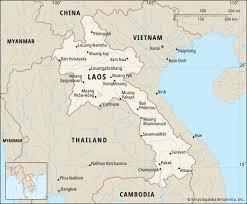
Mining reveals the gap between agreements and reality. Of 157 Chinese or Sino-Lao mining projects, only about 47 were operational at the last inventory, with the remainder stalled in exploration or feasibility phases. Gold, copper, bauxite, and potash dominate concession areas, while rare earth exploration is only now emerging.
Infrastructure is the glue that holds this investment together. The Laos–China Railway, opened in 2021, links Vientiane to Kunming in just four hours. Highways and dams—such as the massive Nam Ou hydropower cascade—financed by the CDB and EXIM embed Laos even deeper into China’s orbit. Meanwhile, control of Laos’ power grid is partially held by a joint venture between Électricité du Laos and China Southern Power Grid, giving Beijing leverage over energy exports and domestic electricity policy.
For critical minerals, the most notable development is a shift in the legal landscape. Laos’ 2017 Law on Minerals prohibited the extraction of rare earths, but revisions are underway. Chinese geologists have identified promising belts in Xieng Khouang, Huaphan, and the Bolaven Plateau, where exploration and pilot projects are inching toward production.
Implications for Investors
For investors, Laos represents option value in heavy rare earths—potentially real, but still very early. If laws are revised and environmental hurdles cleared, Laos could supplement China’s supply chain, particularly for dysprosium and terbium. But attrition is high: many projects granted on paper never advance to production. Delays, rising capital costs, and shifting regulations are the baseline expectation.
Beyond geology, the larger risks are financial and political. Laos is grappling with sovereign debt distress, grid-level Chinese control, and opaque management of Special Economic Zones. Hydropower expansion has triggered relocations and social unrest. The “corridor effect” is another challenge: China’s rail, roads, and SEZs create a strong pull toward exporting raw materials directly into China, undermining Laos’ ambitions for in-country beneficiation unless policy enforcement strengthens.
Where the Study Falls Short
While comprehensive, the report leans on 2016 concession data, leaving newer deals and cancellations under-documented. Reserve and grade data for rare earths remain sparse, and the distinction between state-owned and private Chinese capital is often blurred. Sections on sand and crypto mining highlight trends but lack hard numbers.
More critically, several questions remain unanswered. Will Laos succeed in building domestic refining capacity or default to exporting concentrates into Chinese processing hubs? Can Vientiane enforce its “process-in-country” rules against powerful SOEs? How resilient are supply corridors to regional instability—whether Myanmar border volatility or Mekong hydrology risks? And how will Western rules of origin, especially the 2027 U.S. Department of Defense mandate on non-China magnets, intersect with a supply chain still dominated by Beijing?
Conclusion
For global investors, Laos offers a credible but risky optionality in the heavy rare earth and broader critical minerals space. The infrastructure linking Lao mines to global markets is already built. What remains uncertain is who captures the margin—local miners, midstream processors in Laos, or the Chinese integrators who control the corridors. For now, project-by-project diligence, rather than broad national positioning, will determine whether Laos’ mineral promise translates into meaningful diversification of global supply.
Citation: DiCarlo, J., & Lu, J. (2025). Chinese Investment in Laos. Lao Land for Life project (opens in a new tab), Vientiane; Centre for Development and Environment (CDE), University of Bern.
©!-- /wp:paragraph -->


0 Comments