
Highlights
- The U.S. defense industrial base faces structural supply chain risk as China dominates 90%+ of rare earth processing and magnet production, with new compliance rules effective January 1, 2027 restricting procurement across the entire supply chain from mining to finished magnets.
- Defense contractors including Lockheed Martin, RTX, Northrop Grumman, and European firms face embedded risk in multi-tier supply chains, where rare earth magnets are functional dependencies in critical systems like F-35s (900+ lbs of rare earths) and Virginia-class submarines (9,200 lbs).
- Recent signals show escalating pressure: China's rare earth magnet exports to the U.S. fell 22.5% year-over-year, Europe's GKN scrapped magnet factory plans, and meaningful Western production scale won't arrive until the late 2020s-2030, creating a dangerous gap before 2027 deadlines.
The defense industrial base is no longer operating in a normal cyclical supply environment. It has moved into a structural risk regime based on the rare earth element (and select critical mineral) supply chain crisis. The U.S. aerospace and defense sector generated about $995 billion in total activity in 2024 and supported more than 2.2 million jobs across the supply chain. Europe is also accelerating: EU member-state defense spending reached €343 billion in 2024, while European aerospace and defense turnover reached €325.7 billion. Demand for advanced systems is rising on both sides of the Atlantic, not narrowing to one market. With yet another war now in the Middle East, the risk only intensifies.
No Quick Fixes
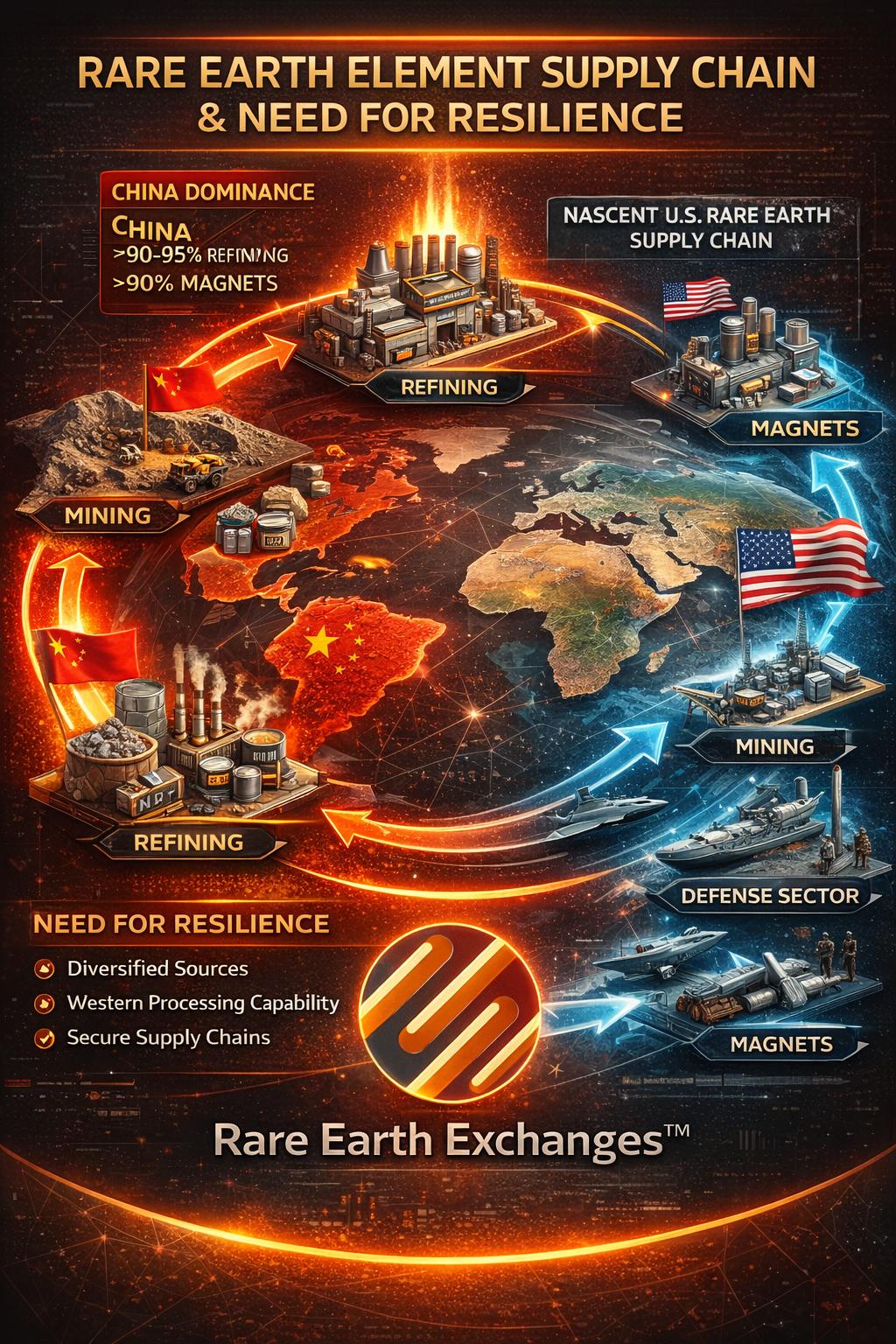
The fragility sits on the supply side. Rare earth permanent magnets (and other components and assemblies) are embedded in motors, actuators, radar, electronic warfare, satellites, seekers, and guidance systems. They are not just another input; they are a functional dependency. Without them, critical systems often do not degrade gracefully—they fail. China still dominates the most important chokepoints, controlling roughly 90%+ of rare earth processing, about 90%+ of magnet production, and, by Reuters’ reporting, about 98% of heavy rare earth processing capacity.
A Daunting Deadline
What changed is that this is no longer only a market-risk story. It is now a compliance story too. Under 10 U.S.C. § 4872 and DFARS (opens in a new tab) implementation rules, effective January 1, 2027, U.S. defense procurement restrictions for covered samarium-cobalt and neodymium-iron-boron magnets extend across the entire supply chain, from mining and feedstock through finished magnets.
At the same time, the U.S. government has formally acknowledged that the country is essentially 100% dependent on imports of sintered NdFeB magnets and lacks meaningful domestic manufacturing capacity at scale for those magnets. That convergence—rising demand, concentrated midstream, and hard compliance deadlines—is why defense contractors are already in a high-risk zone, even before any full cutoff scenario. Note Rare Earth Exchanges suggests there will be no choice by the U.S. government but to A) delay the full implementation of the forthcoming new rules and B) continue to keep China importing while C) the need for intensification of industrial policy for true supply chain resilience.
REEx Insights Supply Chain Signal Detection
That is the premise behind the REEx Signal Detection model. Via our REEx Insights, we do not stop at the mine. REEx Insights maps the full chain: mine → separation → metallization/alloying → magnet production → component integration. The key insight is simple: most defense primes do not buy “rare earths.” They buy assemblies and subsystems with rare-earth dependency buried inside multi-tier supplier stacks. Risk, therefore, shows up first not at the headline level, but in hidden midstream and downstream nodes.
REEx monitors that exposure through five lenses: geopolitical risk, supply disruption, pricing and market signals, supplier health and credibility, and technology/substitution signals. This week’s brief focuses on signals that change procurement risk, qualification timelines, and near-term availability.
Small Magnets, System-Level Risk
The defense exposure is not theoretical. The Department of Defense has said an F-35 requires more than 900 pounds of rare earth elements, an Arleigh Burke DDG-51 destroyer about 5,200 pounds, and a Virginia-class submarine about 9,200 pounds. Rare earth materials and magnets sit inside missiles, radar systems, UAVs, sonar, propulsion, lasers, and communications systems. GAO has also emphasized that rare earths and related critical materials enable unique high-performance combat capabilities and often lack equivalent substitutes that perform at the same level.
That is why substitution is routinely overstated in executive conversations. DOE’s magnet supply-chain assessment warns that U.S. vulnerability is not just about mining but about reliance on China for raw materials and magnets, and that alternatives often shift the burden elsewhere rather than eliminate it. In practice, substitution becomes a redesign problem, a requalification program, and a performance tradeoff. It is not an escape hatch; it is a different constraint.
Unfolding Dynamics
The most important geopolitical signal during the week of March 16–20, 2026, was the formalization of U.S.–Japan cooperation on critical minerals and rare earths, including discussion of price-floor mechanisms for a select group of minerals. That matters because price floors are not just industrial policy. They are insurance against Chinese price suppression. They make non-Chinese projects more bankable and help keep Western supply alive long enough to reach scale.
With defense output pressure rising and Washington still debating outsized topline defense funding scenarios, supply fragility increasingly translates into readiness fragility.
The clearest disruption signal this week was in trade flows. Reuters reported that China’s rare-earth magnet exports rose overall in the first two months of 2026, but shipments to the United States fell about 22.5% year over year. That is not merely a volume story. It is an allocation story. It suggests license friction, selective pressure, or both.
Reuters had already reported worsening shortages of yttrium and scandium affecting U.S. aerospace and semiconductor suppliers, with some firms rationing supply or turning away customers. These are exactly the kinds of signals REEx watches most closely: pressure appears first in niche, high-value nodes before it shows up as a missed delivery at the prime level.
Pricing signals tell the same story from a different angle. China remains the baseline price setter, while ex-China markets remain more volatile and structurally more expensive. NdPr prices in China jumped sharply after MP Materials halted shipments there, while the U.S. government-backed price support mechanism for MP set a $110/kg floor. A similar deal occurred recently with Lynas Rare Earth and the Japanese government.
In other words, the West is moving toward managed pricing and offtake support because market pricing alone has not been enough to build a resilient alternative. For primes, this may be manageable. For tier-two and tier-three suppliers, it can quickly become margin shock, then delivery shock.
Supplier credibility signals are just as important as price and trade signals. The Lynas-related shift toward structured offtake and price floors underscores that governments no longer trust “market formation” to solve the problem on its own. But contract redesign is also a signal that execution risk remains very real, especially in heavy rare earth processing.
Europe’s challenges are even starker. GKN Powder Metallurgy scrapped plans (opens in a new tab) for a rare earth permanent magnet factory in Europe, a setback for the bloc’s efforts to build ex-China magnet capacity. That is a downstream warning signal: the bottleneck is no longer just geology or mining permits. It is whether credible, bankable magnet manufacturing can actually be built outside China at commercial scale.
Ubiquitous Risk Across Defense Contractors in the West
This is why the real exposure for defense contractors is not “Can we buy rare earths?” The deeper question is whether they can trace, certify, and qualify magnet content across multi-tier supply chains before the 2027 rules hit full force. So the biggest risk is embedded in the bill of materials, not always in the purchase order. Companies such as Lockheed Martin, RTX, Northrop Grumman, General Dynamics, Boeing Defense, BAE Systems, Airbus Defence and Space, Leonardo, Rheinmetall, and Thales all face the same baseline problem, even if their exact exposure differs by portfolio mix: a meaningful share of their subsystems depend on magnet-enabled performance, and compliance failures will increasingly become contract failures.
What Resilience?
Resilience, then, is not a mine, a memo of understanding, or a press release. It is a continuously verified chain from oxide to metal to magnet to qualified component. And the gap remains wide. MP Materials’ new proposed Texas “10X” campus is a meaningful signal of U.S. progress, but commissioning is expected around 2028, not tomorrow. Heavy rare earth diversification is slower still, and Rare Earth Exchanges™ has suggested a bigger problem than government or traditional media let on.
The late 2020s into 2030—not 2026—remain the realistic horizon for a more meaningful Western scale. That is the REEx insight based on our proprietary modeling and algorithms. The most important signals rarely announce themselves as a shutdown notice. No rather, they appear first as license friction, trade-flow anomalies, supplier contract resets, project cancellations, price divergence, and qualification delays.
This week’s cleanest example was simple but telling: exports up overall, U.S. shipments down. For defense executives, the lesson is now unavoidable. In 2026, rare earth risk is no longer just a sourcing problem. It is a strategic visibility problem. The winners will not be the firms that merely “secure supply.”
They will be the firms that can continuously see, verify, and adapt across the full chain before disruption reaches production.


0 Comments
No replies yet
Loading new replies...
Moderator
Join the full discussion at the Rare Earth Exchanges Forum →