
Highlights
- ASEAN nations are forming a hybrid critical minerals supply chain model, with Myanmar providing feedstock, Vietnam driving ambition, Malaysia anchoring processing, and Thailand expanding industrial capacity.
- Southeast Asia's advantage lies in strategic positioning rather than just geology, as the region transitions from passive geography to an active, contested supply chain corridor for heavy rare earths.
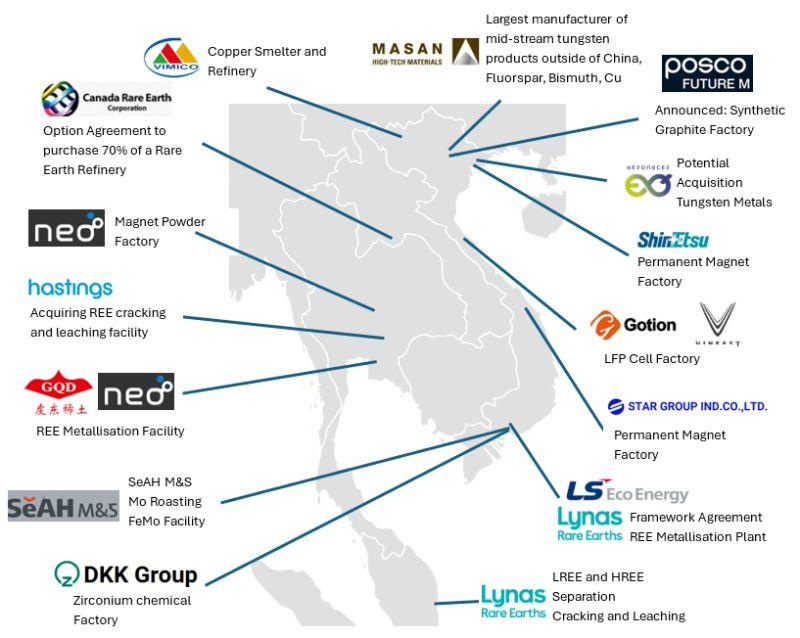
- Despite Chinese technical dominance, regulatory fragmentation, and financing gaps, recent investments from POSCO Future M, Lynas Rare Earths, and Hastings Technology Metals signal a geographic rebalancing in the critical minerals sector.
Southeast Asia is not a monolith—it is a defined but diverse bloc. The region typically includes Vietnam, Thailand, Malaysia, Indonesia, the Philippines, Myanmar, Laos, Cambodia, Singapore, and Brunei. These ten nations collectively form the Association of Southeast Asian Nations (ASEAN), a regional economic and political alliance increasingly relevant to critical minerals strategy.
Against this backdrop, the recent surge in investment—from POSCO Future M in Vietnam to Lynas Rare Earths / LS Eco Energy and Hastings Technology Metals—signals more than opportunism. It reflects a geographic rebalancing.
Where are the resources?
Not all ASEAN nations are equal in geology:
- Myanmar – The region’s most significant current supplier of heavy rare earths (ionic clay deposits, especially dysprosium and terbium), though politically and ethically complex.
- Vietnam – Large undeveloped reserves (e.g., Dong Pao), with growing policy support for domestic processing.
- Malaysia – Not resource-rich, but a critical processing hub (e.g., Lynas’ Kuantan facility).
- Thailand – Emerging midstream processing footprint; limited upstream resources.
- Laos & Cambodia – Underexplored, with early indications of mineral potential.
- Indonesia & Philippines – More prominent in nickel and laterite systems; rare earth potential remains secondary but evolving.
The Takeaway
Southeast Asia’s advantage is not just geology—it is positioning. A hybrid model is forming: Myanmar (feedstock), Vietnam (ambition), Malaysia (processing), Thailand (industrial expansion).
Still, constraints persist—Chinese technical dominance, regulatory fragmentation, and financing gaps. But the direction is unmistakable: ASEAN is transitioning from a passive geography into an active, strategically contested supply chain corridor.


0 Comments
No replies yet
Loading new replies...
Moderator
Join the full discussion at the Rare Earth Exchanges Forum →