
Highlights
- Tactical Resources Corp. will list on Nasdaq under ticker TREO following a business combination with Plum Acquisition Corp. III expected around July 28, 2026.
- The Peak Project in Hudspeth County, Texas, leverages existing Sierra Blanca Quarry infrastructure—rail, power, water, and crushing—to potentially cut development timelines versus greenfield mines.
- Laboratory testing of Tactical's direct-leach processing approach reportedly shows rare earth extraction rates of 88–93%, potentially eliminating energy-intensive conventional processing steps.
- The project remains in early-stage development with no defined mineral resource, requiring further metallurgical validation, engineering, permitting, and financing before commercial production.
- REEx views Tactical as a test case for whether feedstock strategy and capital efficiency can outpace traditional deposit-size metrics in the race to build a Western mine-to-magnet supply chain.
Rare Earth Exchanges® Analysis: Tactical Resources Corp. is preparing to list on the Nasdaq Capital Market under the ticker TREO, bringing investors exposure to an unconventional rare earth strategy focused on processing existing quarry tailings rather than developing a traditional greenfield mine. The approach could materially reduce development timelines if successful, but the project remains in the early stages of metallurgical validation and resource definition. For REEx, Tactical illustrates a broader reality of the Great Powers Era 2.0™: competitive advantage is increasingly determined by execution across the mine-to-magnet supply chain—not simply owning a rare earth deposit.
Can a Feedstock-First Strategy Give Tactical Resources a Head Start?
Tactical Resources Corp. expects to complete its business combination with Plum Acquisition Corp. III on or about July 28, 2026, with the combined company set to trade on the Nasdaq Capital Market under the ticker TREO.
The timing is significant. As the United States races to reduce dependence on China's rare earth supply chain, investors are searching for companies capable of bringing new domestic supply online faster than the decade-long timelines common across the sector. Tactical believes it has found a shortcut.
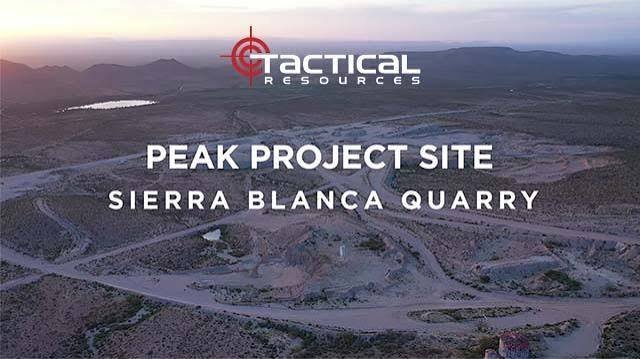
Rather than beginning with a new mine, the company's Peak Project in Hudspeth County, Texas, is built around processing rare earth-bearing material associated with the operating Sierra Blanca Quarry. Existing infrastructure—including rail, highways, power, water, and crushing facilities—could reduce both capital requirements and development timelines compared with conventional mine-first projects.
That proposition formed the centerpiece of a Rare Earth Exchanges Podcast (opens in a new tab), where Tactical President and Executive Chairman Jeet Basi (opens in a new tab) and Plum Acquisition Chairman and CEO Kanishka Roy (opens in a new tab) outlined what they believe differentiates the company. They argued that America's greatest shortage is no longer rare earth deposits, but commercially available feedstock capable of entering the processing pipeline in the near term.
The discussion also highlighted Tactical's reported direct-leach processing approach. According to the company, laboratory testing has demonstrated rare earth extraction rates between approximately 88% and 93%, potentially eliminating several of the most energy-intensive processing steps required by conventional hard-rock rare earth projects. If those results ultimately prove scalable, the approach could improve both capital efficiency and operating economics.
Investors will separate promises from proof, as is the case with all rare earth projects over time.
The Peak Project remains in an early stage of development. Additional metallurgical testing, resource definition, engineering, pilot testing, economic studies, financing, and customer qualification all remain ahead before commercial production can be demonstrated. Tactical also acknowledges the absence of a defined mineral resource and the normal technical, financing, permitting, and execution risks associated with developing a rare earth project.
The feedstock itself remains the central investment question. How much economically recoverable material exists? Can laboratory results be replicated at commercial scale? Will ongoing quarry operations provide sufficient long-term supply? Those questions will ultimately determine whether Tactical's strategy becomes a commercially meaningful business.
REEx Perspective: Tactical Resources is intriguing not because it has solved America's rare earth challenge, but because it is attempting to solve one of its greatest constraints—time. In the Great Powers Era 2.0™, investors should increasingly evaluate companies not simply by the size of their deposits, but by the credibility of their feedstock strategy, metallurgy, capital efficiency, downstream partnerships, and ability to become part of a resilient Western mine-to-magnet supply chain. The Nasdaq listing is an important milestone. The real test begins after the opening bell.


1 Comment
1 reply
Loading new replies...
Active member
Join the full discussion at the Rare Earth Exchanges Forum →