
Highlights
- Glomar Minerals and Cobalt Blue announce a consortium to build a U.S.-based processing facility for seabed polymetallic nodules rich in nickel, cobalt, copper, and manganese—targeting midstream processing as the true supply chain bottleneck.
- The claim of a “first commercial scale” facility stretches credibility: no proven commercial-scale seabed nodule processing exists today, and regulatory approval, environmental opposition, and processing economics remain unresolved.
- The announcement signals a strategic shift toward unconventional feedstocks but isn’t a near-term rare earth solution—investors should watch the processing layer and ignore the hype around “near limitless” supply.
A new consortium between Glomar Minerals (opens in a new tab) and Cobalt Blue (opens in a new tab) promises something bold: a U.S.-based, commercial-scale processing facility for seabed polymetallic nodules—pitched (opens in a new tab) as a “gamechanger” for critical minerals. For Rare Earth Exchanges™ community: the companies want to harvest metal-rich rocks from the ocean floor and process them domestically to reduce reliance on China. The idea is compelling. The execution is another matter.
The Clarion-Clipperton Zone
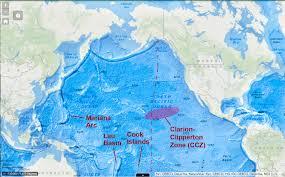
Source: USGS
Where the Story Holds Water—and Why It Matters
The fundamentals are grounded. Polymetallic nodules in the Clarion-Clipperton Zone (opens in a new tab) are real, well-studied, and rich in nickel, cobalt, copper, and manganese—all essential to batteries, defense systems, and industrial electrification. Cobalt Blue’s hydrometallurgical processing expertise is also credible; pilot-scale flowsheets for such materials exist.
More importantly, the announcement correctly identifies the midstream bottleneck—processing—not mining, as the true constraint. That aligns with _Rare Earth Exchanges_’™ core thesis: control of refining and separation determines geopolitical leverage.
The Quiet Leap from Pilot to “First Commercial Scale”
Here, the narrative stretches. No company today operates a commercial-scale seabed nodule processing facility. Moving from pilot flowsheets to industrial throughput is notoriously difficult—especially with variable, multi-metal feedstock. Environmental permitting, capital intensity, and regulatory uncertainty (particularly around deep-sea mining governance) remain unresolved.
The claim of extracting “rare earths” from nodules is technically possible—but economically marginal and not the primary value driver.
The Seduction of “Near Limitless” Supply
The phrase “near limitless resource” signals more ambition than reality.
Yes, nodules are abundant. But abundance ≠ bankable supply. The real gating factors are:
- Regulatory approval (still evolving globally)
- Environmental opposition
- Processing economics at scale
Those execution details at scale matter. And, this is not shale oil—despite the comparison. It is closer to a decade-long industrial experiment.
Why This Matters for Rare Earth and Critical Mineral Investors
This announcement is notable—not for what it solves, but for where it points.
It confirms a strategic shift: the U.S. is waking up to midstream dependency and exploring unconventional feedstocks.
But seabed nodules are not a near-term fix for rare earth supply chains, where solvent extraction at an industrial scale remains the only proven separation method.
For investors, the signal is clear: Watch the processing layer. Ignore the hype.


0 Comments
No replies yet
Loading new replies...
Moderator
Join the full discussion at the Rare Earth Exchanges Forum →