
Highlights
- China's rare earth price index retreated from early 2026 peaks above 300 to 255.7, with magnet-critical elements like dysprosium and terbium declining domestically while surging in ex-China markets.
- A clear pricing decoupling is emerging: heavy rare earths trade at scarcity-driven premiums outside China while remaining managed and lower inside the country's state-influenced system.
- Western price floors and offtake guarantees are beginning to emerge but remain early-stage, as China continues to dominate separated oxides, metals, and magnet production globally.
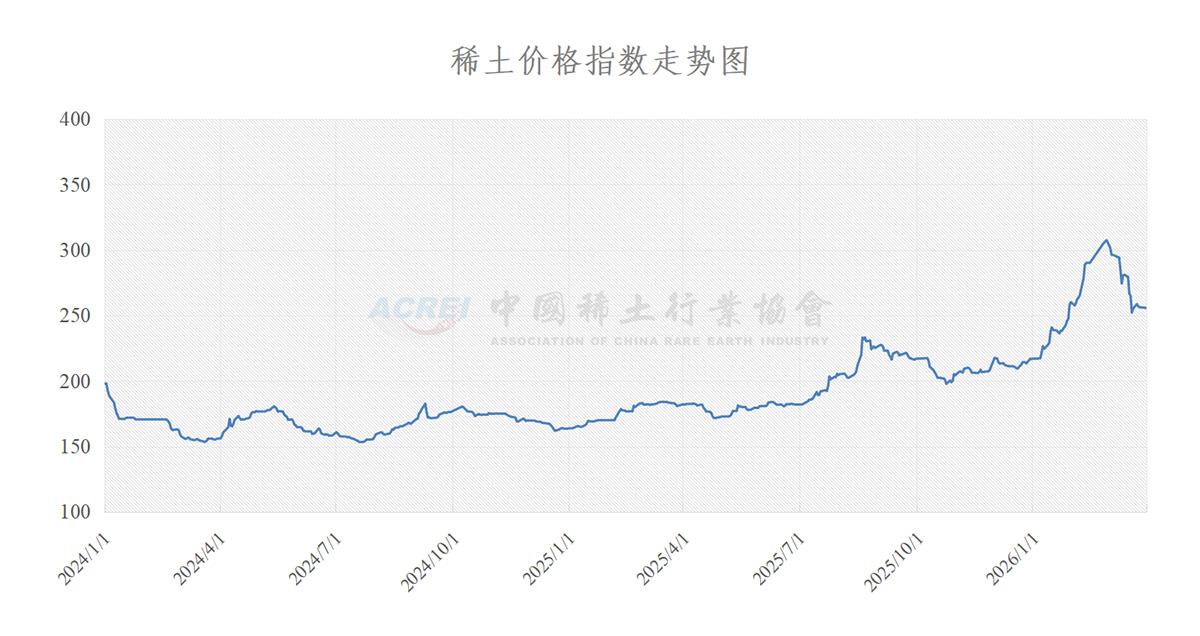
This Rare Earth Exchanges™ brief analyzes China’s March 30, 2026, rare earth price index and pricing table with USD conversions. The key signal: prices surged into early 2026 but are now stabilizing or softening—especially for magnet-critical elements. However, these prices reflect a state-influenced domestic market, not a fully open global benchmark. Meanwhile, early Western industrial policy is attempting to establish price floors, and ex-China markets—especially for heavy rare earths—are beginning to decouple.
A Market That Climbed—Then Paused
China’s official rare earth price index stands at 255.7 (2010 = 100). After a steady 2024–2025 range, prices surged into early 2026 (peaking above 300) before pulling back. So what does this mean in a nutshell: the rally happened—but momentum is fading.
This index is derived from domestic Chinese transaction data, meaning it reflects internal conditions—not transparent global pricing.
Magnet Metals: The Strategic Core Softens (USD View)
Using an approximate exchange rate of ~7.2 RMB/USD, key prices translate as:
- Neodymium oxide (Nd): 702–722 RMB/kg → ~$97–$100/kg (flat)
- Pr-Nd alloy: 870–890 RMB/kg → ~$121–$124/kg (flat)
- Dysprosium oxide (Dy): 1360–1400 RMB/kg → ~$189–$194/kg (declining)
- Terbium oxide (Tb): 6050–6110 RMB/kg → ~$840–$848/kg (declining) *
*in China
These are the core inputs for high-performance magnets.
Translation: the most strategic materials are no longer rising—and some are weakening in China. But this is a very different reality, at least for heavy rare earth elements outside of China.
A Market Splitting in Two
A clear divergence is emerging:
- Light REEs (La, Ce) → stable, oversupplied
- NdPr (magnet base) → stable but capped
- Heavy REEs (Dy, Tb) → declining inside China, surging outside of China
Drivers likely include inventory digestion, uneven EV demand, and controlled supply releases.
Decoupling: One Commodity, Two Markets
Here is the critical development: price decoupling is underway, especially for heavy rare earths.
- Inside China → softer, managed pricing
- Outside China → scarcity-driven, higher, more volatile pricing
Ex-China buyers face:
- Limited processing capacity
- Geopolitical constraints
- Security-of-supply premiums
Result: Chinese prices increasingly understate real global replacement costs, particularly for Dy and Tb.
Pricing Power: Not a Free Market
This pricing system is not the result of a fully open market:
- Based on reported domestic transactions
- Influenced by quotas, state-owned enterprises, and policy controls
- Lacks full transparency and global arbitrage
China still controls the vast majority of separated oxides, metals, and magnets, anchoring real supply.
The West Builds a Floor—But It’s Early
The U.S., Australia, and Japan are beginning to implement price floors, offtake guarantees, and subsidies—especially for NdPr—to support domestic projects. But this remains early-stage.
These mechanisms may de-risk projects, but they do not yet set global prices. China still dominates deliverable supply, meaning the vast majority of the market centers there.
What Investors Should Watch
- NdPr stability vs. lack of upside
- Divergence between China and ex-China heavy REE pricing
- Early Western pricing interventions
- China’s continued dominance in midstream and magnet production
This is not a bull or bear market—it is a fragmenting system with geopolitical pricing layers.
Source Note: This data originates from the China Rare Earth Industry Association, a state-linked body. Prices are compiled from domestic enterprise inputs and reflect a partially managed market environment rather than a fully transparent global marketplace. All figures should be independently verified before use in investment or commercial decisions.


0 Comments
No replies yet
Loading new replies...
Moderator
Join the full discussion at the Rare Earth Exchanges Forum →