
Highlights
- Seven U.S. rare earth projects hold an estimated 12.61 million tonnes of TREO, but only 8% is heavy rare earth oxide critical for high-temperature magnets.
- Four major projects at full design capacity could theoretically cover 86% of projected 2030 U.S. NdPr oxide demand, yet commissioning delays make full capacity unlikely by that date.
- Oxide-to-metal reduction remains the primary bottleneck: separated NdPr oxide must still be converted to metal, alloyed, and customer-qualified before it becomes a usable magnet.
- REEx estimates genuinely resilient U.S. mine-to-magnet capacity could be closer to 20% by 2030–2031 when measured against an independently controlled, commercially proven value chain.
- Capital requirements across projects range from $300 million to $1.6 billion, with permitting, radioactive materials handling, and Chinese price competition adding further uncertainty.
America may be far richer in rare earth resources than its dependence on China suggests—but rocks in the ground are not magnets in a factory. In a new Minerals Engineering review, Vivek Kashyap and collaborators Alind Chandra, Philip Keller, Curtis Moore and Kerry Rippy assess U.S. rare earth resources, processing technologies and near-term projects. The team, led through the National Laboratory of the Rockies, estimates about 12.6 million metric tons of total rare earth oxides (TREO) across seven projects and calculates that four major projects operating at full design capacity could theoretically produce roughly 86% of projected U.S. 2030 neodymium-praseodymium (NdPr) oxide demand for permanent magnets. Yet the same review exposes the catch: separation capacity is expanding much faster than America's ability to convert oxides into metals, alloys and ultimately qualified magnets.
REEx Insight | 86% Is Not 86% Resilience
This is where the study becomes especially interesting. The authors estimate domestic NdPr oxide output could reach approximately 10,840 tonnes annually if Mountain Pass, White Mesa, Round Top and Bear Lodge all reach 100% design capacity by 2030—equivalent to about 86% of projected oxide demand for magnets. Crucially, they immediately caution that projects are unlikely to reach full capacity within one or two years of commissioning.
REEx would go further: oxide self-sufficiency should not be confused with supply-chain resilience.
Previous Rare Earth Exchanges® analysis has treated resilience as the ability to move material reliably through separation → metal → alloy → magnet → customer qualification without falling back on Chinese-controlled capacity. Viewed through that tougher lens, REEx believes genuinely resilient U.S./allied mine-to-magnet capacity could remain closer to roughly 20% around 2030–2031, depending on how resilience and addressable demand are defined. The paper itself helps explain why that estimate can coexist with its much larger 86% NdPr number.
Study Methods | Following the Material Downstream
This is a review article rather than a new laboratory experiment. The researchers evaluated nine major operational or near-term projects using U.S. Geological Survey data, technical literature, feasibility and scoping studies, and company investor presentations.
Refreshingly, the authors explicitly acknowledge that company studies and investor materials can contain "purpose-driven biases" and may lack technical depth. The geology looks formidable. Across seven projects, the authors calculate approximately 12.61 million tonnes of TREO. But about 76% is light rare earth oxide and only 8% heavy rare earth oxide. Dysprosium and terbium—particularly important for high-temperature NdFeB magnets—represent only small fractions of the identified resource base. And this, separate and apart, is projected to be a problem.
America Is Building Separation. The Next Step Is Harder.
The researchers project roughly 50,000 tonnes per year of rare earth separation capacity by 2028, driven principally by Mountain Pass and Energy Fuels' White Mesa Mill, while planned projects could lift TREO production toward 46,700 tonnes annually by 2030. REEx raises questions about both access to heavy rare earth elements and the ability to separate at scale.
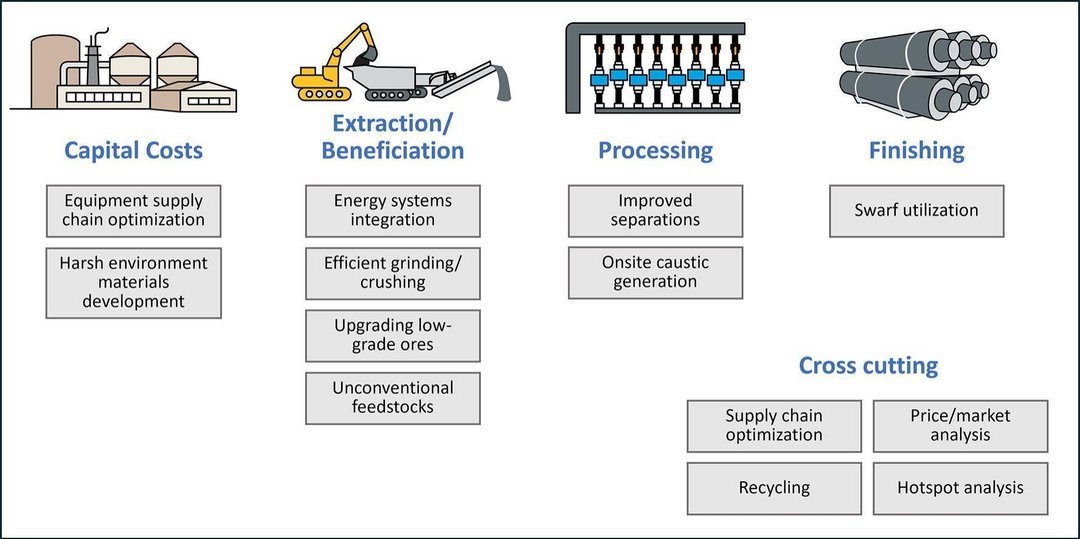
But then comes perhaps the paper's most strategically important observation: metallization remains a primary bottleneck. Separated NdPr oxide cannot simply be placed into an electric motor. It must be converted into metal, alloyed—often with carefully controlled additions of dysprosium or terbium—manufactured into magnets, finished and qualified by customers. The authors describe rare earth oxide-to-metal reduction as a major roadblock to an integrated U.S. value chain. That distinction helps reconcile the apparently bullish 86% oxide scenario with REEx's substantially more conservative resilience outlook.
Limitations | Capacity on Paper Is Not Production
The review relies partly on corporate timelines, engineering studies and announced design capacities. Capital requirements across projects run roughly $300 million to $1.6 billion, and the authors warn that early estimates can rise as projects mature. Permitting, radioactive materials, technical scale-up, Chinese price competition and operating complexity introduce further uncertainty.
The 86% calculation also concerns NdPr oxide demand for permanent magnets, not complete U.S. demand for every rare earth, nor domestic production of finished magnets.
Conclusion | America Has the Resources. Now Build the Chain.
The review is encouraging—but arguably for a different reason than the headline numbers suggest. America is finally assembling meaningful mining and separation capacity. Although, as we suggest above, access to and separation of heavy rare earth elements represents a key challenge to overcome.
Then the next battle moves downstream. REEx sees the critical 2026–2031 question as not simply "How many tonnes of oxide can America produce?" but "How many tonnes can travel through an independently controlled, commercially proven and customer-qualified mine-to-magnet chain?" That number will almost certainly be smaller.
Closing the gap requires investment in heavy rare earth separation, metallization, alloys, magnet manufacturing, recycling, workforce expertise and customer qualification. The United States has spent years proving it has rare earths. The next five years must prove it can turn them into things.
REEx Connect
National Laboratory of the Rockies — Vivek Kashyap, lead author; Kerry Rippy, supervising author U.S. Department of Energy — Research funding; Office of Energy Efficiency and Renewable Energy MP Materials — Mountain Pass mining, separation and downstream magnet production Energy Fuels — White Mesa Mill; NdPr and developing heavy rare earth separation USA Rare Earth — Round Top and U.S. magnet manufacturing Rare Element Resources — Bear Lodge development Ucore Rare Metals — RapidSX separation and Louisiana Strategic Metals Complex
Citation: Kashyap V, Chandra A, Keller P, Moore C, Rippy K. Rare earth production in the United States: A concise review of resource development and commercial processes. Minerals Engineering. 2026;249(Part 1):110723. DOI: 10.1016/j.mineng.2026.110723. The authors declare no known competing financial interests. The work was funded by the U.S. Department of Energy.


0 Comments
No replies yet
Loading new replies...
Moderator
Join the full discussion at the Rare Earth Exchanges Forum →