
Highlights
- Ukraine possesses substantial rare earth element (REE) reserves in two key metallogenic provinces.
- Potential to become a critical mineral alternative to China.
- Western Ukrainian provinces feature environmentally friendly ionic clay REE extraction.
- Eastern Azov region hosts high-grade mineral deposits with multiple by-products.
- The study highlights Ukraine's potential to support post-war economic recovery.
- Opportunity to reduce Western dependence on Chinese rare earth supplies.
A new study (opens in a new tab) titled “Critical Rare Earth Resources of Ukraine: Strategic Potential Amidst Global Economic Transition and Russian Aggression” by Dr. Vitaliy Sukach and colleagues at the M.P. Semenenko Institute of Geochemistry, Mineralogy and Ore Formation of the National Academy of Sciences of Ukraine, (opens in a new tab) published in Geoconcept Journal (2025), shines fresh light on Ukraine’s vast but underdeveloped rare earth element (REE) reserves. These deposits—stretching across the ancient Ukrainian Shield—could become a crucial alternative source of critical minerals for Europe and the global market as nations seek to diversify away from China’s dominant supply chain.
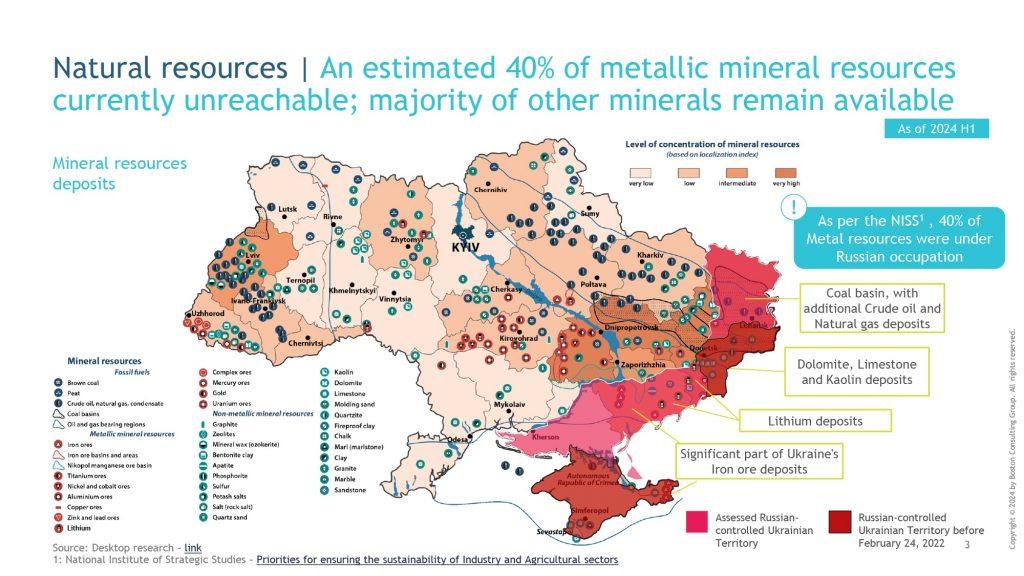
The study identifies two main metallogenic provinces—the Western (Ingulets–Volyn–Podillia) and Eastern (Azov)—each holding distinct rare earth mineral systems. The Western province hosts both hard-rock deposits rich in monazite, xenotime, and bastnäsite and ion-adsorption clay deposits, such as the Khaschuvate and Hlukhivtsi-Turbivka districts, which could be mined using simpler, more environmentally friendly hydrometallurgical methods.
This makes western Ukraine one of the few regions outside Asia with potential for economically viable ionic clay REE extraction, a type currently monopolized by China.
In contrast, the Eastern province, particularly around the Azov and Anadol deposits, is described as one of Europe’s richest rare earth zones, with ore grades up to 2% total rare earth oxides (TREO) and substantial by-products such as zirconium, niobium, tantalum, and thorium. The Azov deposit alone may hold 56 million tons of ore averaging 1.27% TREO, rivaling smaller Chinese or Brazilian complexes. However, much of this territory lies near conflict zones in eastern Ukraine, limiting exploration and investment during wartime.
Why It Matters
For policymakers and investors, this study reframes Ukraine as a potential critical-mineral linchpin between Europe and Asia, with the European Union and the United States actively seeking “friendly-shore” supply chains, Ukraine’s deposits could—once stabilized—support post-war economic recovery and reduce Western dependence on Chinese rare earths. The findings also underscore the potential for green extraction in clay-hosted REEs, which aligns with EU sustainability goals.
Limits and Caveats
While geologically sound, the study’s resource estimates remain preliminary and partly historical, requiring modern validation drilling, reserve classification, and economic feasibility assessments. Additionally, infrastructure, environmental safeguards, and demining will be major challenges for future investment, especially in the conflict-affected Azov region.
The Big Picture
The Sukach study signals that Ukraine holds not just geopolitical significance but also geological leverage in the coming global realignment of mineral supply. For the West, it highlights the urgency of strategic partnerships and capital mobilization—before others move first.
Lead Author: Vitaliy Sukach, M.P. Semenenko Institute of Geochemistry, Mineralogy and Ore Formation, National Academy of Sciences of Ukraine. Journal: Geoconcept Journal (EUnviRO2025 Conference Proceedings, 2025).
©!-- /wp:paragraph -->


Very informative article. Useful to learn that Ukraine “could” be a useful, key supplier to the West.