
Highlights
- Xi Jinping and Narendra Modi meet in Tianjin after seven years, signaling potential realignment amid US trade pressures.
- The meeting highlights India's strategic autonomy, balancing relationships with the US, China, and Russia while managing rare earth supply chain opportunities.
- Trump's trade policies may have inadvertently pushed India and China closer together, potentially challenging the US's critical minerals strategy.
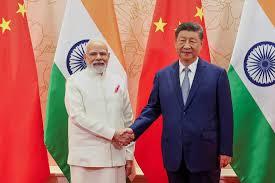
India and China are the emerging giants of the new global economy. With China at the number two spot, continuously gaining on America, according to some rankings, India has emerged as the fourth largest economy as measured by gross domestic product. And of course, both are the most populous nations in the world. Now, China’s head Xi Jinping, along with his Indian counterpart, Narendra Modi, met in Tianjin, China, for the first time in seven years. Their handshake comes against a backdrop of President Donald Trump’s escalated tariff war, now slapping India with a punitive 50% levy. A CNN account is correct that India and China are both heavy importers of Russian oil, and that their shared discomfort with U.S. pressure provides the backdrop for rapprochement. References to ongoing Himalayan border tensions (2020 Galwan clashes) and recent normalization steps—resumed flights, reopened Tibet pilgrimages, and “ten points of consensus”—are consistent with official readouts.
Heads of India and China Meet
Where the Story Gets Glossy
The CNN framing of a “dragon and elephant dancing together” makes for vivid copy, but risks smoothing over deep mistrust. The mainstream media leans into Xi’s messaging about partnership and “multipolarity,” echoing China’s foreign ministry line almost verbatim. Seems almost likeless balanced journalism and more amplification. The suggestion that U.S.–India ties are “derailing” may be overstated; New Delhi continues defense and semiconductor collaboration with Washington even as it hedges with Beijing.
Speculation, Not Substance
The piece implies that Xi may succeed in prying India away from U.S. alignment. This stretches facts. India has a decades-long playbook of strategic autonomy—buying Russian oil, engaging with China, while also deepening Quad ties with America. Any prediction of an Indo-Chinese pivot should be treated as speculative until it shows up in concrete supply-chain or defense deals.
Why It Matters for Rare Earths
For rare earth watchers, this story is more than diplomatic theater. India sits on promising monazite and beach sand deposits—and the South Asian nation is designing a critical mineral and rare earth industrial policy, while China holds the processing crown.
A thaw between the two giants could unlock joint ventures—or at least reduce the chance of India fully siding with U.S. supply-chain decoupling. At the same time, Trump’s tariffs raise the cost of Indian exports, potentially forcing New Delhi closer to Beijing for market access and technology. If Xi and Modi’s “friendship” sticks, investors should expect a tighter Sino-Indian axis in the rare earth conversation, challenging Washington’s ex-China diversification push.
REEx Reflection
Trump’s decision to wage a trade war not just with rivals but with allies was a strategic misstep at the very moment the United States needed to knit together a seamless coalition around critical minerals and rare earths. Price floors, offtake agreements, downstream demand incentives, workforce development, and streamlined permitting are absolutely necessary tools—but without durable alliances, they are insufficient. Nationalism alone will not close the gap with China, which not only dominates refining and magnet production but is racing ahead to capture downstream innovation and the technologies of tomorrow.
By alienating potential partners like India and others in the Indo-Pacific and Europe, Washington risks fighting this battle alone while Beijing builds an integrated, global ecosystem. In the rare earth race, partnerships—not punitive tariffs—will define who owns the future.
Citation: CNN, “Xi and Modi talk friendship in a ‘chaotic’ world as Trump’s tariffs bite (opens in a new tab)” (Aug. 31, 2025).
©!-- /wp:paragraph -->


0 Comments