
Highlights
- Detailed process mineralogy of Zhushan deposit shows 0.77% rare earth oxides and 0.35% Nb₂O₅ with complex mineral intergrowths
- Study demonstrates China's strategic approach to identifying and characterizing dual-resource critical mineral deposits
- Research reveals technical challenges in beneficiation, including fine grain sizes and radioactivity concerns, requiring significant future R&D investment
A peer-reviewed article led by Hao Chen and colleagues, published in Nonferrous Metals (Extractive Metallurgy) (Sept. 2025), provides the most detailed process mineralogy to date of the Zhushan niobium–rare earth deposit in Hubei Province, China. The research team—drawing on institutions including Nile University of Nigeria, Bowen University, Redeemers University, and Durham University—applied a full suite of analytical methods: SEM-AMICS, XRF, ICP-OES, ICP-MS, EPMA, XRD, and LA-ICP-MS.
Zhushan County, Hubei, China
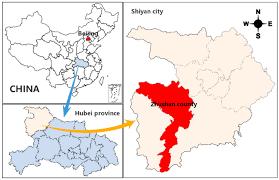
The results confirm that the ore averages 0.77% rare earth oxides (REO), dominated by light REEs, and 0.35% Nb₂O₅, exceeding typical industrial cutoff grades. Monazite is the primary REE mineral, usually under 100 μm in size, closely intergrown with mica and quartz. Niobium occurs mainly in columbite and Nb-Ta oxides, with grains typically under 50 μm. The mineral intergrowths are complex, with columbite showing multi-phase associations that complicate liberation.
Implications for China
Zhushan’s mineralogy features an element of Chinese strategy: identifying and mapping dual-resource deposits with both rare earths and niobium—metals indispensable to permanent magnets, EV drivetrains, advanced alloys, and defense systems. By characterizing mineral associations down to the micrometer scale, Chinese research institutions are laying the groundwork for flowsheet design and future beneficiation trials. If developed, Zhushan would add to China’s already commanding lead in both niobium substitution strategies (currently dominated globally by Brazil’s CBMM) and rare earth refining.
Implications for the West
For the U.S. and allies, this paper is a reminder of the asymmetry in upstream research intensity. While Western projects often struggle to finance basic drilling and pilot processing (although this has started to change under President Trump’s leadership), Chinese scientists are publishing detailed mineralogical studies years before commercial development. This head start translates into reduced technical risk for Chinese developers and a deeper bench of processing expertise. For Washington and Brussels, Zhushan should be viewed not just as another Chinese deposit but as an example of Beijing’s systemic approach—pairing geology with metallurgy, ensuring that even complex resources can eventually be converted into a supply chain advantage.
Limitations of the Study and Resource
The findings also highlight hurdles. The fine-grain size and complex intergrowths mean beneficiation will be energy- and reagent-intensive. Monazite raises radioactivity challenges (thorium/uranium content), requiring careful environmental management. Niobium liberation is particularly problematic due to multi-phase intergrowth, which could lower recoveries or increase costs.
Importantly, the paper provides mineralogical characterization only—not process flowsheets, pilot plant data, or economic feasibility. Commercial development will still require significant R&D investment and scale-up work.
Conclusion
The Zhushan niobium-rare earth deposit represents a strategically significant but technically complex resource. China is already doing the hard science to unlock it, reinforcing its industrial edge in both REEs and niobium. For the U.S. and its allies, the lesson is clear: without parallel investments in advanced mineralogy and pilot processing, Western supply chain ambitions will lag. What China demonstrates at Zhushan today could shape global critical mineral balances tomorrow.
Citation: Chen H., Zhong Y., Ruan Y., Luo H., Chi R., Zhou F. Process Mineralogy of the Zhushan Niobium–Rare Earth Deposit in Hubei Province. Nonferrous Metals (Extractive Metallurgy), Issue 9, p117, Sept. 2025. doi:10.20237/j.issn.1007-7545.2025.09.012
©!-- /wp:paragraph -->


0 Comments