
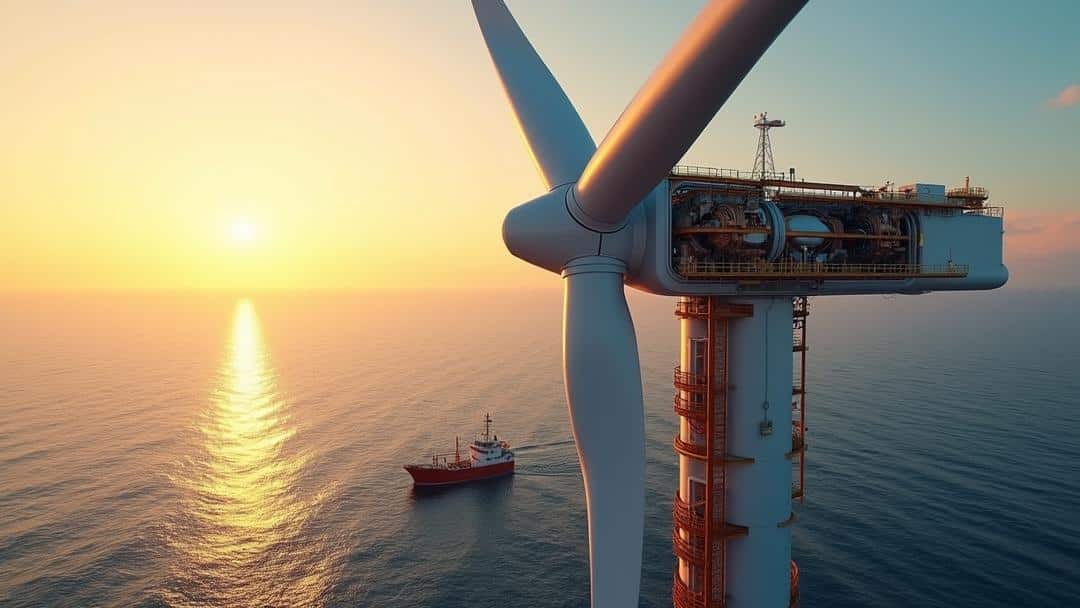
Offshore wind turbines are large wind energy machines installed in marine environments, where stronger, steadier winds enable higher output and more predictable generation than onshore sites. They convert kinetic energy from ocean winds into electricity using rotors, generators, and subsea cables, typically achieving higher capacity factors due to consistent marine wind resources and reduced terrain-induced turbulence.
Before offshore deployment, wind power was limited by land constraints, variable winds, and community siting challenges; after offshore expansion, multi-megawatt machines deliver utility-scale output near coastal load centers, supporting grid stability and decarbonization. Rare earths matter enable modern magnets to turn electricity into motion—driving turbines, electric vehicles, and the systems that keep them efficient and reliable.
In this piece, you'll learn how offshore wind turbines work (components, foundations, grid connection), where rare earth elements (REEs) are used and why, current statistics and economics, key innovators, supply-chain and policy risks, and what's next for fixed-bottom and floating technologies.
Table of Contents
How did offshore wind turbines change energy systems—and why do rare earths matter?
Life before offshore wind meant relying on land-based renewable energy with all its limitations. Onshore wind farms faced community opposition over noise and visual impacts. Land constraints near cities meant long transmission lines from remote wind sites. Variable inland winds created unpredictable power generation that challenged grid operators.
Offshore wind turbines changed this picture dramatically. These massive machines harvest stronger, steadier ocean winds to generate electricity at capacity factors of 40-50% (opens in a new tab), compared to typical onshore projects around 25-35%. By placing turbines in marine environments, developers can build closer to coastal population centers where most electricity demand exists.
The technology works by converting kinetic energy from ocean winds into electricity through massive rotors connected to generators. These generators send power through subsea cables to offshore substations, then to shore through export cables. Marine winds blow more consistently because there's no terrain to disrupt airflow. This predictability helps grid operators plan their electricity supply more effectively.
Rare earth elements became crucial to this transformation because they enable compact, powerful generators that work efficiently in harsh marine conditions. Without rare earth magnets, offshore turbines would need larger, heavier generators or complex gearboxes that require more maintenance in hard-to-reach ocean locations.
The Rare Earth Role in Offshore Wind Turbines
Which Elements are Used and Why
The main rare earth elements in offshore wind turbines are neodymium and praseodymium. These form the core of NdFeB permanent magnets that create powerful magnetic fields in generators. According to the IEA Critical Minerals Market Review 2023 (opens in a new tab), these elements deliver very high magnetic energy density in compact designs.
Dysprosium and sometimes terbium get added in small amounts to maintain magnet performance at high temperatures. Ocean environments can heat nacelles—the sealed housings that contain the turbine’s generator and mechanical systems—significantly, especially during summer operations. The US DOE Critical Materials Assessment 2023 notes these heavy rare earths increase coercivity, the magnet's resistance to losing its magnetization.
Some specialized components use samarium-cobalt magnets instead. These work better in extreme temperatures and corrosive conditions, though they cost more than NdFeB magnets. Pitch and yaw actuators that adjust blade angles might use these more stable magnets.
Minor amounts of cerium and yttrium appear in LED aviation warning lights. The IEA Solid State Lighting Annex (opens in a new tab) explains how YAG:Ce phosphors create the white light required for aircraft safety. Each turbine uses only grams of these materials in lighting and monitoring systems.
How It Works
The generator transforms mechanical rotation into electricity through magnetic fields. In a permanent magnet generator, NdFeB magnets create a strong, stable magnetic field without needing external power. As the rotor spins, this field interacts with copper windings to generate electricity. The IEA's 2021 minerals report shows these generators achieve higher torque density than conventional designs.
This torque density matters because offshore turbines keep growing larger. A 15 MW turbine needs tremendous torque to turn its massive rotor. Rare earth magnets deliver this torque without making the nacelle proportionally heavier. Direct-drive designs eliminate gearboxes entirely, reducing mechanical complexity.
Blade pitch control uses smaller rare earth magnet motors to adjust blade angles thousands of times daily. These adjustments optimize power capture and protect the turbine during storms. The US DOE magnets supply chain review notes these actuators need high torque in confined spaces where only compact rare earth motors fit.
Temperature management drives heavy rare earth use. Nacelles can reach high temperatures from generator losses and sun exposure. Dysprosium atoms diffuse to grain boundaries in the magnet structure, raising the temperature at which magnets lose their properties. Modern grain-boundary diffusion techniques minimize dysprosium use while maintaining performance.
Journey from Mine to Product
Supply Chain Steps
The journey starts at mines extracting ores like bastnäsite and monazite that contain mixed rare earths. Miners crush and concentrate these ores to increase rare earth content. Chemical processing then separates the mixed concentrate into individual rare earth oxides through solvent extraction—a complex process requiring hundreds of separation stages.
These oxides get reduced to metals and alloyed into specific compositions for magnets. The IEA Critical Minerals Market Review 2023 describes how manufacturers create Nd-Pr alloys with precise ratios for optimal magnetic properties. The alloy gets ground into fine powder, aligned in strong magnetic fields, then sintered into solid magnets.
Post-processing adds durability for marine environments. Grain-boundary diffusion introduces dysprosium exactly where needed for temperature resistance. Manufacturers machine magnets to precise dimensions, then apply nickel or epoxy coatings to prevent corrosion from salt spray.
Turbine manufacturers integrate these magnets into generator rotors alongside copper stators and cooling systems. Complete nacelles combine with blades, towers, and control systems at assembly facilities. After shore-side testing, specialized vessels transport components to offshore sites for installation with foundations and electrical infrastructure.
Typical Rare Earth Chokepoints
Separation capacity creates the first major bottleneck. China controls over 90% of rare earth separation, using expertise developed over decades. Building new separation plants outside China requires billions in investment and years of construction.
Heavy rare earth availability poses particular challenges. Dysprosium and terbium occur in much lower concentrations than light rare earths. Only certain ore deposits contain economically recoverable heavy rare earths, limiting global supply options.
Magnet manufacturing expertise concentrates in a few companies. The DOE 2023 report identifies sintering, grain-boundary diffusion, and precision coating as specialized processes requiring proprietary knowledge. Even with raw materials available, scaling magnet production takes years of process refinement.
Statistics & Societal Impact
Quantitative Snapshot
Global offshore wind reached approximately 75 GW of cumulative capacity by end-2023, with over 10 GW added that year alone. The Global Wind Energy Council projects 410 GW of new offshore additions between 2024 and 2033.
Each megawatt of direct-drive turbine capacity requires roughly 240 kg of rare earth oxides (opens in a new tab), primarily neodymium and praseodymium. A single 12 MW offshore turbine therefore contains nearly three tonnes of rare earth materials in its generator and other components.
Floating wind technology is advancing from pilots to commercial scale. Over 80% of global offshore wind resources (opens in a new tab) lie in waters deeper than 60 meters, beyond the reach of fixed-bottom foundations. This vast resource requires floating platforms to access.
Offshore Wind Turbine Downstream Effects
Higher capacity factors transform grid economics. Offshore wind achieves 40-50% capacity factors (opens in a new tab) in mature markets like the North Sea. This means fewer turbines deliver the same annual energy as larger onshore farms, improving project economics despite higher installation costs.
Direct-drive generators eliminate gearbox maintenance, a major cost and downtime source for offshore turbines. The IEA minerals report shows permanent magnet generators reduce operational expenses by cutting vessel trips for repairs. In remote ocean locations, each maintenance visit costs hundreds of thousands of dollars.
Grid stability improves with predictable offshore generation. System operators can better balance supply and demand when wind resources follow consistent daily and seasonal patterns. This reliability makes offshore wind valuable for replacing baseload fossil generation.
Innovators & History
Key Breakthroughs
Denmark pioneered offshore deployment with Vindeby, the world's first offshore wind farm in 1991. This 5 MW project proved turbines could survive marine conditions and informed corrosion protection, foundation design, and maintenance practices later adopted globally.
The 2010s brought commercial direct-drive turbines using permanent magnets. Siemens Gamesa and others developed these gearless designs (opens in a new tab) specifically for offshore reliability. Removing gearboxes eliminated a major failure point while rare earth magnets kept generators compact enough for installation.
From Lab to Product
Industrial magnet producers bridged laboratory discoveries to mass production through process refinement. Companies developed sintering techniques that align magnetic domains for maximum strength. They created corrosion-resistant coatings that survive decades of salt spray exposure.
Heavy rare earth reduction became commercially viable through grain-boundary diffusion. Daido Steel and Toyota announced processes that concentrate dysprosium exactly where needed, cutting usage by 40% while maintaining temperature performance. These advances made rare earth magnets economically feasible for massive offshore generators.
Why Rare Earths and Offshore Wind Turbines Matter Today
Current Drivers
Energy security concerns accelerate offshore wind deployment. Coastal nations seek domestic electricity sources to reduce fossil fuel imports and meet climate commitments. The GWEC 2024 report shows governments supporting offshore wind through contracts-for-difference, production tax credits, and dedicated transmission planning.
Technology improvements expand viable locations. Larger rotors capture more energy from the same wind speeds. Taller towers reach stronger winds above the ocean surface. Advanced controls optimize performance across changing conditions. The IEA Offshore Wind Outlook notes these advances make previously uneconomic sites profitable.
Floating platforms unlock vast new resources. Deep-water wind resources dwarf near-shore potential but remained inaccessible until floating foundation development. Several demonstration projects now prove commercial viability, opening waters off California, Japan, and the Mediterranean.
Security & Policy Context
Rare earth concentration creates vulnerability. China accounts for most rare earth refining and NdFeB magnet manufacturing, giving it leverage over wind turbine supply chains. Price spikes or export restrictions could delay offshore wind projects globally.
Governments respond with supply chain initiatives. The US DOE funds domestic magnet production through the Bipartisan Infrastructure Law. Europe's Critical Raw Materials Act (opens in a new tab) sets targets for domestic processing and recycling. Australia and Canada develop new rare earth mines to diversify supply.
Future Outlook for OffShore Wind Turbines
Rare Earth Materials & Design Trends
Dysprosium reduction will accelerate through microstructure engineering. Core-shell grain structures concentrate heavy rare earths at vulnerable surfaces while using less overall material. Improved cooling systems maintain lower magnet temperatures, reducing thermal stress that requires dysprosium protection.
Recycling is beginning to scale from pilot to commercial operations. Companies such as Ionic Rare Earths, through their Ionic Technologies subsidiary in Belfast, (opens in a new tab) are commercializing magnet-to-magnet recycling that recovers neodymium and dysprosium from manufacturing scrap and end-of-life turbines. Their low-capital process, backed by UK government support, shows how design-for-disassembly and circular magnet systems can strengthen future supply resilience.
Alternative drivetrain configurations balance trade-offs. Medium-speed gearboxes with smaller permanent magnet generators reduce rare earth needs while maintaining reliability advantages over traditional high-speed designs. The IEA Offshore Wind Outlook (opens in a new tab) sees these hybrid approaches gaining market share.
Floating platform standardization reduces costs. As designs converge on proven configurations, mass production replaces custom fabrication. This industrialization makes deep-water wind competitive with fixed-bottom projects.
5-10 Year Scenario
Offshore wind additions will strain rare earth supplies this decade. The IEA projects rapid growth requiring more NdPr production, particularly as turbines grow larger. Securing dysprosium remains challenging despite reduction efforts.
New mines and processing facilities partially ease constraints. Projects in Australia, the US, and Africa will add capacity by 2030, though China will likely maintain majority market share. Recycling contributes meaningful supply by decade's end as early offshore farms reach decommissioning.
Infrastructure becomes the next bottleneck. Offshore substations, HVDC cables, and installation vessels limit deployment speed. BOEM's expanding lease rounds (opens in a new tab) and UK Round 4 auctions (opens in a new tab) require coordinated grid expansion to deliver power onshore.
Policy coordination shapes deployment timelines. Permitting reforms, transmission planning, and local content requirements determine project economics. Nations balancing rapid deployment with supply chain security will navigate trade-offs between speed and resilience.
The Rare Earth Imperative in Offshore Wind
Offshore wind turbines have transformed renewable energy systems by harnessing powerful marine winds through rare earth-enabled technologies. NdFeB magnets containing neodymium, praseodymium, and small amounts of dysprosium enable compact, reliable direct-drive generators that reduce maintenance in harsh offshore environments. With global capacity expanding rapidly and floating platforms unlocking deeper waters, securing rare earth supply chains becomes critical. Future success depends on reducing heavy REE content, developing recycling infrastructure, and diversifying magnet production beyond China. As offshore wind scales to meet decarbonization targets, the industry must balance technological advancement with materials security through innovation in magnet design, supply chain resilience, and circular economy approaches.
FAQs
Do all offshore wind turbines use rare earth magnets?
Not all do. Many modern offshore turbines use permanent-magnet (PM) generators with NdFeB magnets for high torque density and reliability, but some designs retain geared drivetrains or electrically excited generators to reduce rare earth use. OEM choices trade magnet mass, maintenance complexity, and efficiency.
How much rare earth material is in a typical offshore turbine?
A direct-drive design often contains around 240 kg of rare earth oxides per MW, mainly Nd and Pr with small Dy/Tb additions for thermal stability; a 12 MW machine could therefore use on the order of a few tonnes of NdFeB magnets. Actual quantities vary by platform, cooling, and site conditions.
What's the difference between fixed-bottom and floating offshore wind?
Fixed-bottom turbines use monopiles, jackets, or tripods anchored to the seabed in shallow to intermediate depths; floating turbines sit on buoyant platforms (spar, semi-submersible, TLP) moored in deep water. Floating expands access to the majority of global wind resources located in waters deeper than 60 m.
Can the magnets in offshore wind turbines be recycled?
Yes. Magnet-to-magnet recycling processes can recover NdPr (and sometimes Dy/Tb) from manufacturing scrap and end-of-life components, reducing primary mining needs and supply risk. Pilot lines in Europe and the UK are demonstrating commercial pathways, with design-for-disassembly improving future recovery rates.
What policies are shaping offshore wind growth in the US and UK?
In the US, BOEM has expanded lease areas and held auctions for the New York Bight, Carolina Long Bay, California, and the Gulf of Mexico, alongside federal tax credits to support projects. In the UK, The Crown Estate's Round 4 leasing adds multi-gigawatt capacity, supported by Contracts for Difference.
