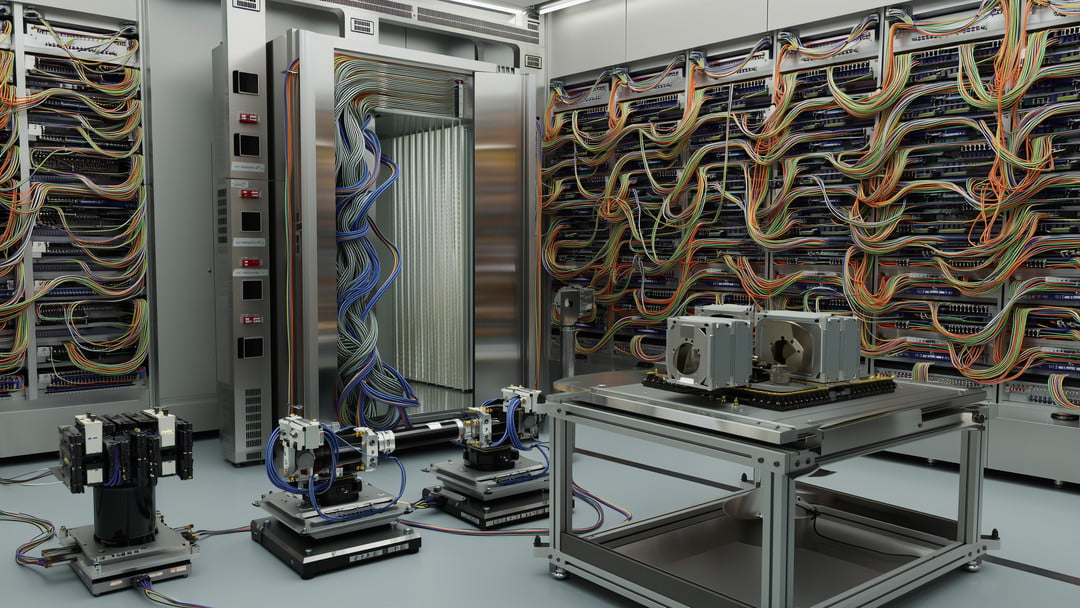
Traditional compute stacks mostly relied on room-temperature CMOS, copper interconnects, and standard clocking, while modern quantum stacks add cryogenics and vacuum systems, ultra-low-noise timing, and precision measurement chains that must stay stable over hours to days. The shift is less about faster chips and more about building an end-to-end instrument where software schedules operations, control electronics synthesize pulses, the QPU evolves fragile quantum states, and readout returns analog signals that must be amplified and digitized without adding excess noise. Rare earth elements matter because many supporting subsystems depend on high-performance magnets, optics, phosphors, catalysts, and specialty alloys that improve precision, thermal stability, and manufacturability. This article maps the full system stack for quantum computing components, identifies where rare earths show up in real hardware, and explains the mechanism by which materials choices affect noise, drift, and scalability. It also covers supply-chain steps, 2025-2026 market and deployment indicators to watch, key innovators, and the policy and supply risks that influence hardware roadmaps.
How Did Quantum Computing Components Change the Hardware Stack — and Why Do Rare Earths Matter?
Not long ago, most computing hardware stacks looked roughly the same. You had room-temperature silicon chips built on CMOS processes, copper interconnects linking them together, and standard clocking to keep everything synchronized. The whole system ran on a bench or in a server rack without much fuss about temperature, vacuum, or stray magnetic fields.
Quantum computing changed that picture completely. A modern quantum hardware stack is less like a server and more like a scientific instrument. It layers cryogenics or ultra-high vacuum on top of a quantum processing unit, adds ultra-low-noise timing and control electronics, and finishes with a precision measurement chain that has to stay stable for hours or even days at a stretch.
The shift is not really about "faster chips." It is about building an end-to-end system where software schedules quantum operations, control electronics synthesize precise pulses, the QPU evolves fragile quantum states, and readout hardware amplifies and digitizes analog signals without adding excess noise. Every layer depends on the one below it, and weak links anywhere in the chain degrade the whole system.
This is where rare earth elements enter the story. Many of the supporting subsystems — high-performance magnets, laser sources, fiber amplifiers, phosphor-based indicators, and specialty alloys — rely on rare earth materials to achieve the precision, thermal stability, and manufacturability that quantum hardware demands. The rest of this article maps those connections across the full system stack, identifies the specific rare earth elements involved, and explains how materials choices ripple into noise budgets, drift performance, and scalability.
Rare Earth Role in Quantum Computing Components
Which Elements Are Used and Why
Several rare earth elements show up repeatedly when you trace through the subsystems surrounding a quantum processor.
Neodymium and praseodymium are the backbone of NdFeB and PrNdFeB permanent magnets. These magnets enable compact, high-field actuators and precision positioning hardware used around dilution refrigerators, vacuum systems, and optical benches. According to the U.S. Geological Survey Mineral Commodity Summaries and reporting from Adamas Intelligence, NdFeB magnets remain the highest-volume end use for these elements.
Dysprosium and terbium are added to NdFeB magnet grades — sometimes through grain-boundary diffusion — to boost coercivity and temperature stability. This matters for magnets that sit in warm zones, vibration stages, or areas with higher stray fields. The International Energy Agency and the U.S. Department of Energy critical materials updates both flag Dy and Tb as strategically important precisely because they improve demagnetization resistance at elevated temperatures.
Samarium appears in SmCo magnets, which are selected when thermal stability, corrosion resistance, and high-temperature coercivity matter more than maximum energy product. ASM International handbooks and legacy technical literature from major magnet producers like Vacuumschmelze describe SmCo as the go-to choice for harsh thermal environments.
Yttrium, europium, terbium, and cerium are found in phosphors, scintillator materials, and specialty lighting relevant to instrumentation indicators, alignment aids, and certain imaging and diagnostics used in manufacturing and quality assurance. Philips Lighting materials literature and SPIE proceedings on phosphor performance document these applications.
Erbium, ytterbium, and neodymium show up as dopants in laser gain media and fiber amplifiers. Erbium-doped fiber amplifiers operating around 1550 nm are a staple of photonic and atomic-physics control stacks. The IEEE Photonics Society and NIST photonics notes provide detailed references on these materials.
How It Works
The connection between rare earths and quantum hardware performance follows a few clear paths.
In magnetic positioning and actuation, Nd/Pr/Dy/Tb magnet grades provide higher coercivity and reduced demagnetization risk under heat and stray fields. The practical outcome is more stable motion control and fewer re-alignments during the long calibration runs that quantum systems require.
In optical generation and amplification, Er/Yb/Nd doped fibers and crystals enable efficient stimulated emission with low relative intensity noise. That translates into cleaner laser control signals for atomic and photonic qubits, with improved stability margins that reduce the control chain's contribution to error budgets.
For display, indicator, and metrology illumination, Y/Eu/Tb/Ce phosphors deliver narrowband emission and high brightness. Lab and manufacturing staff get improved visibility for alignment and service operations without raising the heat load near sensitive hardware.
Materials selection under thermal constraints is a genuine engineering trade-off, not a case of "more magnet is better." Cryogenic platforms and vacuum systems tightly constrain heat, outgassing, and vibration. Meanwhile, warm stages near the top of a cryostat can get hot enough to demagnetize standard NdFeB unless the magnet is stabilized with Dy or Tb additions — or replaced entirely by SmCo. Designers choose the grade that meets the stability requirement at each thermal zone.
Journey from Mine to Product
Supply Chain Steps
The path from ore to quantum lab has many stages, and each one adds precision requirements.
Rare-earth-bearing ore is first mined and upgraded into a mineral concentrate. That concentrate is chemically processed — often through solvent extraction — to produce separated rare earth oxides. Those oxides are then converted into metals and alloyed for magnets, or purified and formed into doped host materials for optical and phosphor applications.
For magnets, the route typically includes alloy melting and strip casting, powder milling, pressing in a magnetic field to align grain orientation, sintering, heat treatment, machining to final dimensions, and coating to prevent corrosion. Only after all of that does a finished magnet get integrated into the actuators, motors, latches, and fixtures used inside quantum hardware tooling.
For optical and photonic components, the route involves high-purity dopant material preparation, crystal growth or glass and fiber preform fabrication, precise dopant concentration control, and optical coating steps. The resulting lasers, amplifiers, and modulators then become part of the quantum control and test infrastructure.
Final integration into quantum computing components happens at the subsystem level. Magnets go into vacuum and cryostat assemblies, optical components populate benches and fiber networks, and everything feeds into control racks. Acceptance testing emphasizes drift, noise, and repeatability — not just whether a part meets its nominal spec on day one.
Typical Chokepoints
Separation capacity is the first major bottleneck. High-purity oxides with consistent impurity profiles are needed for predictable magnetic and optical properties. The International Energy Agency and the U.S. Department of Energy supply chain assessments both highlight separation as the stage where quality and throughput constraints bite hardest.
Heavy rare earths — notably dysprosium and terbium — face tighter availability and more geographically concentrated processing. That can constrain the supply of high-coercivity magnet grades needed for thermally stressed subsystems.
Specialized downstream steps also limit throughput. Sintering large magnet lots to tight tolerances, growing high-purity crystals, and applying precision optical coatings are all scale-limited processes. These can dominate lead times for the components that quantum labs and pilot manufacturing lines need.
Statistics and Societal Impact
Quantitative Snapshot
Market tracking firms have been refining their estimates of quantum computing hardware spending. According to IDC's 2025–2026 forecasts, hardware and control infrastructure investment is growing faster than the software layer, reflecting the engineering reality that scaling qubit counts means scaling the entire control and readout chain.
Installed base indicators give a sense of physical scale. Public disclosures from IBM, Quantinuum, IonQ, Atom Computing, QuEra, and major national laboratories suggest that the combined number of operational dilution refrigerators, ion-trap systems, and neutral-atom platforms worldwide is now in the hundreds, with the superconducting modality accounting for the largest share. These numbers should be understood as reported deployments, not theoretical capacity.
Bill-of-materials proxies help estimate rare earth exposure. Engineering teardown norms published in SPIE and IEEE instrumentation proceedings, along with vendor datasheets, suggest that a single control rack or optical table build can contain anywhere from tens of grams to a few kilograms of rare-earth magnet material, depending on the number of positioning stages and actuators. Laser and amplifier modules typically contain milligram-to-gram quantities of rare-earth-doped gain media.
Supply concentration remains a structural feature of the rare earth market. According to the 2025 and 2026 editions of the U.S. Geological Survey Mineral Commodity Summaries, China continues to dominate both mining and midstream processing, with heavy REE refining being even more concentrated than light REE refining.
Downstream Effects
Better magnetic and optical stability in the control chain reduces how often a quantum system needs recalibration. That directly translates into more productive experiment time per day — a metric that lab managers and system operators care about deeply.
Measurement quality improvements show up as higher readout fidelity, lower phase noise in control references, and reduced vibration and thermal excursions. These improvements lower the effective error rates seen by compilers and error mitigation software, even if the qubit's intrinsic coherence stays the same.
The societal impact of these improvements should be framed honestly. Quantum computing infrastructure in 2026 is enabling research and high-assurance computing experimentation. It is not yet delivering routine commercial advantage in most domains. National lab roadmaps and major vendor technology updates from 2025 and 2026 consistently describe the current era as one of engineering scale-up and error-rate reduction, not breakthrough applications.
Innovators and History
Key Breakthroughs
The development of rare-earth permanent magnets reshaped precision instrumentation long before quantum computing existed. The NdFeB magnet, developed in the early 1980s, made compact high-field actuators practical. SmCo magnets, developed even earlier, provided the thermal stability needed for demanding environments. ASM International historical reviews and IEEE materials retrospectives document how these magnet families became foundational to motion control and positioning hardware.
In photonics, the maturation of erbium-doped fiber amplifiers in the late 1980s and 1990s transformed telecommunications and, eventually, atomic and photonic quantum platforms. Stable, narrow-linewidth optical sources became available off the shelf, lowering the barrier for labs building optical control systems. NIST and IEEE Photonics Society historical overviews trace this progression.
On the quantum platform side, key milestones with direct component relevance include the industrialization of dilution refrigerators for superconducting QPUs, the development of scalable ion-trap vacuum and laser control stacks, and the emergence of neutral-atom tweezer array control systems. Vendor technical roadmaps and national lab program reports from 2025 and 2026 describe these as the engineering achievements that moved quantum hardware from one-off lab demonstrations to repeatable manufactured systems.
From Lab to Product
The transition from lab prototype to manufactured product did not hinge on a single "breakthrough chip." It happened through the slow, unglamorous work of standardizing connectors, clock distribution schemes, RF shielding practices, and vacuum component catalogs. Repeatable calibration pipelines — software that can bring a system to spec after maintenance or a cooldown cycle — were just as important as any qubit improvement.
National labs and university research groups de-risked many of the underlying techniques. OEMs then packaged those techniques into systems with serviceability, documentation, and quality assurance processes. IBM's published technical notes on their quantum systems, Quantinuum's trapped-ion engineering disclosures, and major cryogenics suppliers' application guides all illustrate this pattern of academic innovation followed by industrial hardening.
Why It Matters Now
Current Drivers
The main driver in 2025 and 2026 is the pivot from demonstration devices to engineered systems with quantified error budgets. In this environment, control electronics, timing distribution, and readout chains become first-order constraints on how far a system can scale. The QPU is important, but so is everything around it.
Integration density is another pressure point. More qubits means more control channels, more cabling, more heat load into the cryostat, and more stringent electromagnetic interference control. Components that reduce size, drift, or service time become strategically valuable — and many of those components depend on rare earth materials for their performance.
Workforce and procurement realities also play a role. Engineering teams increasingly need a common component taxonomy to compare superconducting, trapped-ion, neutral-atom, and photonic stacks side by side. Understanding where rare earths fit in the hardware map helps technical buyers and program managers ask better questions about supply risk and substitutability.
Security and Policy Context
Supply concentration risk is most acute at the midstream processing stage — separation, metal making, and alloying — rather than at the mine. The International Energy Agency, the U.S. Department of Energy, and the U.S. Geological Survey have all emphasized this point in their 2025 and 2026 assessments.
Onshoring and "friend-shoring" efforts, rare earth recycling pilots, and critical-minerals stockpiling policies are all actively influencing lead times and price volatility for high-coercivity magnet grades and high-purity optical materials. These policy moves affect the quantum hardware supply chain even though quantum demand is a small fraction of total rare earth consumption.
Export controls and standards discussions now explicitly include measurement equipment, cryogenics, and advanced materials as part of broader technology security policy. Public policy summaries from the European Commission and U.S. government releases from 2025 and 2026 frame these controls as part of a layered approach to protecting strategic technology capabilities.
Future Outlook
Materials and Design Trends
Magnet design is moving toward reduced Dy and Tb content through grain-boundary diffusion techniques and improved microstructure control. SmCo is being used more selectively in hot zones where NdFeB cannot perform reliably. Some hardware designers are also redesigning mechanisms to need fewer high-grade magnets while maintaining the same positioning stability. The International Energy Agency and ASM International materials society reviews both track these trends.
In photonics, the push is toward higher integration of frequency stabilization, lower-noise laser packages, and more manufacturable photonic assemblies for trapped-ion, neutral-atom, and photonic quantum systems. Rare-earth-doped fiber amplifiers remain common where fiber-based architectures dominate. NIST and IEEE Photonics publications describe these developments as evolutionary improvements rather than disruptive shifts.
Recycling and circularity are worth mentioning, but with realism. Magnets are technically recyclable, and several pilot programs exist. However, the collection and separation logistics remain difficult, and quantum-specific demand is tiny compared to the electric vehicle and wind turbine sectors that consume most magnet output. Quantum hardware benefits from — but does not drive — broader magnet recycling economics.
Five-to-Ten-Year Scenario
Demand for rare earths in quantum hardware will likely grow as control stacks get larger and instrument channel counts increase. But this growth should be expressed as a range tied to actual deployment rates, not as a guaranteed "quantum boom." Market outlooks from IDC and Gartner for 2025–2026, along with government program plans, suggest steady but not explosive growth in physical quantum hardware installations over the next decade.
The most likely bottlenecks include midstream REE processing capacity, precision manufacturing throughput for coatings and crystal growth, vacuum hardware availability, and test and QA time for low-noise electronics. These constraints are shared with other high-precision industries, which means quantum hardware competes for the same limited capacity.
Mitigation levers are available. Qualifying materials from multiple sources, designing hardware to tolerate a range of magnet grades, and building calibration software that can compensate for component drift all reduce sensitivity to supply shocks. None of these fully substitute for stable supply, but they buy engineering teams meaningful flexibility.
Glossary
NdFeB and SmCo are the two main families of rare-earth permanent magnets. NdFeB offers the highest energy product (strongest field for its size), while SmCo provides superior thermal stability and corrosion resistance. The choice between them depends on the operating temperature and environmental conditions of the subsystem.
Coercivity is a measure of a magnet's resistance to demagnetization. Higher coercivity means the magnet holds its field strength better when exposed to heat, opposing fields, or mechanical shock. Temperature coefficients describe how fast magnetic properties change per degree of temperature change.
Grain-boundary diffusion is a manufacturing technique where heavy rare earths like Dy or Tb are introduced at the grain boundaries of an NdFeB magnet rather than throughout the bulk. This improves coercivity while using less of the scarce heavy REE material.
Sintering is the process of compacting and heating a pressed magnet powder to form a dense, solid body. Sintering conditions strongly affect grain structure, density, and final magnetic properties.
Rare-earth dopant refers to a small, controlled concentration of a rare earth ion (such as Er, Yb, or Nd) introduced into a glass, crystal, or fiber host to create a laser gain medium. The dopant provides the energy levels needed for stimulated emission at specific wavelengths.
Gain medium is the material inside a laser or amplifier where stimulated emission occurs. In quantum control systems, gain media doped with rare earth ions produce the stable, narrow-linewidth light needed to manipulate atoms or photons.
Phosphor is a material that absorbs energy (often ultraviolet light or electrons) and re-emits it as visible light. Rare-earth phosphors produce narrow emission bands useful for indicators and alignment aids.
Outgassing is the release of trapped gases from materials placed in vacuum. Components used in cryostats and vacuum chambers must have very low outgassing rates to maintain the pressures needed for qubit operation.
FAQs
Are rare earths inside the qubits themselves in quantum computing components?
In many platforms, rare earth elements are more common in supporting hardware such as magnets, lasers, amplifiers, and sensors than in the qubit material itself, especially for superconducting circuits where qubits are patterned metals on substrates. Some approaches use REE dopants or REE-related photonics in the control and measurement chain, and specialized research explores REE ions as quantum memories, but those are not the dominant commercial qubit implementations as of 2026.
Which quantum modality relies most on rare-earth magnets versus rare-earth photonics?
Magnet reliance is strongest in subsystems needing compact, stable actuation or positioning, which show up across modalities in vacuum and cryostat mechanics and lab automation, so it is not exclusive to one qubit type. REE photonics such as Er and Yb doped fiber amplifiers is most visibly tied to ion, neutral-atom, and photonic platforms because their primary control signals are optical rather than microwave pulses.
Do rare-earth materials affect qubit error rates directly?
Rare earth elements usually influence error rates indirectly by improving stability of control fields, mechanical alignment, and signal integrity, which reduces drift, phase noise, and recalibration frequency. The direct error budget is still dominated by decoherence mechanisms at the qubit and interconnect level, but the control and readout chain can become the limiting factor as systems scale in channel count.
What are the main supply risks for rare earths used in quantum hardware stacks?
The highest leverage risks tend to be in separation and alloying capacity, especially for heavy REEs like Dy and Tb used in high-coercivity magnet grades. Even when quantum demand is small, it can inherit volatility from larger markets such as EV motors, wind turbines, and industrial drives that consume most magnet output.
How should engineers map rare earths onto an end-to-end quantum system view?
A practical mapping is to tag rare earth elements to subsystems including motion, actuation, and latching using Nd, Pr, Dy, Tb, and Sm magnets, optical generation and amplification using Er, Yb, and Nd dopants, and instrumentation indicators and lighting using Y, Eu, Tb, and Ce phosphors. Then relate each to a measurable engineering outcome such as thermal margin, drift, phase noise, alignment stability, or service interval so materials choices connect to the same error budgets used by calibration and control software teams.
Conclusion
Rare earth elements play a foundational but often overlooked role in quantum computing components. They appear not in the qubits themselves for most commercial platforms but throughout the supporting infrastructure of magnets, lasers, amplifiers, and instrumentation that keeps quantum systems stable and measurable. As the industry pivots from demonstration devices to engineered systems with quantified error budgets in 2025 and 2026, the reliability and availability of these materials become increasingly important. Supply chain concentration in midstream processing, heavy REE constraints, and precision manufacturing throughput represent real bottlenecks. Engineers and procurement teams benefit from mapping rare earths to specific subsystems and measurable outcomes such as thermal margin, drift, phase noise, and service intervals. By connecting materials choices to the same error budgets used by calibration and control software, organizations can make informed decisions about sourcing, design flexibility, and long-term scalability of their quantum hardware stacks.