
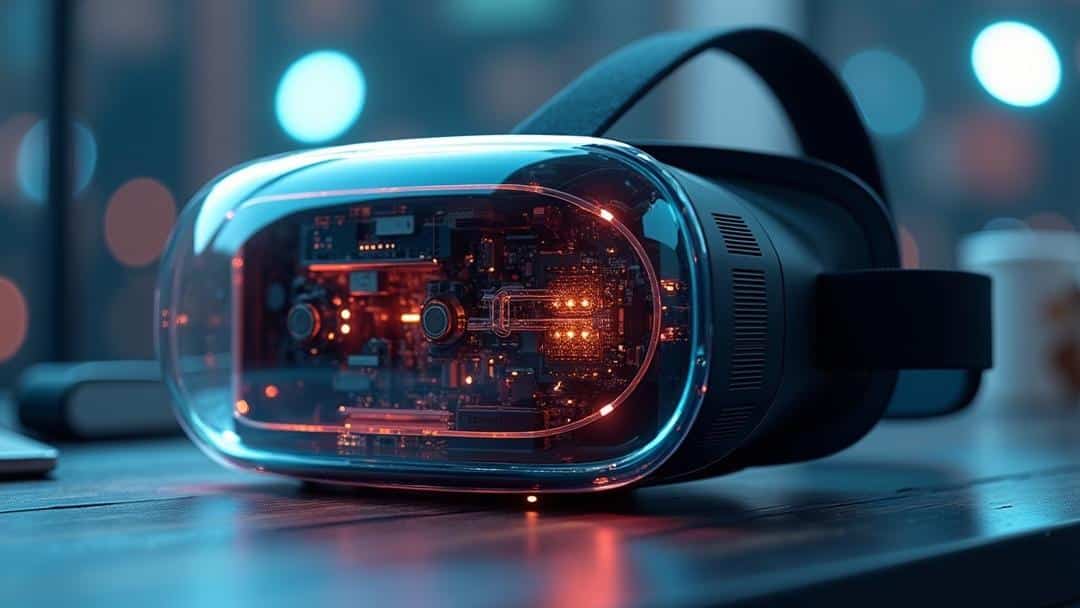
Virtual reality headsets revolutionized human-computer interaction by replacing flat screens with head-worn displays that fuse motion tracking, near-eye optics, and spatial audio for embodied presence. Rare earth elements (REEs) enable these advances through high-energy magnets for haptics and audio, high-index optical glass for compact lenses, efficient LED phosphors, and precision polishing compounds. This comprehensive guide explores which REEs appear in VR systems, their materials-level functions, supply chain dynamics, and the intersection of market statistics with societal impact.
Table of Contents
How did virtual reality headsets change human–computer interaction?
Before virtual reality headsets arrived, computer interaction meant staring at flat screens while sitting at a desk. We used keyboards, mice, and game controllers to navigate digital worlds that stayed trapped behind glass. Even the best gaming monitors and surround-sound speakers couldn't make you feel like you were actually inside the experience.
VR headsets changed everything by putting displays directly in front of your eyes and tracking your head movements in real time. When you turn your head, the view changes instantly, just like in real life. Motion sensors follow your hands and body, while spatial audio makes sounds come from the right directions. This creates what researchers call "embodied presence" — the feeling of actually being somewhere else.
The shift from external screens to head-worn displays required major advances in optics, displays, and miniaturization. Modern VR systems achieve latencies under 20 milliseconds (opens in a new tab) between head movement and visual response, fast enough to prevent motion sickness for most users. Achieving this performance in a device light enough to wear comfortably depends heavily on rare earth elements.
The Rare Earth Role in Virtual Reality Headsets
Which Elements Power VR Technology
The most important rare earth elements in VR headsets are neodymium and praseodymium. These elements create super-strong permanent magnets that power the tiny speakers in your headset and the vibration motors in hand controllers. Neodymium-iron-boron (NdFeB) magnets deliver up to 10 times the magnetic strength of traditional ferrite magnets at the same size.
For headsets that need to work in warm environments or near heat-generating electronics, manufacturers add small amounts of dysprosium or terbium. These heavy rare earths help magnets maintain their strength at temperatures up to 200°C (opens in a new tab), preventing demagnetization when components heat up during extended use.
The display system relies on different rare earths. Many VR headsets use LCD panels with LED backlights that contain cerium and europium. Cerium converts blue LED light into yellow wavelengths through YAG:Ce phosphors, creating the white light needed for full-color displays. Some systems also use terbium for green phosphors to improve color accuracy.
The optical lenses that focus images for each eye often contain lanthanum. Lanthanum oxide increases the refractive index of optical glass while controlling color dispersion, allowing engineers to design thinner lens assemblies. This is crucial for modern "pancake" optics that reduce the bulk of VR headsets.
Even the manufacturing process depends on rare earths. Cerium oxide serves as the primary polishing compound for precision optical surfaces (opens in a new tab), achieving the nanometer-scale smoothness required for clear VR visuals.
How Rare Earths Make VR Work
The haptic feedback you feel when grabbing virtual objects comes from linear resonant actuators containing NdFeB magnets. These magnets generate precise vibrations using less power than older technologies (opens in a new tab), extending battery life while providing more realistic touch sensations. The same magnets drive the speakers that deliver spatial audio, creating soundscapes that change as you move your head.
Inside LCD-based VR displays, blue LEDs shine through YAG:Ce phosphor coatings to produce white backlighting. This conversion process achieves over 150 lumens per watt efficiency (opens in a new tab), generating bright images without excessive heat. Less heat means smaller cooling systems and longer component life.
The lenses between your eyes and the display screens use lanthanum-enriched glass to bend light more sharply than regular glass. High-index lanthanum crown glass achieves refractive indices above 1.8 (opens in a new tab) while minimizing chromatic aberration that would blur colors at the edges of your view. This allows the entire lens stack to be thinner and lighter.
Temperature management relies on rare earth additions to maintain performance. Grain-boundary diffusion adds dysprosium or terbium only to the outer edges of magnet crystals (opens in a new tab), creating heat-resistant shells around standard NdFeB cores. This technique uses 50-80% less heavy rare earths than mixing them throughout the entire magnet.
Journey from Mine to Product
From Ore to Oxide
The path from underground deposits to working VR headsets spans multiple continents and specialized facilities. Mining operations extract rare earth ores like bastnäsite and monazite, which contain mixtures of all 17 rare earth elements. China processes about 85% of global rare earth ores, though new facilities in the United States and Australia are increasing Western capacity.
Separating individual rare earths requires hundreds of chemical extraction steps. Facilities dissolve the ore in acid, then use solvent extraction to isolate specific elements based on their slightly different chemical properties. Producing one kilogram of separated dysprosium oxide generates approximately 2,000 kilograms of waste material (opens in a new tab).
Creating Components
Pure rare earth oxides get converted into metals through high-temperature reduction processes. For magnets, manufacturers melt neodymium, iron, and boron together in precise ratios, then rapidly cool the alloy into fine powder. This powder gets pressed in strong magnetic fields and sintered at 1,100°C to create finished magnets.
Phosphor production follows a different path. Manufacturers mix yttrium, aluminum, and cerium oxides, then heat them to create crystalline YAG:Ce powder. LED makers apply thin coatings of these phosphors over blue LED chips to generate white light for displays.
Optical glass containing lanthanum requires careful melting and cooling cycles to achieve uniform composition. Glass manufacturers must control lanthanum oxide content to within 0.1% tolerance to maintain consistent optical properties across lens batches.
Final Assembly Challenges
VR headset assembly brings these components together with extreme precision. Teardowns of devices like the Meta Quest 3 (opens in a new tab) reveal dozens of tiny NdFeB magnets distributed throughout the system — in speakers, haptic actuators, cooling fans, and position sensors.
The biggest supply chain bottleneck occurs at the separation stage. Heavy rare earths like dysprosium are 100 times less abundant than light rare earths like cerium, and deposits containing them are geographically limited. Most heavy rare earth production comes from ion-adsorption clay deposits in southern China.
Magnet manufacturing represents another chokepoint. Over 90% of NdFeB magnet production capacity is located in China, though Japan maintains significant technical expertise in high-performance grades. New facilities in Texas and other locations aim to diversify this supply chain.
Statistics and Societal Impact
Market Scale and Growth
The VR industry has grown from a niche market to mainstream adoption. Global VR headset shipments reached 8.8 million units in 2022 (opens in a new tab), with projections suggesting continued double-digit growth through 2027. Meta alone has sold approximately 20 million Quest headsets since launching the product line in 2019.
Each headset contains measurable amounts of rare earth elements. A typical VR headset uses 2-5 grams of neodymium and praseodymium in its magnets, plus smaller amounts of dysprosium for high-temperature resistance. Display phosphors and optical components add milligrams of cerium, europium, and lanthanum.
Real-World Benefits
The superior performance of rare earth magnets directly impacts user experience. NdFeB magnets provide 5-10 times more force than ferrite alternatives at the same weight, enabling haptic actuators strong enough to simulate texture and resistance. This matters for training simulations where realistic feedback improves skill transfer.
Efficient LED phosphors reduce the power needed for bright displays. Modern YAG:Ce phosphors achieve quantum efficiencies above 90%, meaning almost all absorbed blue light gets converted to useful white light. Lower power consumption extends battery life and reduces heat generation, allowing longer training or gaming sessions.
The compact optics enabled by lanthanum glass have made VR headsets practical for extended wear. High-index glass reduces lens stack thickness by 30-40% compared to conventional glass, bringing the center of gravity closer to the user's face and reducing neck strain.
Innovators and History
Magnet Breakthroughs
The foundation for modern VR hardware traces back to the 1980s. Masato Sagawa at Sumitomo Special Metals and researchers at General Motors independently discovered NdFeB magnets in 1984. These magnets offered twice the energy density of previous rare earth magnets, revolutionizing everything from computer hard drives to electric motors.
Initial NdFeB magnets lost their magnetization at relatively low temperatures. Researchers discovered that adding 2-6% dysprosium increased operating temperatures from 80°C to over 150°C, making the magnets suitable for electronics that generate heat during operation.
Display Evolution
The development of white LEDs using rare earth phosphors transformed display technology. Shuji Nakamura's blue LED breakthrough in the 1990s provided the foundation, but creating white light required phosphor innovations. YAG:Ce phosphors emerged as the most efficient solution, enabling the bright, compact displays essential for VR.
Optical advances came through systematic improvements in glass chemistry. Schott and Ohara developed lanthanum (opens in a new tab) crown glasses with refractive indices exceeding 1.9 (opens in a new tab) while maintaining low dispersion. These materials made possible the folded optical paths used in modern pancake lenses.
Manufacturing Innovation
Recent advances focus on reducing rare earth content without sacrificing performance. Shin-Etsu Chemical pioneered grain-boundary diffusion in 2010, allowing manufacturers to add dysprosium only where needed most. This technique cuts heavy rare earth usage by more than half while maintaining temperature resistance.
Production has scaled dramatically from laboratory curiosities to mass manufacturing. Global NdFeB magnet production exceeded 200,000 metric tons in 2022, with automated facilities producing millions of tiny magnets for consumer electronics daily.
Why It Matters Now
Current Technology Drivers
VR technology is advancing toward lighter, higher-resolution systems with better tracking and longer battery life. Next-generation displays target 4K resolution per eye with 120Hz refresh rates (opens in a new tab), requiring more efficient backlighting and better optical systems. These improvements depend on continued advances in rare earth materials.
Enterprise applications are driving demand for reliable, comfortable headsets. Military training programs use VR to reduce costs and improve safety, while healthcare providers employ VR for surgical planning and rehabilitation therapy. These professional uses require consistent performance over thousands of hours.
Supply Chain Vulnerabilities
The concentration of rare earth processing creates strategic risks. China controls approximately 85% of rare earth oxide production and 90% of metal and alloy production. This dominance extends through the entire magnet supply chain.
Recent policy changes highlight these vulnerabilities. China banned exports of rare earth extraction and separation technologies in December 2023, restricting access to critical processing knowledge. MP Materials is investing $700 million to build integrated U.S. magnet production, aiming to establish domestic supply chains.
While large players like MP Materials are investing heavily in vertically integrated magnet production, smaller U.S. manufacturers are also working to close the gap at the component level. Companies such as Vulcan Elements, a U.S. rare earth magnet manufacturer producing NdFeB rare earth magnets manufactured in the United States (opens in a new tab), are focused on producing high-performance permanent magnets domestically for applications that demand compact size, precision, and reliability. These characteristics are critical for VR headset audio drivers, haptic actuators, and motion tracking components, where magnet performance directly affects user experience, thermal stability, and battery life.
Future Outlook
Technology Evolution
Materials science continues advancing to reduce rare earth dependency. Grain-boundary diffusion techniques now achieve the same temperature resistance using 70% less dysprosium. Researchers are exploring iron-nitrogen and manganese-based magnets as potential alternatives, though none match NdFeB performance yet.
Display technology is shifting toward self-emissive screens. MicroLED and advanced OLED panels eliminate the need for rare earth phosphors in backlighting, though they still require rare earth magnets for audio and haptics. Emerging pancake and waveguide optics use even more sophisticated high-index glasses, maintaining demand for lanthanum.
Recycling and Sustainability
Recovering rare earths from electronic waste is becoming economically viable. The University of Birmingham's Hydrogen Processing of Magnet Scrap (HPMS) technique can recover 90% of rare earths from used magnets. HyProMag is scaling this technology for commercial recycling, targeting consumer electronics including VR headsets.
Collection remains the biggest challenge. VR headsets contain dozens of tiny magnets scattered throughout the device, making manual disassembly labor-intensive. Automated recycling systems are being developed to efficiently separate and process these components.
Demand Projections
VR represents a small but growing segment of rare earth demand. Electric vehicles and wind turbines will drive 90% of NdFeB magnet demand growth through 2030, but VR and AR devices could consume several hundred tons of rare earth magnets annually by decade's end.
Supply chains are slowly diversifying. MP Materials plans to produce 1,000 tons of NdFeB magnets annually at its Fort Worth facility by 2025. Australian, Canadian, and African rare earth projects are advancing, though most will take 5-10 years to reach full production.
The balance between supply and demand will likely remain tight for critical elements like dysprosium and terbium. Continued innovation in thrifting techniques and recycling will be essential to support growing VR adoption without creating new supply bottlenecks.
Conclusion
Rare earth elements are fundamental enablers of modern VR technology, from the neodymium magnets in haptic actuators to the lanthanum glass in precision optics. As VR adoption accelerates across consumer and enterprise markets, understanding REE supply chains, innovation pathways, and recycling potential becomes crucial for sustainable growth. While challenges remain in geographic concentration and processing bottlenecks, ongoing advances in materials efficiency, recycling technologies, and supply chain diversification offer paths toward resilient VR ecosystem development.
FAQs
Which rare earths are most likely inside virtual reality headsets?
Expect Nd/Pr with possible Dy/Tb in speakers, haptics, and motors; La in high-index optical glass; Ce in polishing slurries and YAG:Ce phosphors for LCD backlights; and Y in YAG host materials. The exact mix varies by display type and vendor choices.
Do OLED-based headsets avoid rare earth elements entirely?
No. While OLED panels don't require REE phosphors for light generation, headsets still use REE magnets in audio/haptics, lanthanum-containing optical glass, and ceria for optics polishing. Additional REE components may appear in fans or motorized IPD systems.
How much dysprosium or terbium does a typical headset use?
The mass is small and depends on magnet grade and thermal rating. Heavy REEs are often confined to grain boundaries in NdFeB to boost coercivity, minimizing total Dy/Tb content through grain-boundary diffusion rather than bulk additions.
Are there viable REE-free alternatives for VR magnets?
Ferrite magnets avoid REEs but have much lower energy density, leading to heavier actuators or weaker output—undesirable in head-worn devices. Some designs can partially substitute with ferrites, but premium audio/haptics typically retain NdFeB for performance.
Can the rare earths in VR headsets be recycled?
Yes, magnets are increasingly recoverable via hydrogen processing and re-sintering, with pilots progressing toward consumer electronics streams. Optical compounds and phosphors have emerging but less mature pathways. Scaling collection and disassembly remains the main barrier for small devices.
