
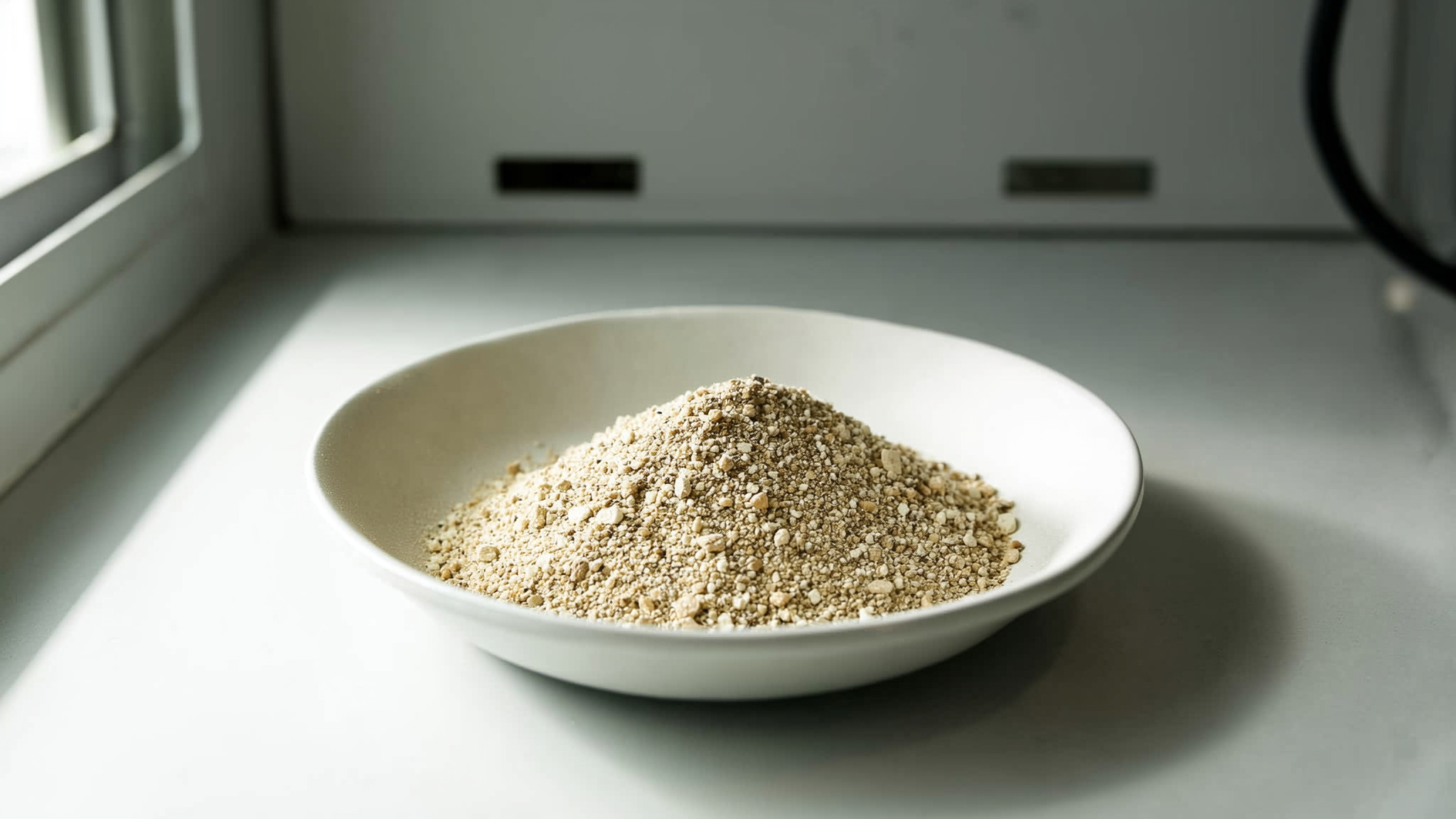
If you are asking what is TREO, the short answer is that it is a grade: total rare earth oxide, the one percentage a mining company puts at the top of a resource statement. The number looks simple. Behind it sit choices about which elements are counted, which oxide forms are used and which lab method produced the raw data, and each choice moves the figure. This guide explains where TREO comes from, how to convert an assay to it, why a high TREO grade is not the same as a valuable one, and what to check on a certificate of analysis before you trust the number. For background on the 17 elements themselves, start with what rare earth minerals are and who controls the 17 elements.
Table of Contents
What is TREO in rare earth reporting?
TREO, or total rare earth oxide, is the sum of the rare earth oxides in a sample, expressed as a weight percent. It is the standard headline grade in resource statements. TREO normally covers the elements from lanthanum through lutetium plus yttrium, fifteen in all. Scandium is usually left out, even though it is a rare earth element. Promethium, which has no stable isotope, is not listed. The definition published by OD6 Metals, an ASX-listed rare earth explorer (opens in a new tab) treats TREO as heavy plus light rare earth oxides across that same list. Geoscience Australia (opens in a new tab) counts yttrium and scandium among the rare earths.
The plain-English definition
Think of TREO as one grade that rolls up many individual oxide grades. A rock might carry small amounts of a dozen different rare earth oxides, and TREO adds them into a single percentage. That single number is easy to compare across deposits, which is why most press releases lead with it.
Which elements are counted (and the yttrium and scandium footnote)
The core list runs La, Ce, Pr, Nd, Sm, Eu, Gd, Tb, Dy, Ho, Er, Tm, Yb and Lu. Yttrium usually joins them, making fifteen. That is the OD6 Metals element list for TREO.
Scandium is not listed in the OD6 TREO definition, and USGS excludes most scandium from its REO basis. Yttrium is the one to watch. Geoscience Australia's footnote for one deposit excludes Y2O3 from the TREO line, so check the footnotes on any statement to see whether yttrium is inside or outside the number.
Why do companies report grade as oxide, not metal?
Geoscience Australia's resource review describes rare earth content reported as oxides, and Arafura and Lynas both follow that convention when they state grade as % TREO. A lab does not usually measure oxide directly. An ICP-MS assay returns each element in parts per million. The lab or geologist then converts those element results to oxide using fixed stoichiometric factors and adds the oxides together. ALS shows both paths on its method page (opens in a new tab): ME-MS81h reports element ppm, while its fusion-XRF method reports oxides. A resource statement therefore carries a number one step removed from what the instrument measured, and the factor set used for that step decides the last decimal.
What a lab actually measures
For ore-grade rock, ICP-MS reads each element and returns a concentration in ppm. That is an element result. Fusion-XRF is the exception; it reports analytes already in oxide form, so an XRF certificate lists La2O3 and Nd2O3 directly.
TREO is a calculated number
Because most assays return elements, the TREO on a certificate was built afterward with whichever factor set the lab or geologist chose. That choice belongs in the footnotes. A reader who knows the factor set can check the number.
Element-to-oxide conversion table
Each factor is the oxide molar mass divided by the mass of metal in that oxide. Different reporters may round differently or use older atomic weights, so a recomputed TREO can differ in the third decimal even from the same raw assay.
How the factor is calculated (worked example: Nd to Nd2O3)
Take the molar mass of the whole oxide and divide it by the mass contributed by the metal alone. For Nd2O3, two neodymium atoms and three oxygen atoms make up the oxide. Neodymium's standard atomic weight is 144.242, so the two Nd atoms weigh 288.484. Oxygen's abridged standard atomic weight is 15.999, so the three oxygen atoms add 47.997, and the whole oxide comes to 336.481.
Dividing 336.481 by 288.484 gives 1.1664, the factor listed in the table below.
The same arithmetic works for every element once you know its oxide formula and atomic weight. Those two inputs never change, so the factor is the same for every deposit.
Conversion factors for the 16 rare earth elements (including scandium)
Scandium sits in the table for reference only.
| Element | Oxide | Factor |
|---|---|---|
| La | La2O3 | 1.1728 |
| Ce | CeO2 | 1.2284 |
| Pr | Pr6O11 | 1.2082 |
| Nd | Nd2O3 | 1.1664 |
| Sm | Sm2O3 | 1.1596 |
| Eu | Eu2O3 | 1.1579 |
| Gd | Gd2O3 | 1.1526 |
| Tb | Tb4O7 | 1.1762 |
| Dy | Dy2O3 | 1.1477 |
| Ho | Ho2O3 | 1.1455 |
| Er | Er2O3 | 1.1435 |
| Tm | Tm2O3 | 1.1421 |
| Yb | Yb2O3 | 1.1387 |
| Lu | Lu2O3 | 1.1372 |
| Y | Y2O3 | 1.2699 |
| Sc | Sc2O3 | 1.5338 |
Worked example: turning an assay row into %TREO
Start with the element column of the certificate. Take one element at a time and multiply its ppm value by the factor from the table. Neodymium uses 1.1664, and cerium uses 1.2284 because its oxide is CeO2. Do that for every rare earth in the list, then add the oxide values together.
Dividing the sum by 10,000 converts ppm to percent, and that percentage is TREO. If the certificate includes yttrium, decide whether it belongs inside your TREO line and write that choice down next to the number. A row-by-row sum like this is also the quickest way to check a published TREO, since any gap between your sum and theirs points to a different factor set, a different element list or a rounding step.
Ce, Pr and Tb: why the oxide formulas differ
Most rare earths form a sesquioxide, written M2O3. Cerium, praseodymium and terbium settle into other forms, so cerium reports as CeO2, praseodymium as Pr6O11 and terbium as Tb4O7. These mixed-valence oxides carry more oxygen per metal atom, which is why their factors sit apart from their neighbors in the table. ALS lists these same oxide forms on its fusion-XRF method.
Talk to REEx about testing and verification
Why TREO% is not value: the NdPr and magnet-oxide share
TREO counts every rare earth oxide equally, so it hides which oxides you actually have, and value sits mostly in neodymium, praseodymium, dysprosium and terbium. Two deposits can carry the same TREO grade and be worth very different amounts. Arafura reports its Nolans resource both ways, stating grade in % TREO alongside the NdPr share of that TREO, so a reader can see the magnet fraction directly. The Arafura Nolans project (opens in a new tab) figures are in the key figures table on this page. Lynas states Mt Weld grade in % TREO and sizes its plant capacity in metric tons of NdPr oxide. For the ionic-clay case, see SREO vs TREO: the rare earth metric investors keep getting wrong.
Two deposits, same TREO, different economics
A deposit heavy in cerium and lanthanum can post a strong TREO number while carrying little of the magnet metals, and a leaner deposit rich in NdPr can be worth more per metric ton. Neodymium drives much of that value, as covered in neodymium: the magnet rare earth that drives most deposit value.
NdPr share, MREO share, and the Nolans model
The NdPr share tells you how much of the grade is the magnet fraction. A broader magnet oxide share, commonly written MREO, adds dysprosium and terbium to that pair. Nolans is the layout to look for. When a company gives only TREO, the magnet share is missing.
Key figures (verified 2026-09-16)
| Item | Value | Source | As of |
|---|---|---|---|
| TREO element scope | La–Lu + Y (15); Sc and Pm not listed | OD6 Metals (opens in a new tab) | 2026-09-16 |
| Rare earth element count | 15 lanthanides + Y + Sc = 17 | Geoscience Australia (opens in a new tab) | 2023-12-19 |
| Usual reporting basis | Rare earth oxides and Y2O3, not elemental metal | Geoscience Australia (opens in a new tab) | 2023-12-19 |
| Y2O3 in TREO | Varies by reporter; one GA deposit footnote excludes Y2O3 | Geoscience Australia (opens in a new tab) | 2023-12-19 |
| USGS reporting basis | REO equivalent; lanthanides + Y, most Sc excluded | USGS MCS 2026 (opens in a new tab) | 2026-02-01 |
| World mine production 2025 (est.) | 390,000 t REO equiv. (China 270,000 t) | USGS MCS 2026 (opens in a new tab) | 2026-02-01 |
| US mine production 2025 | 51,000 t REO in concentrate | USGS MCS 2026 (opens in a new tab) | 2026-02-01 |
| World reserves | >85,000,000 t REO equiv. | USGS MCS 2026 (opens in a new tab) | 2026-02-01 |
| Nolans Mineral Resource (total) | 56 Mt at 2.6% TREO; NdPr 26.4% of TREO | Arafura Rare Earths (opens in a new tab) (company-reported, JORC 2012) | 2017-06-07 |
| Nolans Measured Resource | 3.2% TREO; NdPr 26.1% of TREO | Arafura Rare Earths (opens in a new tab) (company-reported, JORC 2012) | 2017-06-07 |
| Nolans Indicated Resource | 2.7% TREO; NdPr 26.4% of TREO | Arafura Rare Earths (opens in a new tab) (company-reported, JORC 2012) | 2017-06-07 |
| Nolans Inferred Resource | 2.3% TREO; NdPr 26.5% of TREO | Arafura Rare Earths (opens in a new tab) (company-reported, JORC 2012) | 2017-06-07 |
| Nolans Ore Reserve | 29.5 Mt at 2.9% TREO; NdPr 26.4% of TREO | Arafura Rare Earths (opens in a new tab) (company-reported, JORC 2012) | 2020-03-16 |
| Mt Weld Mineral Resource | 106.6 Mt at 4.12% TREO (4.39 Mt contained); 2.5% TREO cut-off | Lynas Rare Earths (opens in a new tab) (company-reported) | 2024-08-05 |
| Mt Weld Ore Reserve | 32.0 Mt at 6.4% TREO (2.0 Mt contained); 2.8% TREO cut-off | Lynas Rare Earths (opens in a new tab) (company-reported) | 2024-08-05 |
| Lynas NdPr oxide capacity (Mt Weld feed) | 7,200 tpa | Lynas Rare Earths (opens in a new tab) (company-reported) | 2024-08-05 |
| Ore-grade REE method | Lithium borate fusion + ICP-MS (ME-MS81h) | ALS Global (opens in a new tab) | 2026-09-16 |
| Reporting basis by method | ICP-MS = element ppm; fusion-XRF = oxide % | ALS Global (opens in a new tab) | 2026-09-16 |
Related traps: SREO in ionic clays, cut-off grades
Ionic-clay deposits raise a separate problem. Only part of the rare earth in the rock comes out in a simple leach, so a soluble grade (SREO) can differ from total grade (TREO). Cut-off grades are the second trap. A cut-off, also stated in % TREO, decides what counts as ore, and Lynas states one for Mt Weld alongside its resource grade. Read the two together, since a grade reported above a high cut-off describes a different block of rock from the same grade above a low one.
How labs measure TREO and how to read a certificate of analysis
Most ore-grade rare earth assays use lithium borate fusion followed by ICP-MS (ALS method ME-MS81h), and the ALS method page (opens in a new tab) lists the two alternatives covered below. Once a certificate of analysis is in hand, four checks turn it into a number you can use:
- whether each line is an element or an oxide
- whether it is in ppm or percent
- which oxide stoichiometry was applied to any calculated value
- whether Y2O3 and Sc2O3 sit inside or outside the TREO line
For a full walk-through, see how a certificate of analysis works in rare earth trade.
When XRF or partial-leach methods are used
Fusion-XRF reports results directly as oxides, which suits an oxide-basis report. An ammonium sulfate leach is used for clay-hosted material. Method choice changes what the number means, because a leach grade answers a different question from a total-digestion grade.
Reading a CoA: element vs oxide basis, units, detection limits
Start at the column headers. Elements read as ppm; oxides read as percent or ppm oxide, and mixing the two inflates or deflates a TREO sum. Values reported below a detection limit are not hard grades. Look for the method footnote on each column.
Questions to ask before you accept a TREO number
Ask the reporter four things:
- which method produced it
- which atomic weights and oxide forms fed the conversion
- what the NdPr share of that TREO is
- what cut-off grade the figure sits above
Those answers make a headline grade comparable.
TREO in the market context: what the headline numbers mean
Global rare earth supply is counted in metric tons of REO equivalent, and the USGS states its figures on that basis. World mine production, China's share, US output and world reserves are in the same key figures table. The USGS Mineral Commodity Summaries (opens in a new tab) note that this basis covers lanthanides plus yttrium and excludes most scandium. That footnote matters because basis definitions differ between sources, just as they do between company reports.
Global production and reserves are stated in REO equivalent
REO equivalent is a common yardstick, and like TREO it is a total that says nothing about the mix. A country can lead on tonnage while its output skews toward lower-value oxides. Check scope before setting a national figure against a company's statement.
Reading a resource statement line by line
Read grade, tonnage and cut-off together, then find the magnet share. A large tonnage at modest grade can hold more contained magnet oxide than a small high-grade block, so contained metric tons matter as much as the percentage. The Mt Weld figures in the key figures table show grade, contained tons and cut-off side by side.
When TREO is the right metric and when it is not
TREO does its job when the question is how much rare earth a deposit holds and at what grade; the answer to what is TREO for a deposit is a quantity, never a value. Judging value takes two more inputs: the NdPr or magnet oxide share and a realistic recovery.
Talk to REEx about testing and verification
Frequently asked questions
What is TREO in one sentence?
TREO stands for total rare earth oxide: the combined weight of all rare earth oxides in a sample, stated as a percentage of the rock. It is a measure of quantity, not of value, and it is usually calculated from element assays with the conversion factors listed on this page.
Does TREO include yttrium and scandium?
Yttrium usually is, and scandium usually is not. The OD6 Metals TREO list runs lanthanum through lutetium plus yttrium, fifteen elements, and scandium is not listed. Geoscience Australia's footnote for one deposit shows a reporter excluding Y2O3 as well, so check the footnotes on any statement before comparing numbers.
Is a higher TREO grade always better?
No. A high TREO grade dominated by cerium and lanthanum can be worth less than a lower grade rich in neodymium and praseodymium, because the value sits in the magnet oxides. Ask for the NdPr share of TREO, plus expected recovery, before judging one grade against another.
How do I convert a neodymium assay in ppm to Nd2O3?
Multiply the neodymium value by 1.1664. That factor is the molar mass of Nd2O3 divided by the mass of neodymium in it, using the atomic weights named in the conversion table caption. So 1,000 ppm Nd becomes about 1,166 ppm Nd2O3. Other elements use their own factors from that table.
What is the difference between TREO, REO, MREO and SREO?
REO means a rare earth oxide, and TREO is the total of all rare earth oxides in a sample. MREO is the magnet oxide subset, centered on neodymium, praseodymium, dysprosium and terbium. SREO is the soluble or extractable fraction, used for clay-hosted deposits where only part of the rare earth comes out in a leach.
Why does my certificate of analysis show elements instead of oxides?
Because ICP-MS methods, such as ALS ME-MS81h, measure and report each element in ppm. Oxide grades and TREO are then worked out from those element results with stoichiometric factors. Fusion-XRF is the exception, since it reports analytes directly as oxides. Check the method footnote to see which basis your certificate uses.
Can two labs report different TREO for the same sample?
Yes. Four causes are common: the method used, the oxide stoichiometry applied, the vintage of atomic weights, and whether yttrium and scandium are inside the TREO line. Any of these can shift a recomputed TREO, sometimes in the third decimal. Confirm all four before treating two numbers as comparable.
